
Introduction
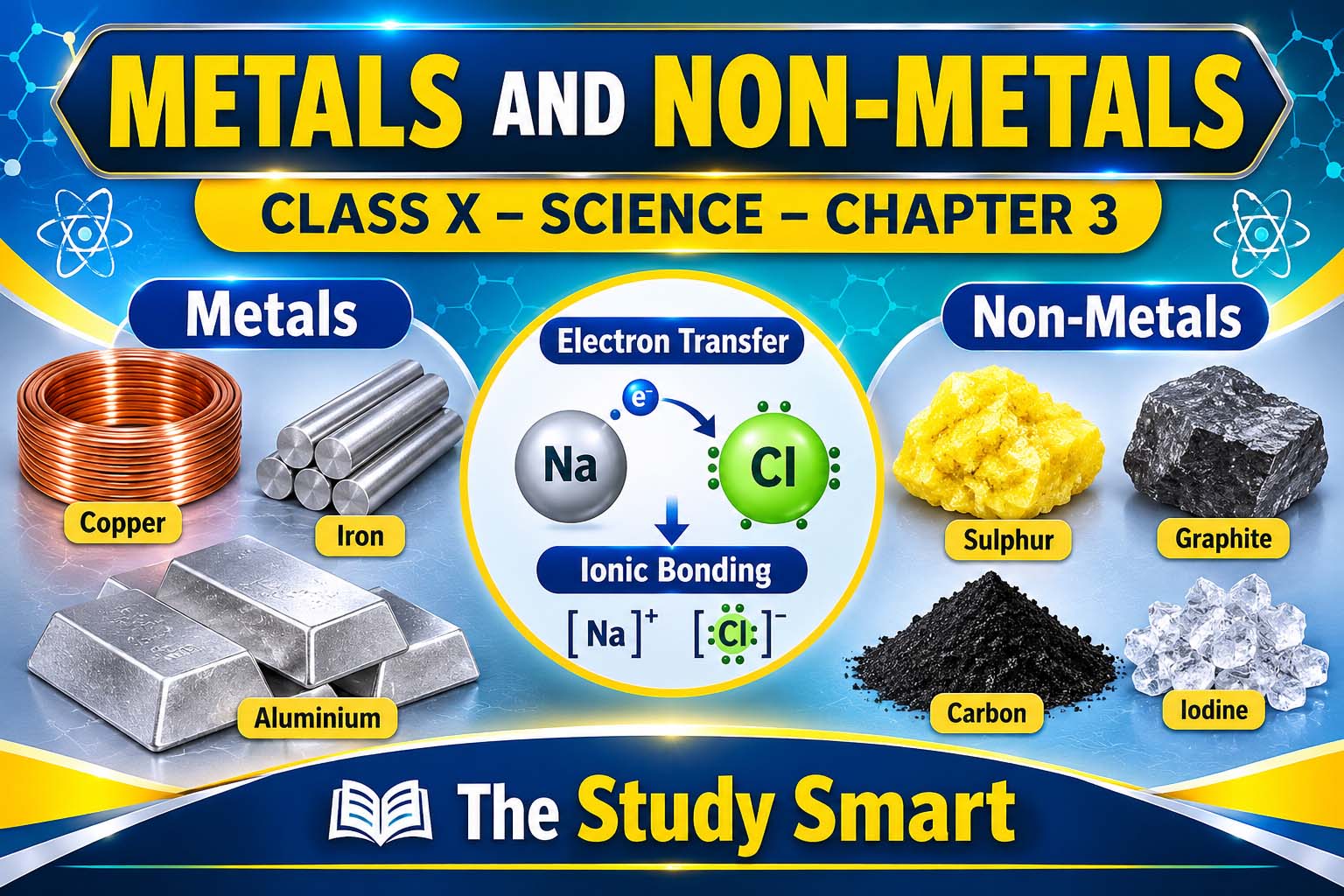
All the materials around us are made up of elements. Based on their properties, elements are broadly classified into two categories:
- Metals
- Non-metals
Metals and non-metals differ in their physical and chemical properties. They also react differently with oxygen, water, acids and other substances.
This chapter explains the properties of metals and non-metals, their reactions, reactivity series, ionic compounds, extraction of metals, corrosion and alloys.
These notes are prepared in simple language and pointwise format to help CBSE Class 10 students understand the chapter and revise important concepts for examinations.
1. Metals
Definition: Metals are elements that generally have a shiny appearance, conduct heat and electricity, and are malleable and ductile.
Examples:
- Iron (Fe)
- Copper (Cu)
- Aluminium (Al)
- Gold (Au)
- Silver (Ag)
- Zinc (Zn)
- Sodium (Na)
- Magnesium (Mg)
1.1 Physical Properties of Metals
1. Lustre
- Metals generally have a shiny surface.
- This property is called metallic lustre.
- Examples: Gold, silver and copper.
2. Hardness
- Most metals are hard and strong.
- Sodium and potassium are soft metals and can be cut with a knife.
3. Malleability
- The ability of metals to be beaten into thin sheets is called malleability.
- Example: Aluminium foil and gold leaves.
4. Ductility
- The ability of metals to be drawn into thin wires is called ductility.
- Example: Copper and aluminium wires.
5. Conductivity
- Metals are generally good conductors of heat and electricity.
- Copper and aluminium are used in electrical wires.
6. Sonority
- Metals produce a ringing sound when struck.
- This property is called sonority.
7. State
- Most metals are solids at room temperature.
- Mercury (Hg) is an exception because it is liquid at room temperature.
8. Melting and Boiling Points
- Most metals have high melting and boiling points.
- Sodium and potassium have comparatively low melting points.
9. Density
- Most metals have high density.
- However, some metals such as lithium, sodium and potassium have low density.
1.2 Important Exceptions in Physical Properties
| Property | Exception |
|---|---|
| Liquid metal at room temperature | Mercury |
| Soft metals | Sodium and Potassium |
| Low-density metals | Lithium, Sodium, Potassium |
| Metal with low melting point | Gallium and Caesium |
| Best conductor of electricity | Silver |
| Good electrical conductor used in wiring | Copper |
| Highest tensile strength among common metals | Tungsten is notable for its high strength at high temperatures |
2. Non-Metals
Definition: Non-metals are elements that generally do not show the typical physical properties of metals. They are usually poor conductors of heat and electricity and are neither malleable nor ductile.
Examples:
- Carbon (C)
- Sulphur (S)
- Oxygen (O)
- Nitrogen (N)
- Hydrogen (H)
- Chlorine (Cl)
- Phosphorus (P)
- Bromine (Br)
2.1 Physical Properties of Non-Metals
- Appearance: Generally dull and non-lustrous.
- Hardness: Most non-metals are soft, but diamond is extremely hard.
- State: Non-metals may exist as solids, liquids or gases at room temperature.
- Conductivity: Generally poor conductors of heat and electricity.
- Malleability: Non-metals are not malleable.
- Ductility: Non-metals are not ductile.
- Sonority: Non-metals are generally non-sonorous.
- Density: Most non-metals have comparatively low density.
- Melting and Boiling Points: Generally low, with important exceptions such as diamond.
2.2 Important Exceptions in Non-Metals
| Non-metal | Special property |
|---|---|
| Diamond | Hardest naturally occurring substance |
| Graphite | Good conductor of electricity |
| Iodine | Has a lustrous surface |
| Bromine | Liquid non-metal at room temperature |
| Diamond | Very high melting point |
Remember: Graphite and diamond are allotropes of carbon. They have different physical properties because their carbon atoms are arranged differently.
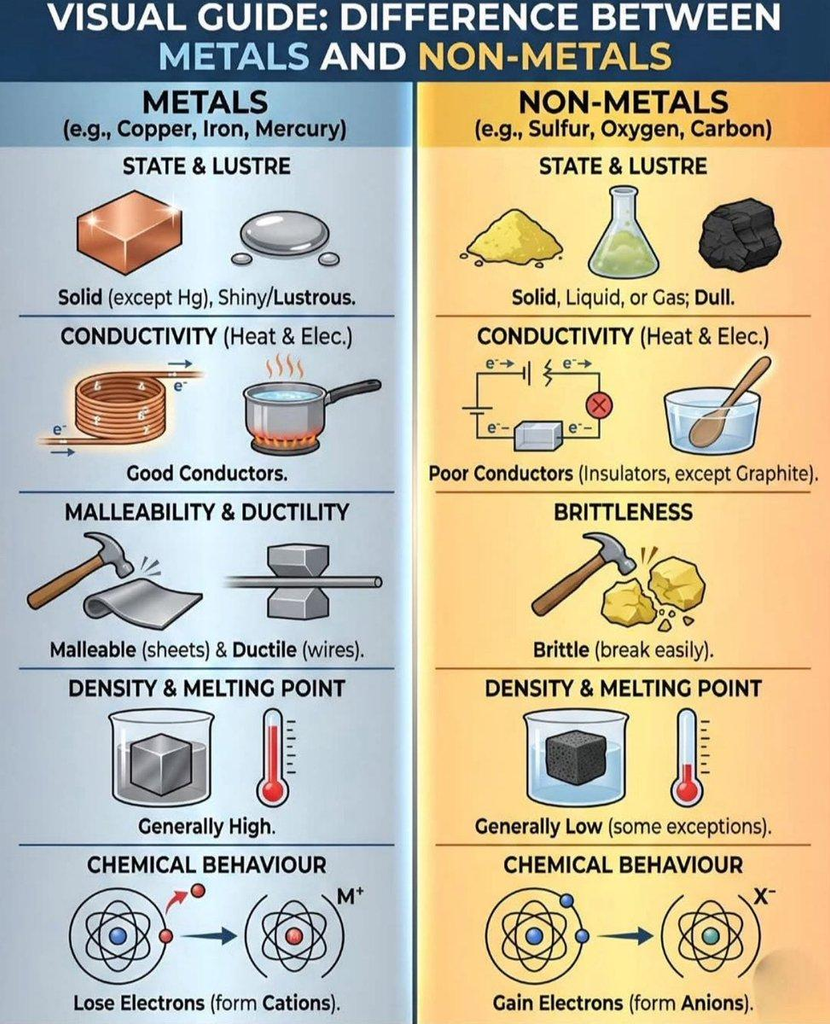
3. Difference Between Metals and Non-Metals
| Metals | Non-Metals |
|---|---|
| Generally lustrous | Generally dull |
| Generally hard | Generally soft |
| Malleable | Non-malleable |
| Ductile | Non-ductile |
| Good conductors of heat | Generally poor conductors of heat |
| Good conductors of electricity | Generally poor conductors of electricity |
| Sonorous | Non-sonorous |
| Usually form positive ions | Usually form negative ions |
| Generally form basic oxides | Generally form acidic or neutral oxides |
Important: These are general properties. Remember the exceptions of graphite, iodine, diamond and mercury.
4. Chemical Properties of Metals
Metals react with different substances to form new compounds.
4.1 Reaction of Metals with Oxygen
Metals react with oxygen to form metal oxides.
General reaction:
Metal + Oxygen → Metal Oxide
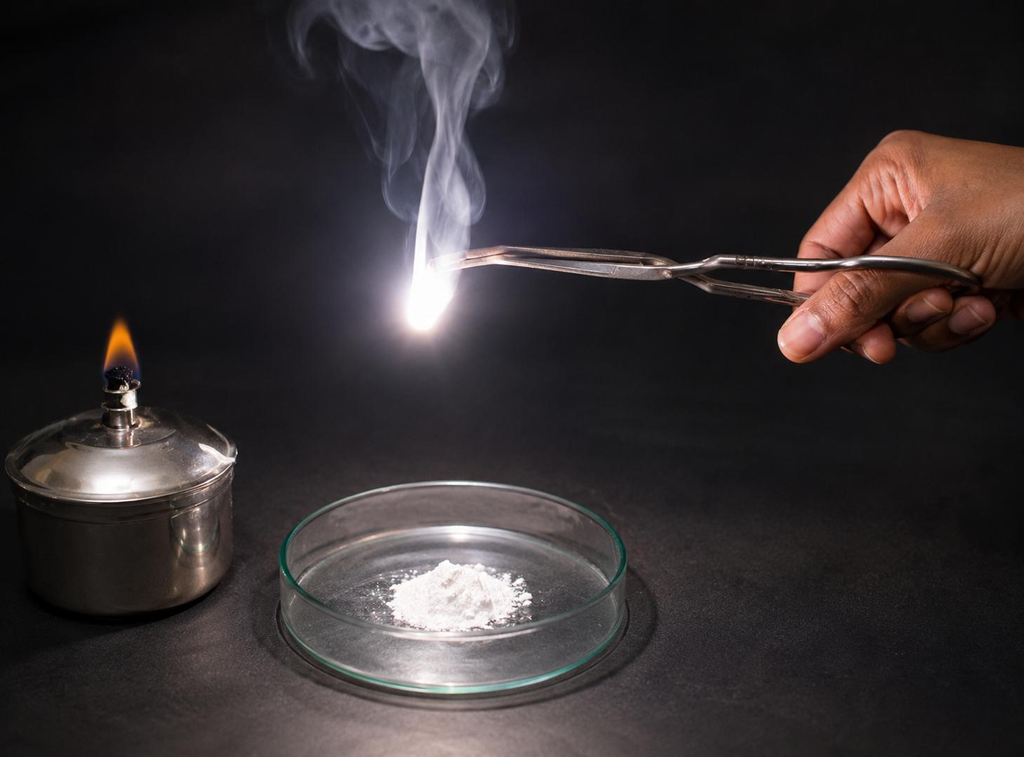
Example 1: Magnesium with oxygen
2Mg + O₂ → 2MgO
- Magnesium burns with a dazzling white flame.
- A white powder of magnesium oxide is formed.
- Magnesium oxide is basic in nature.
Example 2: Copper with oxygen
2Cu + O₂ → 2CuO
- Copper reacts with oxygen on heating.
- A black coating of copper oxide is formed.
Example 3: Sodium with oxygen
4Na + O₂ → 2Na₂O
- Sodium reacts rapidly with oxygen.
- It is stored in kerosene to prevent contact with air and moisture.
4.2 Nature of Metal Oxides
- Most metal oxides are basic in nature.
- Basic oxides react with acids to form salt and water.
- Some metal oxides show both acidic and basic properties.
Amphoteric Oxides: Metal oxides that react with both acids and bases to form salt and water are called amphoteric oxides.
Important examples:
- Aluminium oxide (Al₂O₃)
- Zinc oxide (ZnO)
Example:
ZnO + 2HCl → ZnCl₂ + H₂O
ZnO + 2NaOH → Na₂ZnO₂ + H₂O
4.3 Reaction of Metals with Water
Metals react with water to form metal hydroxides or metal oxides and hydrogen gas.
The reaction depends on the reactivity of the metal.
A. Sodium with water
2Na + 2H₂O → 2NaOH + H₂
- Sodium reacts violently with water.
- A large amount of heat is produced.
- Hydrogen gas is released.
- Sodium is stored in kerosene.
B. Calcium with water
Ca + 2H₂O → Ca(OH)₂ + H₂
- Calcium reacts less vigorously than sodium.
- Hydrogen gas is produced.
- Calcium starts floating because hydrogen bubbles stick to its surface.
C. Magnesium with hot water
Mg + 2H₂O → Mg(OH)₂ + H₂
- Magnesium reacts slowly with hot water.
- With steam, it forms magnesium oxide and hydrogen.
Mg + H₂O (steam) → MgO + H₂
D. Aluminium with steam
2Al + 3H₂O → Al₂O₃ + 3H₂
E. Zinc with steam
Zn + H₂O → ZnO + H₂
F. Iron with steam
3Fe + 4H₂O → Fe₃O₄ + 4H₂
Important points:
- Sodium and potassium react vigorously with cold water.
- Calcium reacts with cold water.
- Magnesium reacts slowly with hot water and with steam.
- Aluminium, zinc and iron react with steam.
- Copper, silver and gold do not react with water.
4.4 Reaction of Metals with Dilute Acids
Metals react with dilute acids to produce salt and hydrogen gas.
General reaction:
Metal + Dilute Acid → Salt + Hydrogen
Example 1: Zinc with hydrochloric acid
Zn + 2HCl → ZnCl₂ + H₂
Example 2: Magnesium with hydrochloric acid
Mg + 2HCl → MgCl₂ + H₂
Example 3: Iron with dilute sulphuric acid
Fe + H₂SO₄ → FeSO₄ + H₂
Important observations:
- Hydrogen gas is released.
- The gas burns with a pop sound when tested with a burning splint.
- More reactive metals generally react more vigorously.
Exception:
Copper, silver and gold do not react with dilute hydrochloric acid or dilute sulphuric acid.
Why does nitric acid generally not produce hydrogen gas with metals?
Nitric acid is a strong oxidising agent. It oxidises the hydrogen formed into water and is itself reduced to nitrogen oxides. Very dilute nitric acid can behave differently with some metals, so the usual rule has exceptions.
4.5 Reaction of Metals with Salt Solutions
A more reactive metal displaces a less reactive metal from its salt solution.
This is called a displacement reaction.
General reaction:
Metal A + Salt of Metal B → Salt of Metal A + Metal B
Example 1: Iron with copper sulphate
Fe + CuSO₄ → FeSO₄ + Cu
Observations:
- Blue copper sulphate solution turns green.
- A reddish-brown deposit of copper appears on the iron nail.
Example 2: Copper with silver nitrate
Cu + 2AgNO₃ → Cu(NO₃)₂ + 2Ag
Observations:
- Silver gets deposited.
- The solution becomes blue due to copper nitrate formation.
Remember: A less reactive metal cannot displace a more reactive metal from its salt solution.
5. Reactivity Series of Metals
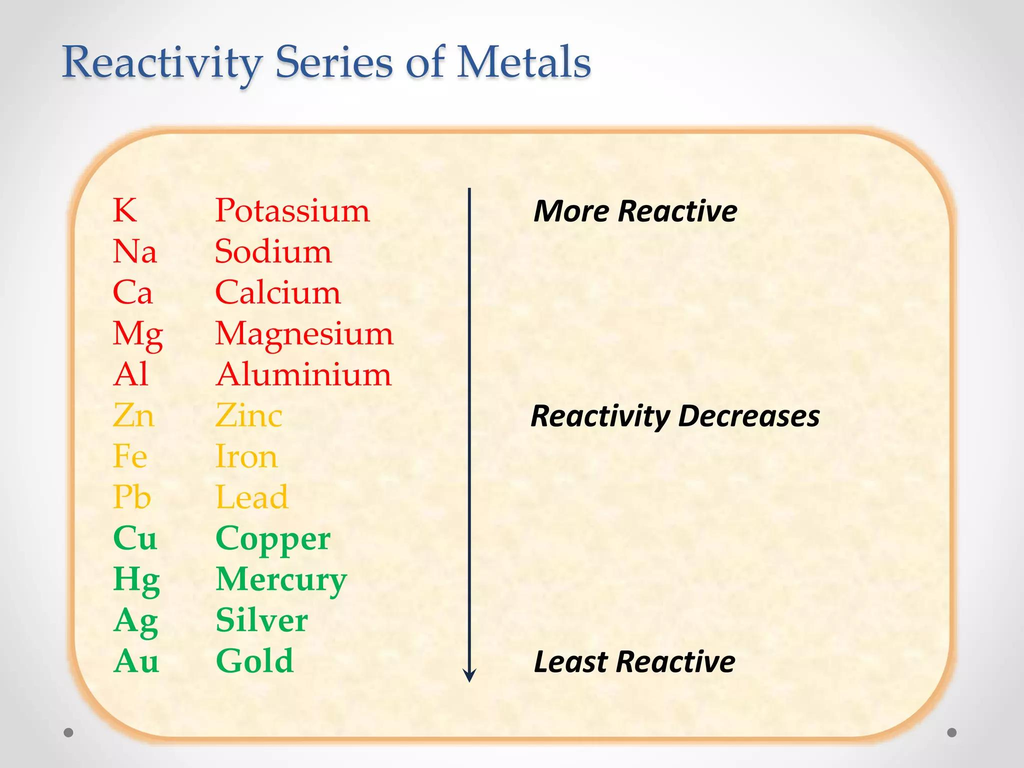
Definition: The arrangement of metals in decreasing order of their chemical reactivity is called the reactivity series.
Reactivity Series
Most reactive to least reactive:
K > Na > Ca > Mg > Al > Zn > Fe > Pb > H > Cu > Hg > Ag > Au
| Metal | Name |
|---|---|
| K | Potassium |
| Na | Sodium |
| Ca | Calcium |
| Mg | Magnesium |
| Al | Aluminium |
| Zn | Zinc |
| Fe | Iron |
| Pb | Lead |
| H | Hydrogen |
| Cu | Copper |
| Hg | Mercury |
| Ag | Silver |
| Au | Gold |
Importance of Reactivity Series
- It helps predict displacement reactions.
- It explains the reaction of metals with water.
- It helps predict the reaction of metals with dilute acids.
- It helps determine the method of extraction of metals.
- It helps compare the chemical reactivity of different metals.
Important facts:
- Potassium is among the most reactive metals.
- Gold is one of the least reactive metals.
- Metals above hydrogen generally displace hydrogen from dilute acids.
- Metals below hydrogen generally do not displace hydrogen from dilute acids.
6. Chemical Properties of Non-Metals
6.1 Reaction with Oxygen
Non-metals react with oxygen to form non-metal oxides.
General reaction:
Non-Metal + Oxygen → Non-Metal Oxide
Example 1: Carbon with oxygen
C + O₂ → CO₂
Carbon dioxide is formed when carbon burns in sufficient oxygen.
Example 2: Sulphur with oxygen
S + O₂ → SO₂
Sulphur dioxide is formed.
Example 3: Carbon with insufficient oxygen
2C + O₂ → 2CO
Carbon monoxide is a poisonous gas.
6.2 Nature of Non-Metal Oxides
- Most non-metal oxides are acidic in nature.
- They turn blue litmus red when dissolved in water.
- Some non-metal oxides are neutral.
Examples:
CO₂ + H₂O → H₂CO₃
SO₂ + H₂O → H₂SO₃
6.3 Reaction with Water and Acids
- Non-metals generally do not react with water to release hydrogen gas.
- Non-metals generally do not react with dilute acids to release hydrogen gas.
6.4 Reaction with Hydrogen
Non-metals can react with hydrogen to form covalent compounds.
Examples:
H₂ + Cl₂ → 2HCl
N₂ + 3H₂ ⇌ 2NH₃
Sulphur also forms hydrogen sulphide (H₂S) with hydrogen.
7. Formation of Ionic Compounds
7.1 What are Ions?
An ion is an atom or group of atoms carrying an electric charge.
There are two types of ions:
1. Cation
- A positively charged ion.
- Formed by the loss of electrons.
- Example: Na⁺, Mg²⁺, Al³⁺.
2. Anion
- A negatively charged ion.
- Formed by the gain of electrons.
- Example: Cl⁻, O²⁻, S²⁻.
7.2 Ionic Bond
The electrostatic force of attraction between oppositely charged ions is called an ionic bond.
Ionic compounds are formed by the transfer of electrons from metals to non-metals.
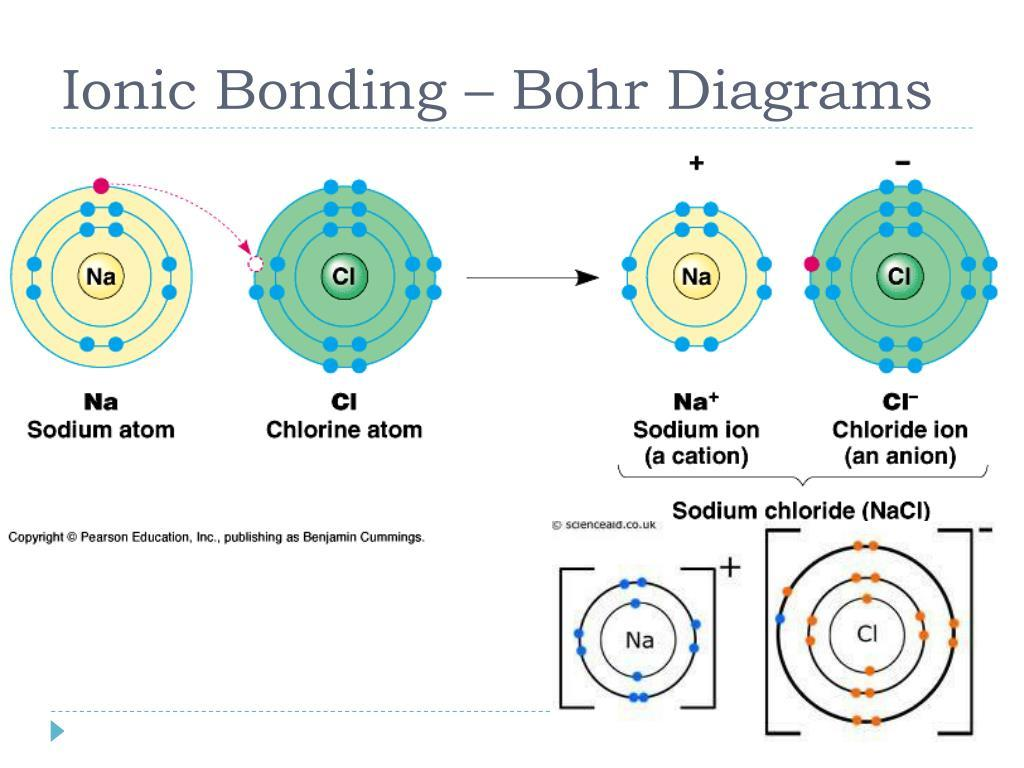
7.3 Formation of Sodium Chloride (NaCl)
Sodium:
- Atomic number = 11
- Electronic configuration = 2, 8, 1
- It loses one electron to form Na⁺.
Na → Na⁺ + e⁻
Chlorine:
- Atomic number = 17
- Electronic configuration = 2, 8, 7
- It gains one electron to form Cl⁻.
Cl + e⁻ → Cl⁻
The oppositely charged ions attract each other and form sodium chloride.
Na⁺ + Cl⁻ → NaCl
7.4 Formation of Magnesium Chloride (MgCl₂)
- Atomic number of magnesium = 12.
- Electronic configuration = 2, 8, 2.
- Magnesium loses two electrons to form Mg²⁺.
- Each chlorine atom gains one electron.
- Two chlorine atoms are required to accept the two electrons.
Mg → Mg²⁺ + 2e⁻
2Cl + 2e⁻ → 2Cl⁻
Mg²⁺ + 2Cl⁻ → MgCl₂
7.5 Properties of Ionic Compounds
- Ionic compounds are generally solid.
- They are usually hard and brittle.
- They have high melting and boiling points.
- They are generally soluble in water.
- They are generally insoluble in kerosene and petrol.
- They do not conduct electricity in the solid state.
- They conduct electricity in molten state.
- Their aqueous solutions conduct electricity.
Why do ionic compounds conduct electricity in molten state but not in solid state?
In the solid state, ions are fixed in their positions and cannot move freely. In the molten state or aqueous solution, ions become free to move and carry electric current.
8. Occurrence of Metals
Metals occur in nature in different forms.
They are mainly found in:
- Earth’s crust.
- Seawater.
- Minerals and ores.
8.1 Minerals
Naturally occurring substances containing metals or their compounds are called minerals.
8.2 Ores
Minerals from which metals can be extracted conveniently and economically are called ores.
Important distinction:
All ores are minerals, but all minerals are not ores.
8.3 Gangue
The unwanted impurities such as sand, soil and rocky materials present in an ore are called gangue.
8.4 Occurrence According to Reactivity
1. Highly reactive metals
- Potassium
- Sodium
- Calcium
- Magnesium
- Aluminium
These metals are generally found in combined form.
2. Moderately reactive metals
- Zinc
- Iron
- Lead
These are generally found as oxides, sulphides or carbonates.
3. Least reactive metals
- Gold
- Silver
- Copper (sometimes)
These may occur in free or combined states.
9. Extraction of Metals
The process of obtaining metals from their ores is called extraction of metals.
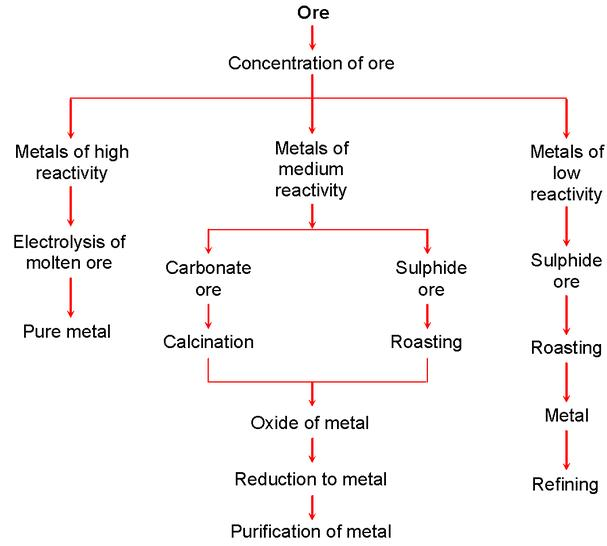
The method of extraction depends upon the reactivity of the metal.
Main Steps in Extraction
- Concentration of ore.
- Conversion of concentrated ore into metal oxide.
- Reduction of metal oxide into metal.
- Refining or purification of metal.
9.1 Concentration of Ore
The process of removing unwanted impurities (gangue) from an ore is called concentration or enrichment of ore.
9.2 Conversion of Ore into Metal Oxide
Metal oxides are generally easier to reduce into metals.
Sulphide ores and carbonate ores are converted into oxides by roasting and calcination respectively.
A. Roasting
Heating sulphide ores strongly in the presence of excess air is called roasting.
Example:
2ZnS + 3O₂ → 2ZnO + 2SO₂
B. Calcination
Heating carbonate ores strongly in limited or no supply of air is called calcination.
Example:
ZnCO₃ → ZnO + CO₂
Difference Between Roasting and Calcination
| Roasting | Calcination |
|---|---|
| Used mainly for sulphide ores | Used mainly for carbonate ores |
| Heating in excess air | Heating in limited or no air |
| Converts sulphide into oxide | Converts carbonate into oxide |
| Generally releases SO₂ | Generally releases CO₂ |
9.3 Reduction of Metal Oxides
Reduction is the process of removing oxygen from metal oxides to obtain metals.
The method depends upon the reactivity of the metal.
A. Extraction of Low-Reactivity Metals
- Metals such as mercury and copper are comparatively less reactive.
- Their oxides can be reduced by heating.
Example:
2HgO → 2Hg + O₂
B. Extraction of Moderately Reactive Metals
- Metals such as zinc, iron and lead are moderately reactive.
- Their oxides are generally reduced using carbon or carbon monoxide.
Example:
ZnO + C → Zn + CO
Iron extraction involves reduction of iron oxide in a blast furnace.
C. Extraction of Highly Reactive Metals
- Metals such as sodium, potassium, calcium, magnesium and aluminium are highly reactive.
- They cannot be extracted by reduction with carbon.
- They are extracted by electrolytic reduction of their molten compounds.
Example:
2NaCl(l) → 2Na(l) + Cl₂(g)
This is carried out using electrolysis of molten sodium chloride.
9.4 Thermite Reaction
When iron oxide reacts with aluminium, molten iron and aluminium oxide are formed with a large amount of heat.
Equation:
Fe₂O₃ + 2Al → 2Fe + Al₂O₃ + Heat
Important points:
- Aluminium acts as a reducing agent.
- A large amount of heat is released.
- It is used in welding railway tracks and repairing iron parts.
- The process is called thermite welding.
9.5 Refining of Metals
The process of removing impurities from extracted metals is called refining.
Electrolytic Refining
Electrolytic refining is a common method of purification of metals.
Example: Purification of copper.
- Impure copper is used as the anode (positive electrode).
- Pure copper is used as the cathode (negative electrode).
- Copper sulphate solution is used as the electrolyte.
- On passing electric current, pure copper gets deposited on the cathode.
- Insoluble impurities settle below the anode.
Anode Mud: The insoluble impurities that settle below the anode during electrolytic refining are called anode mud.
10. Corrosion
Definition: The gradual destruction of metals due to their reaction with air, moisture or other substances present in the environment is called corrosion.
10.1 Rusting of Iron
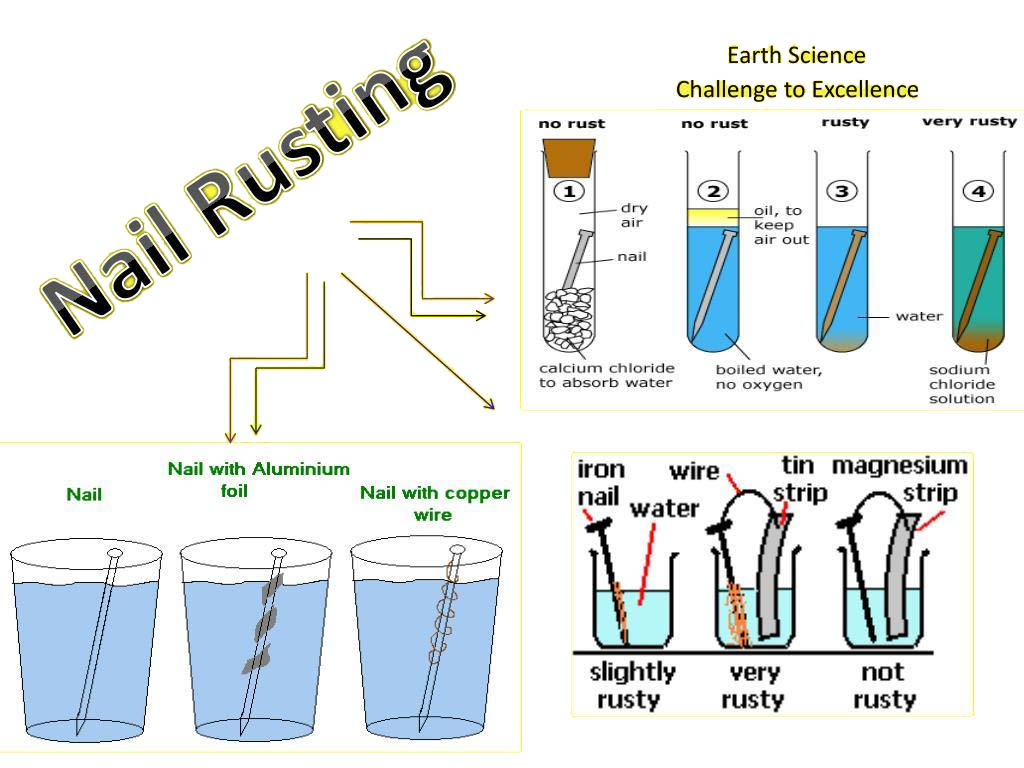
When iron comes in contact with oxygen and moisture, it forms a reddish-brown coating called rust.
Rust is hydrated iron(III) oxide, commonly represented as:
Fe₂O₃·xH₂O
Conditions required for rusting:
- Oxygen (air).
- Moisture (water).
10.2 Prevention of Corrosion
Corrosion can be prevented by the following methods:
- Painting: Applying paint prevents contact with air and moisture.
- Oiling and Greasing: A protective layer prevents corrosion.
- Galvanisation: Coating iron or steel with zinc.
- Electroplating: Coating a metal with another metal using electricity.
- Alloying: Mixing metals with other elements to improve corrosion resistance.
10.3 Galvanisation
The process of depositing a thin layer of zinc on iron or steel to protect it from rusting is called galvanisation.
Example: Galvanised iron pipes and iron sheets.
11. Alloys
Definition: An alloy is a homogeneous mixture of two or more metals, or a metal and a non-metal.
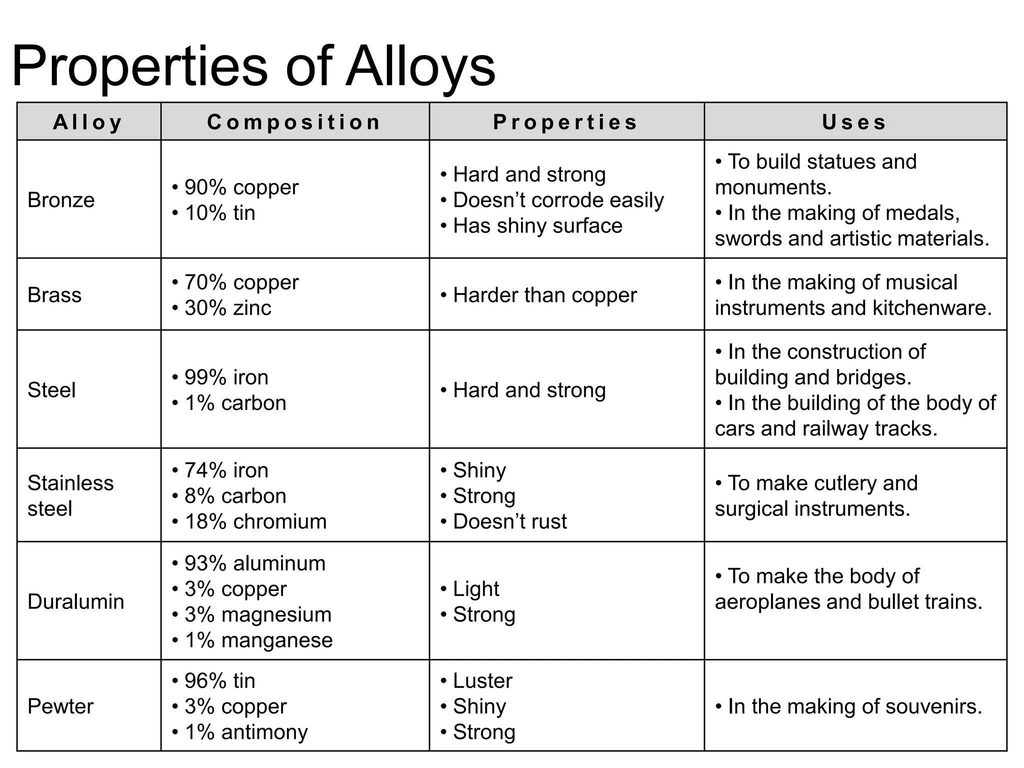
Alloys are generally prepared to improve the properties of pure metals.
11.1 Why Are Alloys Made?
- To increase hardness.
- To increase strength.
- To improve resistance to corrosion.
- To modify melting point.
- To improve durability and usefulness.
11.2 Important Alloys and Their Composition
| Alloy | Composition |
|---|---|
| Brass | Copper + Zinc |
| Bronze | Copper + Tin |
| Steel | Iron + Carbon |
| Stainless Steel | Iron + Chromium + Nickel (and carbon) |
| Solder | Lead + Tin |
| Duralumin | Aluminium + Copper + Magnesium + Manganese |
| German Silver | Copper + Zinc + Nickel |
11.3 Amalgam
An alloy containing mercury is called an amalgam.
Examples:
- Sodium amalgam.
- Zinc amalgam.
11.4 Important Facts About Alloys
- Alloys are generally harder than pure metals.
- They may have better corrosion resistance.
- Their melting points may be lower than those of their constituent metals.
- They generally have lower electrical conductivity than pure metals.
Why is pure gold mixed with other metals to make jewellery?
Pure gold is very soft. It is mixed with copper or silver to increase its hardness and durability.
12. Important Uses of Metals and Non-Metals
Uses of Metals
| Metal | Uses |
|---|---|
| Iron | Construction of buildings, bridges and machines |
| Copper | Electrical wires and utensils |
| Aluminium | Aircraft, foil and cooking utensils |
| Gold | Jewellery and electronic components |
| Silver | Jewellery and electrical contacts |
| Zinc | Galvanisation |
| Mercury | Scientific instruments (traditional applications) |
| Tungsten | Electric lamp filaments and high-temperature applications |
Uses of Non-Metals
| Non-Metal | Uses |
|---|---|
| Oxygen | Respiration and medical applications |
| Nitrogen | Fertilisers and food packaging |
| Chlorine | Water disinfection |
| Carbon | Fuels, graphite electrodes and industrial applications |
| Sulphur | Manufacture of sulphuric acid |
| Phosphorus | Fertilisers and safety matches |
| Hydrogen | Fuel and industrial processes |
| Iodine | Antiseptic preparations |
13. Important Chemical Equations for Board Exams
Students should practise writing and balancing these equations.
| No. | Reaction | Balanced Equation |
|---|---|---|
| 1 | Magnesium + Oxygen | 2Mg + O₂ → 2MgO |
| 2 | Sodium + Water | 2Na + 2H₂O → 2NaOH + H₂ |
| 3 | Calcium + Water | Ca + 2H₂O → Ca(OH)₂ + H₂ |
| 4 | Magnesium + Steam | Mg + H₂O → MgO + H₂ |
| 5 | Zinc + Hydrochloric acid | Zn + 2HCl → ZnCl₂ + H₂ |
| 6 | Iron + Copper sulphate | Fe + CuSO₄ → FeSO₄ + Cu |
| 7 | Copper + Silver nitrate | Cu + 2AgNO₃ → Cu(NO₃)₂ + 2Ag |
| 8 | Carbon + Oxygen | C + O₂ → CO₂ |
| 9 | Sulphur + Oxygen | S + O₂ → SO₂ |
| 10 | Carbon dioxide + Water | CO₂ + H₂O → H₂CO₃ |
| 11 | Zinc carbonate | ZnCO₃ → ZnO + CO₂ |
| 12 | Zinc sulphide | 2ZnS + 3O₂ → 2ZnO + 2SO₂ |
| 13 | Thermite reaction | Fe₂O₃ + 2Al → 2Fe + Al₂O₃ |
| 14 | Mercury oxide | 2HgO → 2Hg + O₂ |
| 15 | Sodium + Chlorine | 2Na + Cl₂ → 2NaCl |
14. Important Definitions for Quick Revision
- Malleability: Property of metals to be beaten into thin sheets.
- Ductility: Property of metals to be drawn into thin wires.
- Sonority: Property of metals to produce a ringing sound when struck.
- Corrosion: Gradual destruction of metals due to environmental reactions.
- Galvanisation: Coating iron or steel with zinc to prevent rusting.
- Alloy: Homogeneous mixture of two or more metals or a metal and a non-metal.
- Ore: A mineral from which a metal can be extracted economically.
- Gangue: Unwanted impurities present in an ore.
- Roasting: Heating sulphide ores in excess air.
- Calcination: Heating carbonate ores in limited or no air.
- Reduction: Removal of oxygen from a metal oxide.
- Oxidation: Addition of oxygen or removal of electrons.
- Ionic Bond: Electrostatic attraction between oppositely charged ions.
- Cation: Positively charged ion.
- Anion: Negatively charged ion.
- Amphoteric Oxides: Oxides that react with both acids and bases.
- Reactivity Series: Arrangement of metals in decreasing order of reactivity.
- Displacement Reaction: Reaction in which a more reactive element displaces a less reactive element.
- Anode Mud: Insoluble impurities deposited below the anode during electrolytic refining.
- Amalgam: An alloy containing mercury.
15. Most Important Exam Points
Revise these points before the examination:
- Mercury is the only common metal that is liquid at room temperature.
- Bromine is a liquid non-metal at room temperature.
- Sodium and potassium are stored in kerosene.
- Magnesium burns with a dazzling white flame.
- Copper develops a black coating of copper oxide on heating.
- Aluminium oxide and zinc oxide are amphoteric.
- Graphite is a non-metal that conducts electricity.
- Diamond is the hardest naturally occurring substance.
- Gold and silver are among the least reactive metals.
- More reactive metals displace less reactive metals from salt solutions.
- Ionic compounds conduct electricity in molten or aqueous states.
- Ionic compounds do not conduct electricity in solid state.
- Roasting is used for sulphide ores.
- Calcination is used for carbonate ores.
- Highly reactive metals are extracted by electrolytic reduction.
- Galvanisation prevents rusting by coating iron with zinc.
- Rust is hydrated iron(III) oxide.
- Thermite reaction is used for welding railway tracks.
- Alloys are generally harder than pure metals.
- Impure copper is purified by electrolytic refining.
16. Chapter Summary
- Metals and non-metals have different physical and chemical properties.
- Metals generally lose electrons to form positive ions.
- Non-metals generally gain or share electrons.
- Metals react with oxygen, water and dilute acids in different ways.
- The reactivity series helps predict chemical reactions.
- Ionic compounds are formed by the transfer of electrons.
- Metals are extracted from ores using different methods depending on their reactivity.
- Corrosion damages metals and can be prevented using protective methods.
- Alloys improve the properties of pure metals.
17. Preparation Tips for CBSE Class 10 Students
To prepare this chapter effectively:
- Learn all the important definitions.
- Memorise the reactivity series.
- Practise balancing chemical equations.
- Understand the formation of NaCl and MgCl₂.
- Revise roasting and calcination differences.
- Learn the extraction methods of metals.
- Practise questions on corrosion and prevention.
- Revise the exceptions to physical properties.
- Practise NCERT in-text and exercise questions.
- Attempt objective and assertion-reason questions for revision.
Final Advice: Do not simply memorise chemical equations. Understand the reactants, products and observations in each reaction. This will help you answer both direct and application-based questions.
Keep Learning, Keep Growing!
The Study Smart – Your Learning Partner
Disclaimer: These notes are prepared as supplementary revision material. Students should also refer to the latest NCERT textbook and CBSE syllabus for their academic session.