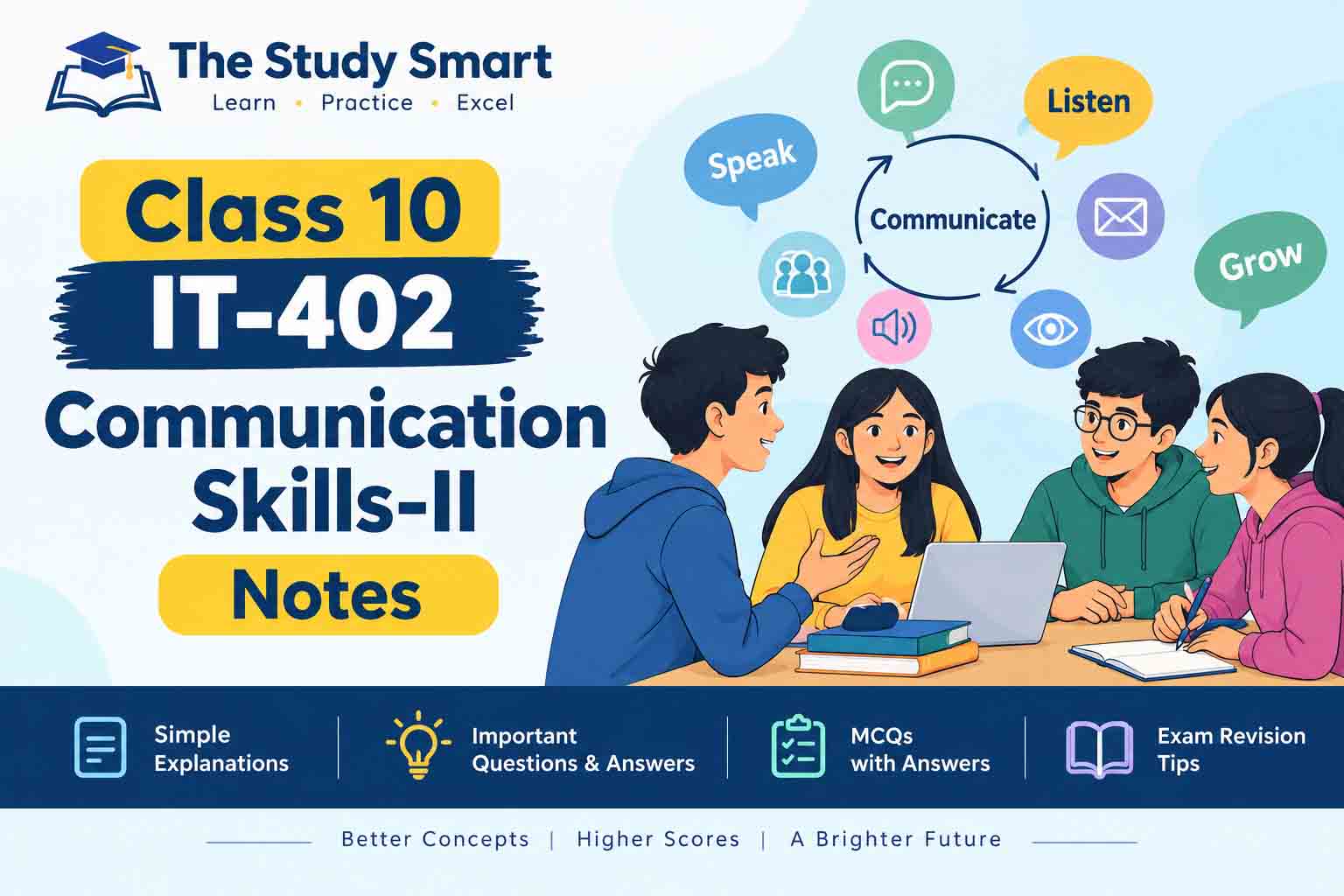
Are you preparing for CBSE Class 10 Information Technology (IT-402)? In this post, you will learn the important concepts of Communication Skills-II, an Employability Skills unit, through simple explanations, practical examples, revision notes and practice questions.
These notes are designed to help students understand the concepts and revise for examinations.
Table of Contents
- What is Communication?
- Methods of Communication
- Communication Cycle
- Importance of Feedback
- Types of Feedback
- Barriers to Effective Communication
- How to Overcome Communication Barriers
- Principles of Effective Communication
- The 7 Cs of Communication
- Important Questions and Answers
- Multiple-Choice Questions
- Quick Revision
1. What is Communication?
Communication is the process of exchanging information, ideas, thoughts or feelings between two or more people.
Communication takes place when a sender shares a message with a receiver through a suitable medium.
Example
A teacher explains a lesson to students in the classroom. The teacher is the sender, the explanation is the message, and the students are the receivers.
Importance of Communication
Communication is important because it helps us:
- Share information and ideas.
- Express thoughts and feelings.
- Build relationships.
- Work effectively in a team.
- Solve problems and avoid misunderstandings.
- Improve learning and decision-making.
2. Methods of Communication
Communication can take place in different ways.
A. Verbal Communication
Verbal communication uses words to convey a message. It includes spoken and written communication.
Examples:
- Speaking to a teacher.
- Talking on the telephone.
- Writing an email.
- Sending a letter.
B. Non-verbal Communication
Non-verbal communication conveys information without relying on spoken or written words.
Examples:
- Facial expressions.
- Gestures.
- Eye contact.
- Body posture.
- Appropriate body movements.
For example, smiling may express happiness, while nodding may indicate agreement.
C. Visual Communication
Visual communication uses visual elements to communicate information.
Examples:
- Signs and symbols.
- Charts and graphs.
- Posters.
- Maps and diagrams.
A road sign is an example of visual communication because it conveys information through symbols.
3. Communication Cycle
The communication cycle describes how a message travels from the sender to the receiver and how feedback completes the process.
The main elements are:
- Sender: The person who initiates communication.
- Message: The information or idea being communicated.
- Encoding: Converting an idea into words, symbols or gestures.
- Channel: The medium used to send the message.
- Receiver: The person who receives the message.
- Decoding: Interpreting the received message.
- Feedback: The receiver’s response to the message.
Example of a Communication Cycle
A teacher asks a student to complete homework.
- Sender: Teacher
- Message: Complete the homework by tomorrow.
- Encoding: The teacher expresses the instruction in words.
- Channel: Spoken communication.
- Receiver: Student
- Decoding: The student understands the instruction.
- Feedback: The student replies, “Yes, I will complete it.”
Feedback helps the sender know whether the message has been understood.
4. Importance of Feedback
Feedback is the response given by a receiver after receiving and interpreting a message.
Feedback is important because it:
- Confirms whether a message has been understood.
- Helps identify misunderstandings.
- Improves performance.
- Encourages better communication.
- Helps the sender make corrections when necessary.
Example
A student gives a presentation. The teacher appreciates the student’s clear explanation and suggests speaking more slowly. This feedback helps the student improve.
5. Types of Feedback
A. Positive Feedback
Positive feedback appreciates good performance or encourages desirable behaviour.
Example: “Your presentation was clear and well organised.”
B. Constructive Feedback
Constructive feedback identifies areas for improvement and offers helpful suggestions.
Example: “Your answer is good. Add one example to make it clearer.”
C. Descriptive Feedback
Descriptive feedback provides specific information about a person’s performance rather than simply giving a general judgment.
Example: “You explained the first two points clearly, but you should provide more details for the third point.”
D. Specific and Non-specific Feedback
Specific feedback identifies exactly what was done well or what needs improvement.
Example: “Your introduction clearly explains the topic.”
Non-specific feedback gives a general response without identifying particular details.
Example: “Good job!”
Specific feedback is generally more useful because it tells the receiver what to continue or improve.
6. Barriers to Effective Communication
A communication barrier is anything that prevents a message from being communicated or understood correctly.
Types of Communication Barriers
1. Physical barriers: Noise, distance, poor lighting or interruptions.
Example: Students cannot hear the teacher because of construction noise.
2. Language barriers: Differences in language, vocabulary or pronunciation.
Example: A student cannot understand instructions written in an unfamiliar language.
3. Emotional barriers: Anger, fear, stress or nervousness that affects communication.
Example: A nervous student finds it difficult to answer a question.
4. Cultural barriers: Differences in customs, beliefs or social practices that lead to misunderstandings.
5. Organisational barriers: Unclear instructions, complicated procedures or poor information flow within an organisation.
6. Personal barriers: Poor listening habits, lack of confidence or preconceived ideas.
7. How to Overcome Communication Barriers
Communication can be improved by following these practices:
- Use simple and clear language.
- Listen carefully without interrupting.
- Ask questions when something is unclear.
- Choose an appropriate communication channel.
- Avoid unnecessary background noise.
- Maintain suitable eye contact and positive body language.
- Respect different opinions and cultural backgrounds.
- Give constructive feedback.
- Confirm that the receiver has understood the message.
8. Principles of Effective Communication
Effective communication occurs when the intended message is conveyed and understood correctly.
Some important principles include clarity, completeness, correctness, courtesy and conciseness.
These principles help make communication understandable, relevant and respectful.
9. The 7 Cs of Effective Communication
The 7 Cs are important guidelines for effective communication.
1. Clear: The message should be easy to understand.
Example: Give direct and understandable instructions.
2. Concise: The message should be brief and free from unnecessary words.
Example: Write a short email that includes only relevant information.
3. Concrete: The message should be specific and supported by facts or details.
Example: State the exact date and time of a meeting.
4. Correct: The message should contain accurate information and use correct grammar.
Example: Check dates, names and facts before sending an email.
5. Coherent: The ideas should be logically organised and connected.
Example: Arrange the points in a sensible sequence.
6. Complete: The message should include all the information the receiver needs.
Example: An invitation should mention the date, time and venue.
7. Courteous: The message should be polite, respectful and considerate.
Example: Use polite expressions while making a request.
Remember: Clear, Concise, Concrete, Correct, Coherent, Complete and Courteous.
10. Important Questions and Answers
Q1. What is communication?
Answer: Communication is the process of exchanging information, ideas, thoughts or feelings between two or more people.
Q2. Name the three main methods of communication.
Answer: Verbal communication, non-verbal communication and visual communication.
Q3. What is feedback?
Answer: Feedback is the response given by the receiver after receiving and interpreting a message. It helps the sender understand whether the message has been understood.
Q4. What is a communication barrier?
Answer: A communication barrier is any obstacle that prevents a message from being transmitted or understood effectively.
Q5. Write any four barriers to effective communication.
Answer: Physical barriers, language barriers, emotional barriers and cultural barriers.
Q6. How can language barriers be overcome?
Answer: Language barriers can be reduced by using simple language, explaining unfamiliar words, selecting a language understood by the receiver and asking questions to confirm understanding.
Q7. What is the difference between verbal and non-verbal communication?
Answer: Verbal communication uses words, either spoken or written. Non-verbal communication conveys messages through facial expressions, gestures, posture and other non-word cues.
Q8. What are the 7 Cs of communication?
Answer: The 7 Cs are Clear, Concise, Concrete, Correct, Coherent, Complete and Courteous.
Q9. Differentiate between specific and non-specific feedback.
Answer: Specific feedback identifies particular strengths or areas for improvement, whereas non-specific feedback gives a general response without detailed information.
Q10. Why is feedback important in communication?
Answer: Feedback confirms understanding, identifies errors, reduces misunderstandings and helps improve communication and performance.
11. Multiple-Choice Questions (MCQs)
1. Which of the following is an example of non-verbal communication?
A. Writing a letter
B. Speaking on the phone
C. Smiling
D. Sending an email
Correct answer: C. Smiling
2. Who initiates the communication process?
A. Receiver
B. Sender
C. Observer
D. Listener
Correct answer: B. Sender
3. Which element helps the sender know whether the message was understood?
A. Noise
B. Feedback
C. Distance
D. Interruption
Correct answer: B. Feedback
4. Which of the following is a physical barrier?
A. Background noise
B. Fear
C. Language difference
D. Lack of confidence
Correct answer: A. Background noise
5. Which of the 7 Cs means using polite and respectful language?
A. Concrete
B. Concise
C. Courteous
D. Coherent
Correct answer: C. Courteous
6. Which type of communication uses charts and diagrams?
A. Visual communication
B. Verbal communication
C. Written communication only
D. Oral communication
Correct answer: A. Visual communication
7. Which feedback is most useful for identifying a specific area for improvement?
A. No feedback
B. Specific feedback
C. Unrelated feedback
D. Unclear feedback
Correct answer: B. Specific feedback
8. Which of the following is an example of a language barrier?
A. Loud traffic
B. Nervousness
C. Unfamiliar vocabulary
D. Poor lighting
Correct answer: C. Unfamiliar vocabulary
12. Quick Revision Notes
Before your examination, revise these key points:
- Communication means exchanging information, ideas and feelings.
- The main methods include verbal, non-verbal and visual communication.
- The communication cycle involves a sender, message, encoding, channel, receiver, decoding and feedback.
- Feedback helps confirm understanding and improve performance.
- Barriers may be physical, language-related, emotional, cultural, organisational or personal.
- Effective communication requires clear language, active listening and an appropriate channel.
- The 7 Cs are Clear, Concise, Concrete, Correct, Coherent, Complete and Courteous.
Conclusion
Communication Skills-II helps students communicate more effectively in their academic, personal and professional lives. Understanding communication methods, feedback, barriers and the 7 Cs can help students revise important concepts and apply them in everyday situations.
Keep practising the questions in this article and review your prescribed textbook for complete syllabus coverage.
More study resources: Visit The Study Smart for CBSE notes, chapter-wise questions, exam preparation materials and competitive examination resources.
Official CBSE resources: CBSE Skill Education Curriculum | CBSE Skill Education Books and Support Material