The Study Smart – CBSE Class 8 Science Notes
Understanding light, mirrors, and lenses is important in everyday life. Mirrors help us see our reflections, while lenses are used in spectacles, cameras, microscopes, and telescopes. In this chapter, we will learn about different types of mirrors and lenses, the laws of reflection, image formation, and the practical applications of these optical devices.
These Class 8 Science notes will help students understand the important concepts and prepare for school examinations.
1. What Are Spherical Mirrors?
A spherical mirror is a curved mirror whose reflecting surface forms part of a hollow sphere. Unlike a plane mirror, a spherical mirror can produce images that differ in size, position, and orientation.
Spherical mirrors are of two types:
A. Concave Mirror
A concave mirror has a reflecting surface that curves inward.
Characteristics:
- When an object is placed close to the mirror, its image is erect and enlarged.
- As the object moves farther away, the image becomes inverted.
- The image size changes with the distance of the object from the mirror.
Uses of concave mirrors:
- Reflectors in torches and vehicle headlights.
- Dentists use them to obtain an enlarged view of teeth.
- Large concave mirrors are used as the main mirrors in many reflecting telescopes.
B. Convex Mirror
A convex mirror has a reflecting surface that curves outward.
Characteristics:
- It always forms an erect image.
- The image is always smaller than the object.
- The image becomes slightly smaller as the object moves farther away.
Uses of convex mirrors:
- Side-view mirrors in vehicles.
- Mirrors at road intersections and sharp bends.
- Security mirrors in large stores to monitor a wide area.
2. Comparison Between Plane, Concave, and Convex Mirrors
| Feature | Plane Mirror | Concave Mirror | Convex Mirror |
|---|---|---|---|
| Reflecting surface | Flat | Curves inward | Curves outward |
| Image orientation | Erect | Erect when the object is close; inverted when farther away | Always erect |
| Image size | Same as object | Can be enlarged or smaller depending on object distance | Always smaller |
| Image size with changing distance | Remains unchanged | Changes with object distance | Changes slightly |
| Lateral inversion | Yes | Yes | Yes |
Remember: Plane mirrors form images of the same size as the object, while concave and convex mirrors can produce different image sizes.
3. Laws of Reflection
Reflection is the process in which light bounces back after striking a surface.
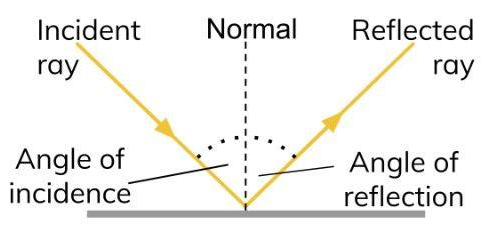
The laws of reflection apply to plane, concave, and convex mirrors.
Important Terms
- Incident ray: The ray of light that falls on a mirror.
- Reflected ray: The ray of light that bounces back from the mirror.
- Normal: An imaginary line drawn at 90° to the mirror at the point where the incident ray strikes it.
- Angle of incidence (i): The angle between the incident ray and the normal.
- Angle of reflection (r): The angle between the reflected ray and the normal.
The Two Laws of Reflection
First Law: The angle of incidence is equal to the angle of reflection.
Formula:
i = r
For example, if the angle of incidence is 30°, the angle of reflection is also 30°.
When a ray falls along the normal, both angles are 0°.
Second Law: The incident ray, the normal at the point of incidence, and the reflected ray lie in the same plane.
These two laws explain how light behaves when it strikes a reflecting surface.
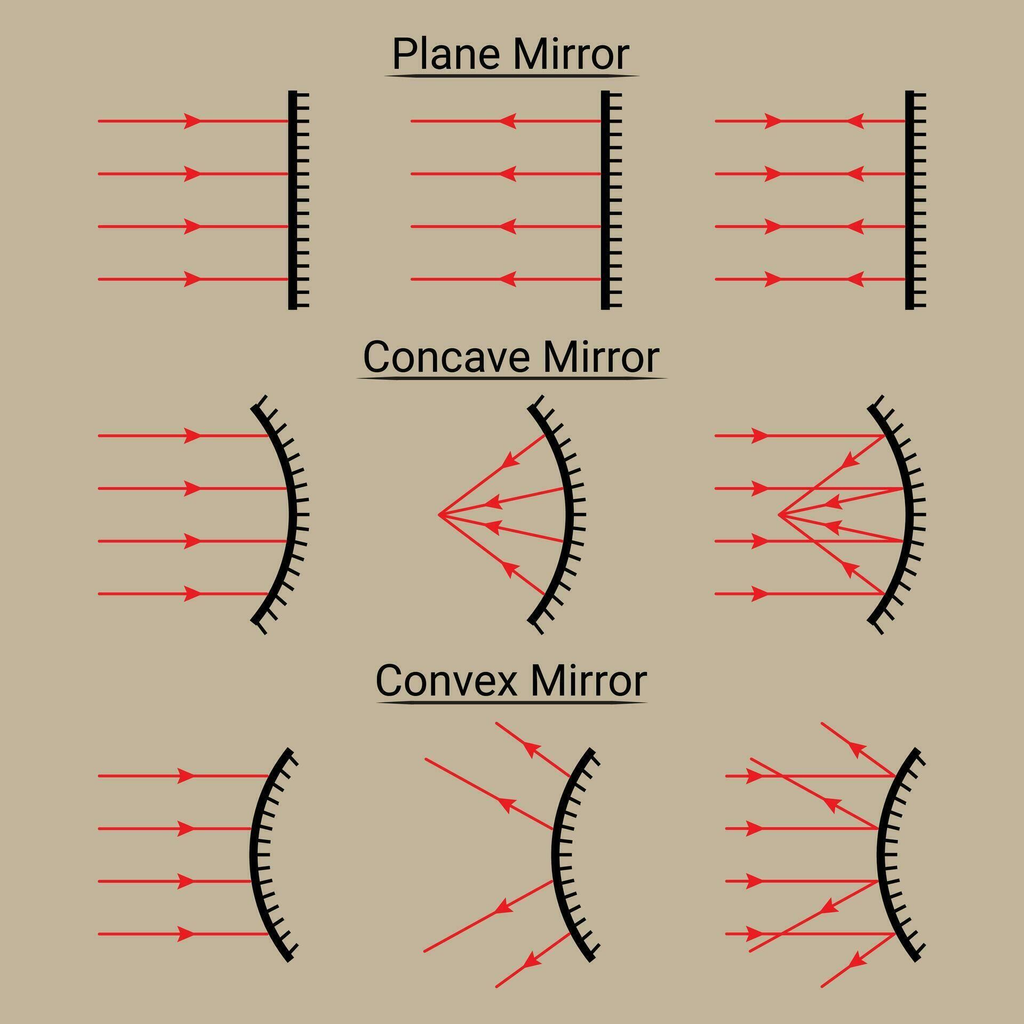
4. Reflection of Parallel Rays by Different Mirrors
When parallel rays of light strike different types of mirrors, they behave differently.
| Type of Mirror | Effect on Parallel Rays |
|---|---|
| Plane mirror | The reflected rays remain parallel. |
| Concave mirror | The reflected rays converge, or come closer together. |
| Convex mirror | The reflected rays diverge, or spread apart. |
Although all mirrors follow the laws of reflection, their shapes affect the direction of the reflected rays.
5. Concentration of Light by a Concave Mirror
A concave mirror can concentrate sunlight into a small, bright spot. This happens because the reflected rays converge at one place, increasing the intensity of light.
If a piece of paper is placed at this bright spot for some time, it may begin to burn.
Safety note: Do not look directly at concentrated sunlight or attempt this experiment without appropriate adult supervision.
6. What Are Solar Concentrators?
Devices that use mirrors or lenses to concentrate sunlight into a small area are called solar concentrators.
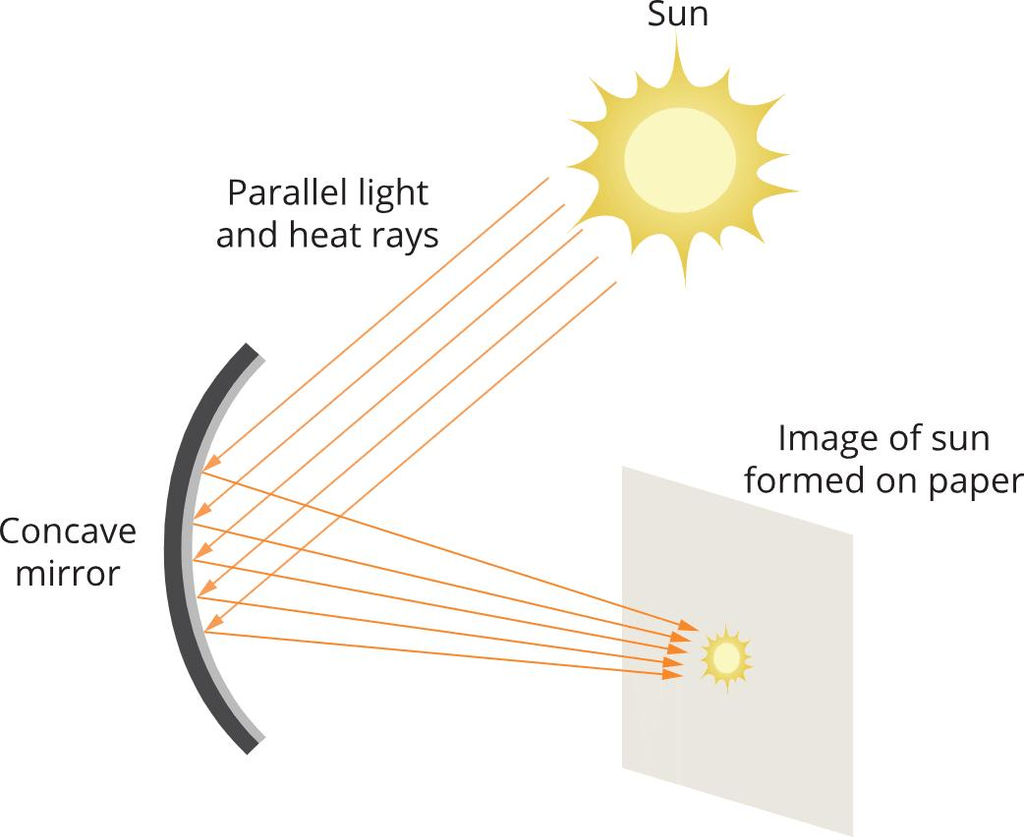
Concentrated sunlight can be used for:
- Producing steam to generate electricity.
- Providing heat for large-scale cooking.
- Operating solar furnaces, which can even be used for melting steel.
Solar concentrators demonstrate how the properties of light can be used for practical purposes.
7. What Is a Lens?
A lens is a piece of transparent material, usually glass or plastic, with one or both surfaces curved.
Unlike mirrors, lenses allow light to pass through them. Objects are viewed through a lens rather than in a lens.
A water drop is a simple example of a lens. Its curved surface can make letters beneath it appear larger, similar to a magnifying glass.
8. Types of Lenses
Lenses are classified into two main types based on their shape.
A. Convex Lens
A convex lens is thicker in the middle than at the edges.
Characteristics:
- When an object is close to the lens, its image is erect and enlarged.
- As the object moves farther away, the image becomes inverted.
- The image is initially enlarged and gradually becomes smaller as the object moves away.
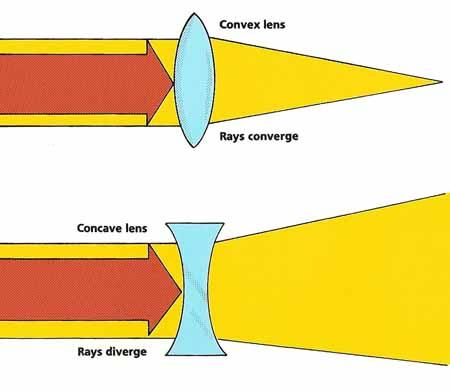
A convex lens is also called a converging lens because it brings parallel rays of light closer together after they pass through it.
B. Concave Lens
A concave lens is thicker at the edges than in the middle.
Characteristics:
- It always forms an erect image.
- The image is diminished, meaning smaller than the object.
- The image size changes as the distance between the object and the lens increases.
A concave lens is also called a diverging lens because it spreads parallel rays of light apart after they pass through it.
9. Effect of Lenses on Parallel Rays of Light
Different transparent objects affect parallel rays of light in different ways.
| Transparent Object | Effect on Parallel Rays |
|---|---|
| Thin glass plate | Light passes through without changing its path significantly. |
| Convex lens | Parallel rays converge after passing through the lens. |
| Concave lens | Parallel rays diverge after passing through the lens. |
Quick revision:
- Convex lens = Converging lens.
- Concave lens = Diverging lens.
10. Uses of Lenses in Everyday Life
Lenses are used in many devices that we use in our daily lives.
- Eyeglasses: Help people see clearly.
- Magnifying glasses: Enlarge small objects and printed text.
- Cameras: Use lenses to form images.
- Telescopes: Use lenses in optical systems to observe distant objects.
- Microscopes: Use lenses to observe very small objects.
- Human eye: Contains a convex lens that changes its shape to help focus on nearby and distant objects.
Lenses are essential in vision correction, photography, scientific research, and observation.
11. Quick Revision Notes
Revise these important points before your examination.
- A spherical mirror has a curved reflecting surface forming part of a sphere.
- Concave mirrors curve inward.
- Convex mirrors curve outward.
- A plane mirror forms an erect image of the same size as the object.
- A concave mirror can form an erect, enlarged image when the object is close.
- A convex mirror always forms an erect, diminished image.
- The angle of incidence is equal to the angle of reflection.
- The incident ray, normal, and reflected ray lie in the same plane.
- Parallel rays remain parallel after reflection from a plane mirror.
- Concave mirrors converge parallel rays after reflection.
- Convex mirrors diverge parallel rays after reflection.
- A convex lens is thicker in the middle and converges parallel rays.
- A concave lens is thinner in the middle and diverges parallel rays.
- Solar concentrators use mirrors or lenses to concentrate sunlight.
12. Frequently Asked Questions (FAQs)
Q1. What is a spherical mirror?
A spherical mirror is a curved mirror whose reflecting surface forms part of a hollow sphere.
Q2. What are the two types of spherical mirrors?
The two types are concave mirrors and convex mirrors.
Q3. Why are convex mirrors used as side-view mirrors in vehicles?
Convex mirrors form erect, diminished images and provide a wider field of view, helping drivers see a larger area behind their vehicles.
Q4. State the first law of reflection.
The angle of incidence is equal to the angle of reflection.
Q5. What is the formula for the law of reflection?
The formula is i = r, where i is the angle of incidence and r is the angle of reflection.
Q6. What is the difference between a convex lens and a concave lens?
A convex lens is thicker in the middle than at the edges and converges parallel rays. A concave lens is thinner in the middle than at the edges and diverges parallel rays.
Q7. What is a solar concentrator?
A solar concentrator is a device that uses mirrors or lenses to concentrate sunlight into a small area.
Q8. Name three uses of lenses.
Lenses are used in eyeglasses, cameras, and microscopes.
Q9. Which mirror is used by dentists?
Dentists use concave mirrors to obtain an enlarged view of teeth.
Q10. What is meant by an erect image?
An erect image is an image that appears upright.
Conclusion
The chapter Light – Mirrors and Lenses explains how mirrors and lenses change the direction of light and form images. Understanding the differences between concave and convex mirrors, the laws of reflection, and the properties of convex and concave lenses will help students build a strong foundation in science.
Read these notes carefully, revise the comparison tables, and practise the important questions to prepare effectively for your Class 8 Science examination.
Keep learning with The Study Smart!
Explore more CBSE study notes, chapter-wise explanations, revision materials, and entrance examination preparation resources on The Study Smart.