Class 8 Science Chapter 10: Light – Mirrors and Lenses | Questions and Answers
Welcome to The Study Smart! In this post, you will learn the important concepts, in-text questions, exercise solutions, and revision points from Class 8 Science Chapter 10: Light – Mirrors and Lenses.
These notes are designed to help students understand the concepts easily, complete their homework, and prepare for school examinations.
📚 Chapter Overview
In this chapter, we explore how light behaves when it strikes mirrors or passes through lenses. We also learn how images are formed and how these principles are used in everyday life.
Topics covered:
- Reflection of light
- Laws of reflection
- Plane, concave, and convex mirrors
- Convex and concave lenses
- Image formation by mirrors and lenses
- Refraction of light
- Everyday applications of optical devices
Section A: In-Text Questions and Answers
Q1. Can mirrors produce enlarged or diminished images?
Answer: Yes. Different mirrors form images of different sizes.
- Concave mirror: Can produce enlarged or diminished images, depending on the position of the object.
- Convex mirror: Always produces a diminished, upright image of a real object.
- Plane mirror: Produces an image of the same size as the object.
Q2. Why do vehicle side-view mirrors carry the warning “Objects in mirror are closer than they appear”?
Answer: Vehicle side-view mirrors are generally convex mirrors. They provide a wider field of view but make objects appear smaller and farther away than they actually are. The warning reminds drivers to judge distances carefully.
Q3. Why do some reading glasses have curved lenses?
Answer: Reading glasses commonly use convex lenses to help people see nearby objects clearly. A convex lens converges light and helps focus it appropriately on the retina when the eye needs additional focusing power.
Q4. How can we distinguish between concave and convex mirrors?
Answer:
- A concave mirror has a reflecting surface that curves inward. It can form enlarged or diminished images, depending on the object’s position.
- A convex mirror has a reflecting surface that bulges outward. It forms an upright, diminished image of a real object.
Q5. Are there laws that govern image formation by mirrors?
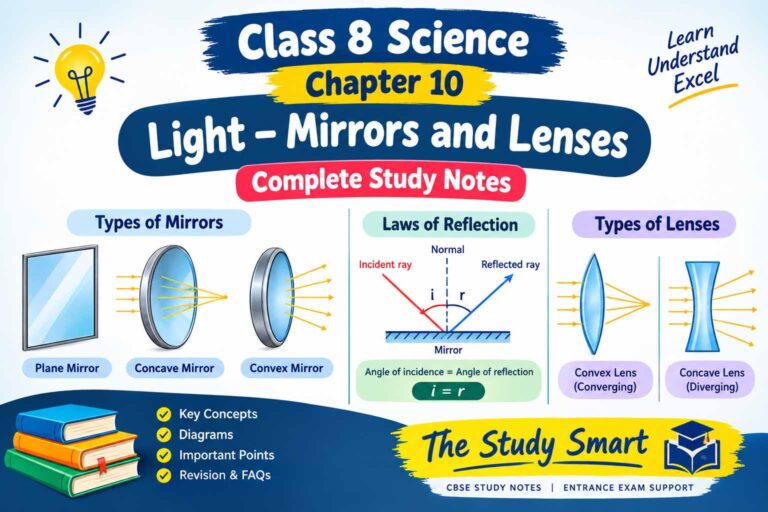
Answer: Yes. Image formation by mirrors follows the laws of reflection:
- The angle of incidence is equal to the angle of reflection.
- The incident ray, reflected ray, and normal at the point of incidence lie in the same plane.
Q6. Do the laws of reflection apply to spherical mirrors?
Answer: Yes. Both concave and convex mirrors obey the laws of reflection. These laws apply at each point on the reflecting surface.
Q7. What changes can be observed when objects are viewed through lenses?
Answer: Depending on the type of lens and the object’s position, the image may appear larger or smaller, upright or inverted. The image may also be real or virtual.
For example, a concave lens generally forms an upright, diminished, virtual image of a real object.
Q8. Can lenses converge or diverge light?
Answer: Yes.
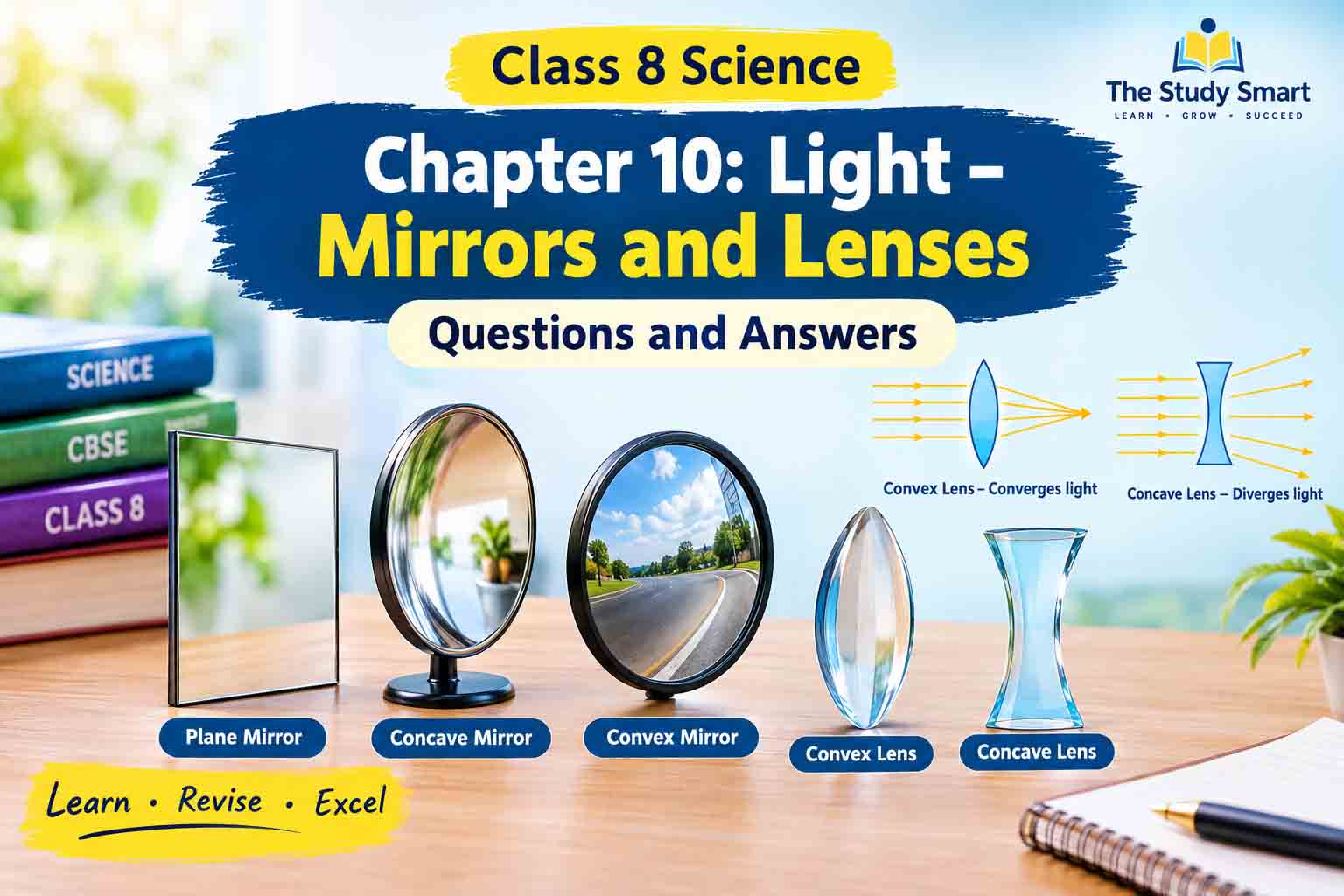
- A convex lens generally converges parallel light rays.
- A concave lens diverges parallel light rays.
Q9. Can a convex lens burn paper using sunlight?
Answer: A convex lens can concentrate sunlight into a small bright spot. The concentrated energy can heat paper enough to ignite it under suitable conditions. Never look directly at the Sun through a lens, and do not attempt this experiment without appropriate adult supervision.
Q10. Where are lenses used?
Answer: Lenses are used in many optical devices, including:
- Spectacles
- Cameras
- Microscopes
- Telescopes
- Projectors
- Magnifying glasses
- Binoculars
Section B: Exercise Questions and Answers
Q1. A light ray makes an angle of 40° with the normal to a mirror. What angle does the reflected ray make with the mirror?
Answer: The correct answer is 50°.
Explanation:
According to the law of reflection:
Angle of reflection = Angle of incidence = 40°
The normal is perpendicular to the mirror, so the angle between the reflected ray and the mirror is:
90° − 40° = 50°
Q2. What happens when a light ray strikes a mirror along the normal?
Answer: When a light ray strikes a mirror along the normal, the angle of incidence is 0°. Therefore, the angle of reflection is also 0°.
The reflected ray retraces the same path in the opposite direction. Tilting the mirror does not change this result if the incident ray remains along the new normal.
If the angle of incidence is 20°, the angle of reflection is also 20°, measured from the normal.
Q3. How can the images formed by plane, concave, and convex mirrors be compared?
Answer:
| Mirror | Image characteristics |
|---|---|
| Plane mirror | Upright, virtual, same size |
| Concave mirror | May be enlarged, diminished, or same size; may be real or virtual |
| Convex mirror | Upright, virtual, diminished |
The image formed by a concave mirror depends on the position of the object.
Q4. How do convex and concave lenses affect the appearance of an object?
Answer:
- A convex lens can make an object appear enlarged when the object is placed within its focal length. At other positions, it may form an inverted image.
- A concave lens generally forms an upright, virtual, diminished image of a real object.
- A flat transparent glass piece generally does not produce the magnification associated with curved lenses.
Q5. What is the angle of incidence when a light ray falls normally on a mirror?
Answer: The correct answer is 0°.
The angle of incidence is measured between the incident ray and the normal. When the ray travels along the normal, the angle between them is zero.
Q6. How can a plane mirror be distinguished from concave and convex mirrors using a graph sheet?
Answer: Observe the apparent size and shape of the grid.
- A plane mirror shows a virtual image of the same size as the object.
- A convex mirror makes the grid appear smaller.
- A concave mirror may make the grid appear larger or smaller, depending on the object’s distance.
Note: The exact identification of each mirror in a textbook figure depends on the image shown in that figure.
Q7. What happens when a person walks towards a large convex mirror?
Answer: The person sees an upright, virtual image that remains smaller than the person. As the person approaches the mirror, the image generally becomes larger, although it remains diminished.
Q8. How does a magnifying glass change the appearance of text?
Answer: A magnifying glass uses a convex lens. When the text is placed closer to the lens than its focal length, it appears upright and enlarged.
When the distance between the text and the lens changes, the size, sharpness, and orientation of the image may change. If the object is moved beyond the focal length, the lens can form a real, inverted image.
Q9. Match the optical devices with their characteristics.
Answer:
| Optical device | Characteristic |
|---|---|
| Concave mirror | Reflecting surface curves inward |
| Convex mirror | Forms an upright, diminished image of a real object |
| Convex lens | Can produce an inverted image when the object is beyond its focal length |
| Concave lens | Generally forms a diminished, upright image of a real object |
Q10. Assertion and Reason
Assertion: Convex mirrors are used to observe traffic behind a vehicle.
Reason: Convex mirrors provide a wider field of view than plane mirrors.
Answer: Both the assertion and reason are correct, and the reason correctly explains the assertion.
Explanation: A convex mirror allows drivers to see a larger area behind the vehicle, helping them monitor surrounding traffic.
Q11. How can convex and concave mirrors be identified from image diagrams?
Answer: Examine the image characteristics and the mirror’s shape.
- A convex mirror forms an upright, diminished image of a real object.
- A concave mirror can form real, inverted images or virtual, upright images, depending on the object’s position.
Use the actual textbook diagram to match each image with the correct mirror.
Q12. Why does a pencil appear bent when partly immersed in water inside a glass tumbler?
Answer: The pencil appears bent because of refraction of light.
Light changes direction when it passes from water into air. The light coming from the submerged part of the pencil is refracted at the water–air boundary. Our eyes trace the refracted rays backward, making the underwater portion appear displaced from its actual position.
This creates the illusion that the pencil is bent or broken at the water surface.
Section C: Important Concepts for Quick Revision
1. Laws of Reflection
- Angle of incidence = Angle of reflection.
- The incident ray, reflected ray, and normal lie in the same plane.
2. Types of Mirrors
| Feature | Plane | Concave | Convex |
|---|---|---|---|
| Surface | Flat | Curves inward | Bulges outward |
| Typical use | Looking mirror | Shaving or dentist’s mirror | Vehicle side-view mirror |
| Image size | Same as object | Depends on object position | Smaller |
3. Types of Lenses
| Feature | Convex lens | Concave lens |
|---|---|---|
| Shape | Thicker at the centre | Thinner at the centre |
| Effect on parallel rays | Converges | Diverges |
| Common application | Magnifying glass | Some spectacle lenses |
4. Important Terms
- Reflection: The bouncing back of light from a surface.
- Refraction: The change in direction of light when it passes between media because its speed changes.
- Normal: An imaginary line perpendicular to a surface at the point where a ray strikes it.
- Real image: An image formed where light rays actually meet.
- Virtual image: An image formed where light rays appear to meet.
Section D: Practice Questions
Test your understanding with these questions.
- State the two laws of reflection.
- Why are convex mirrors preferred for vehicle side-view mirrors?
- Differentiate between convex and concave lenses.
- Explain why a pencil appears bent in water.
- A light ray strikes a mirror at an angle of 35° to the normal. Find the angle of reflection.
- Give three everyday applications of lenses.
Answer Key
- The angle of incidence equals the angle of reflection; the incident ray, reflected ray, and normal lie in the same plane.
- Convex mirrors provide a wider field of view and form upright, diminished images.
- A convex lens converges parallel rays, whereas a concave lens diverges them.
- Refraction at the water–air boundary makes the submerged portion appear displaced.
- 35°.
- Spectacles, cameras, and microscopes.
Conclusion
Understanding mirrors and lenses helps us explain many everyday optical phenomena, from vehicle mirrors to magnifying glasses. Revise the laws of reflection, image characteristics, and the difference between reflection and refraction before your examination.
Keep learning with The Study Smart, your resource for school notes, chapter explanations, question banks, and exam preparation materials.
Reference for further reading: Learn CBSE – Class 8 Science Chapter 10: Light: Mirrors and Lenses
This study guide provides independently worded explanations for revision. Please consult your prescribed textbook for the exact exercise wording and any diagrams needed for diagram-based questions.