
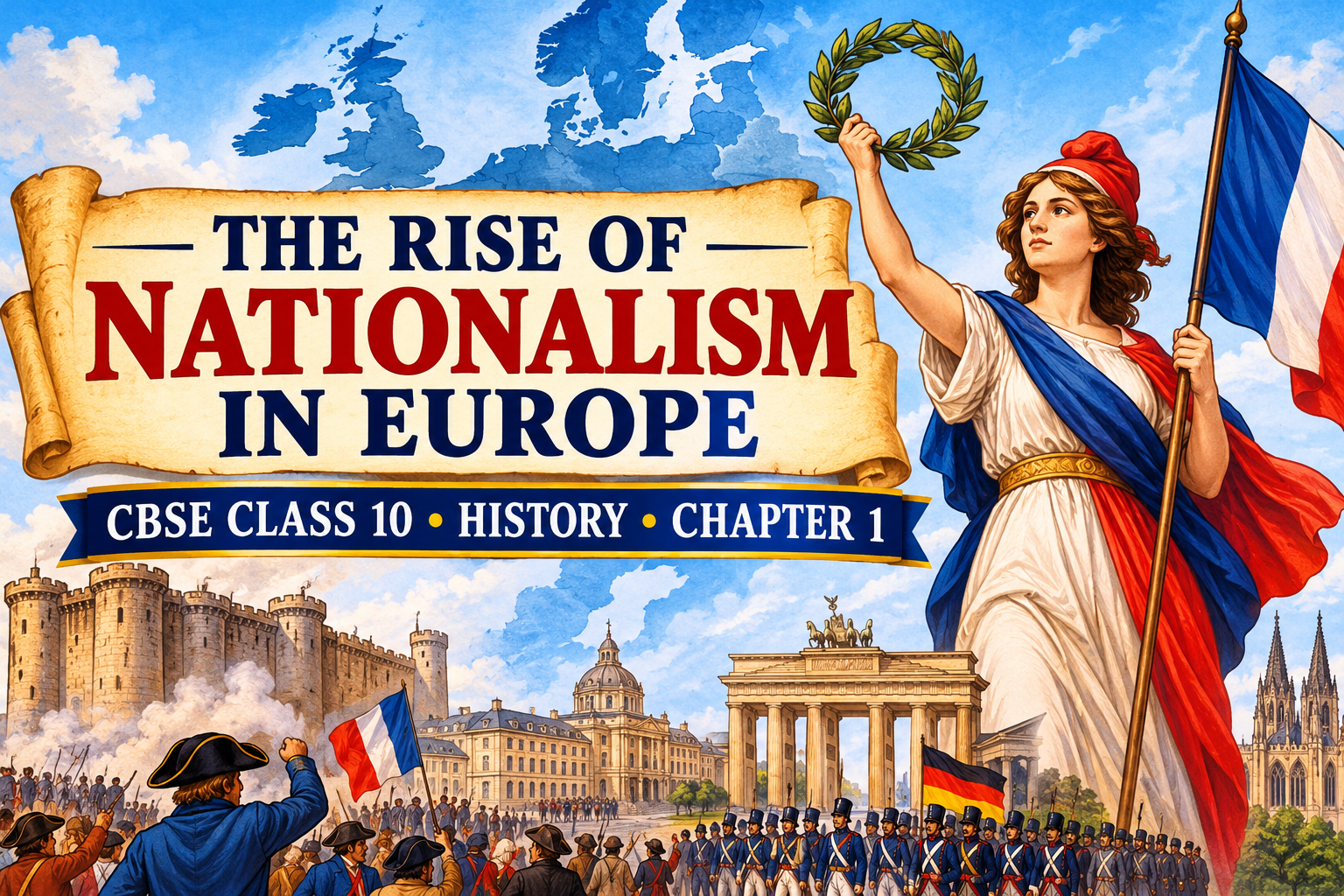
Subject: Social Science – History
Class: 10
Book: India and the Contemporary World – II
Chapter: 1 – The Rise of Nationalism in Europe
Board: CBSE
Introduction
Nationalism is a feeling of unity, pride and belonging among people who share a common history, culture, language, territory or identity. It played an important role in shaping modern Europe during the nineteenth century.
Before the nineteenth century, Europe was divided into numerous kingdoms, duchies, empires and small political territories. People generally identified themselves with their local rulers, regions or communities rather than with a unified nation.
The French Revolution of 1789 introduced the powerful idea that sovereignty belonged to the people rather than to a monarch. This idea gradually spread across Europe and inspired movements for freedom, equality and national unity.
In this chapter, we will study how nationalism developed in Europe, how Germany and Italy became unified, and how national symbols and revolutionary movements helped shape modern nations.
1. The French Revolution and the Idea of the Nation
The French Revolution of 1789 was one of the most important events in the history of nationalism.
Before the revolution, France was ruled by an absolute monarch. The king enjoyed enormous powers, and society was divided into unequal social classes.
The revolution introduced the concept that the people formed the nation and were the source of political authority.
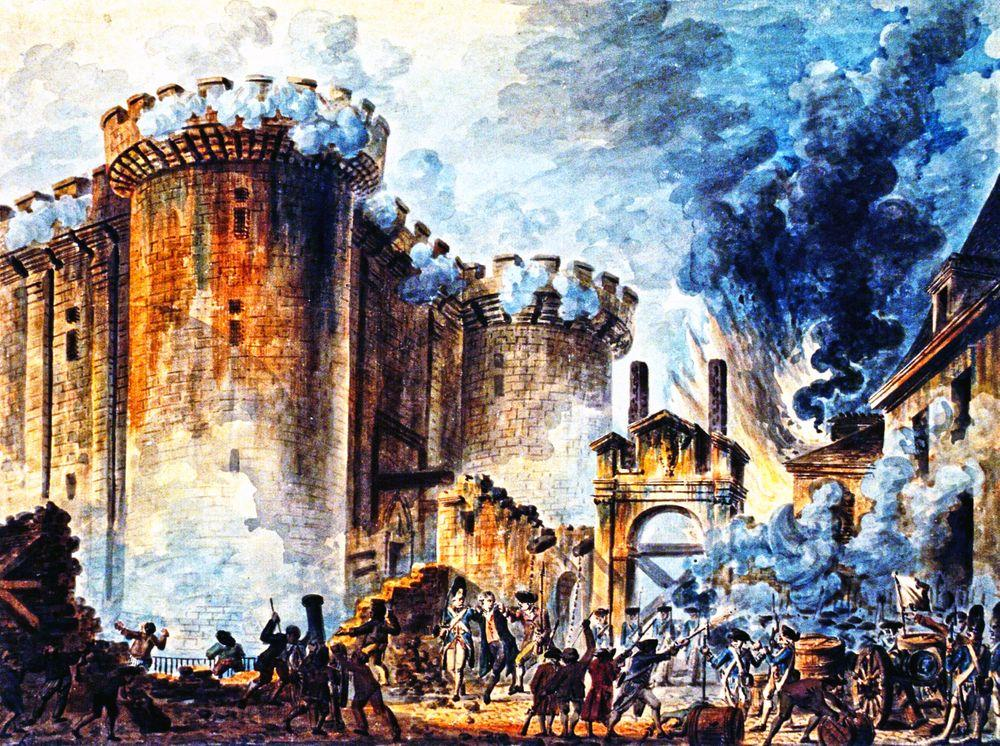
Important Measures Introduced by the French Revolution
The revolutionaries introduced several measures to create a sense of collective national identity.
- La Patrie (The Fatherland): It represented the idea of a united nation.
- Le Citoyen (The Citizen): It emphasised equal rights and duties among citizens.
- New National Flag: The royal standard was replaced by the French tricolour.
- National Assembly: The Estates General was elected and renamed the National Assembly.
- Uniform Laws: A uniform system of administration and laws was introduced.
- Common Language: French was promoted as the common national language.
- National Symbols: New hymns, oaths and commemorative celebrations were introduced.
These measures helped transform France into a modern nation-state.
What is a Nation-State?
A nation-state is a political organisation in which people share a sense of common national identity and are governed by a central authority.
Remember: The French Revolution of 1789 gave a powerful beginning to modern nationalism in Europe.
2. Napoleon and the Civil Code of 1804
Napoleon Bonaparte came to power in France in 1799. In 1804, he introduced the Civil Code, commonly known as the Napoleonic Code.
Although Napoleon became an emperor, he preserved several important reforms introduced during the French Revolution.
Main Features of the Napoleonic Code
- Established equality before the law.
- Abolished privileges based on birth.
- Secured the right to property.
- Simplified administrative systems.
- Abolished feudal privileges in areas under French control.
- Introduced uniform laws and standardised administrative practices.
Napoleon’s Reforms in Europe
Napoleon introduced reforms in the territories under his control.
Some important changes included:
- Removal of restrictions imposed by feudal systems.
- Improvement in transport and communication.
- Introduction of uniform weights and measures.
- Establishment of efficient administrative systems.
- Reduction of privileges enjoyed by certain social groups.
Negative Effects of Napoleon’s Rule
Initially, many people welcomed French armies because they brought reforms and modern laws.
However, people gradually became hostile towards French rule because of:
- Increased taxation.
- Censorship.
- Forced recruitment into the French army.
- Political restrictions.
- Loss of national independence.
Thus, Napoleon spread revolutionary ideas but also created resentment through military domination.
3. The Making of Nationalism in Europe
During the nineteenth century, nationalism became closely connected with liberalism.
The educated middle classes, including businessmen, professionals and intellectuals, supported the ideas of freedom, equality and national unity.
Meaning of Liberalism
The word liberalism comes from the Latin word liber, meaning free.
Liberalism had two major aspects.
A. Political Liberalism
- Equality before the law.
- Freedom of individuals.
- Government based on consent.
- Constitutional government.
- End of autocratic rule.
- Protection of individual rights.
However, liberalism did not initially mean universal voting rights. In many European countries, voting rights were restricted to property-owning men.
Women and men without property were excluded from political participation.
B. Economic Liberalism
Economic liberalism supported:
- Freedom of markets.
- Removal of trade restrictions.
- Free movement of goods.
- Removal of customs barriers.
- Creation of a common economic system.
Zollverein – The Customs Union
- The German-speaking regions were divided into 39 states. Each state had its own currency, customs duties and trade regulations.
- This created difficulties for merchants and traders.
- In 1834, a customs union called the Zollverein was formed at the initiative of Prussia.
Objectives and Achievements of Zollverein
- Abolished tariff barriers between many German states.
- Reduced the number of currencies.
- Improved trade and commercial activities.
- Encouraged economic cooperation.
- Strengthened the feeling of German national unity.
The Zollverein helped create economic unity among German states before their political unification.
Exam Point: Zollverein was established in 1834 under the leadership of Prussia.
4. Conservatism and the Congress of Vienna (1815)
After Napoleon’s defeat in 1815, European rulers wanted to restore the traditional political order.
This political ideology was known as conservatism.
Meaning of Conservatism
Conservatism supported the preservation of traditional institutions such as:
- Monarchy.
- Church.
- Traditional social hierarchy.
- Family and property systems.
- Established political institutions.
Conservatives believed that traditional institutions provided stability and social order.
Congress of Vienna (1815)
The Congress of Vienna was held in 1815 after the defeat of Napoleon.
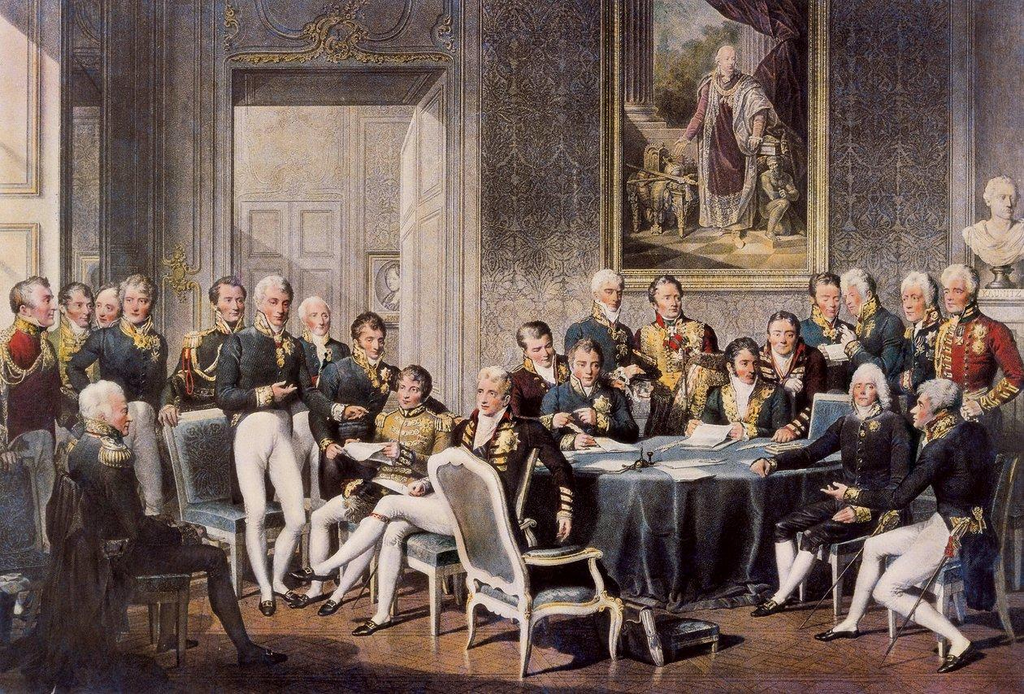
It was hosted by Austrian Chancellor Duke Metternich.
Major Participants:
- Britain.
- Russia.
- Prussia.
- Austria.
Important Decisions of the Congress of Vienna
- The Bourbon dynasty was restored to power in France.
- France lost the territories it had annexed under Napoleon.
- A series of states were established around France to prevent future French expansion.
- The Kingdom of the Netherlands was established in the north.
- Prussia received important territories on its western borders.
- Austria was given control of northern Italy.
The Congress aimed to restore the old conservative order and prevent the spread of revolutionary ideas.
Role of Giuseppe Mazzini
Giuseppe Mazzini was an Italian revolutionary who supported the idea of a united Italian republic.
He founded two secret revolutionary organisations:
- Young Italy.
- Young Europe.
He believed that nations were natural units of humanity and that Italy should become a unified republic.
His revolutionary ideas inspired many young Europeans.
5. The Age of Revolutions: 1830–1848
Between 1830 and 1848, several revolutionary movements took place in Europe.
These movements were inspired by nationalism, liberalism and the desire for political freedom.
A. July Revolution of 1830 in France
- In July 1830, the Bourbon kings were overthrown in France.
- Louis Philippe became the constitutional monarch.
- This revolution inspired similar movements in other European countries.
B. Belgian Revolution
- The Belgian people revolted against the United Kingdom of the Netherlands.
- Belgium became an independent country in 1831.
C. Greek War of Independence (1821–1832)
- Greece had been under Ottoman Empire rule for centuries.
- In 1821, Greeks began a struggle for independence.
- European nationalists supported the Greek freedom movement because they admired ancient Greek civilisation.
- Important supporters included the English poet Lord Byron, who died during the struggle.
- The Treaty of Constantinople in 1832 recognised Greece as an independent nation.
D. Romanticism and National Feeling
Romanticism was a cultural movement that developed during the nineteenth century.
It emphasised emotions, imagination, folk traditions and shared cultural heritage.
Romantic artists and writers helped develop nationalist feelings.
Important contributors included:
- Johann Gottfried Herder: Believed that true German culture was found among ordinary people, known as Das Volk.
- Jacob and Wilhelm Grimm: Collected German folk tales and stories.
- Polish musicians and artists: Used music and language to maintain Polish national identity.
Language as a Tool of Nationalism
- Language played an important role in developing national consciousness.
- For example, Poland had been partitioned and disappeared as an independent state from the political map of Europe.
- The Russian authorities tried to impose the Russian language in Polish territories.
- Polish nationalists continued to use their language in religious gatherings and cultural activities.
- Thus, language became a symbol of resistance and national identity.
6. The Revolution of 1848: The Revolution of the Liberals
The year 1848 was an important year in European history.
A series of revolutions occurred in different European countries.
These revolutions were driven by two major groups:
- The poor, workers and peasants who demanded economic and social improvements.
- The educated middle classes who demanded political rights, constitutional government and national unity.
Revolution in France (1848)
- In February 1848, the French monarchy was overthrown.
- France became a republic.
- Universal male suffrage was introduced, allowing all adult men to vote.
- The right to work was also recognised, and national workshops were established to provide employment.
Frankfurt Parliament
- In the German regions, the middle-class liberals attempted to unite the different German states into one nation.
- On 18 May 1848, representatives gathered in the Church of St. Paul at Frankfurt.
- This assembly became known as the Frankfurt Parliament.
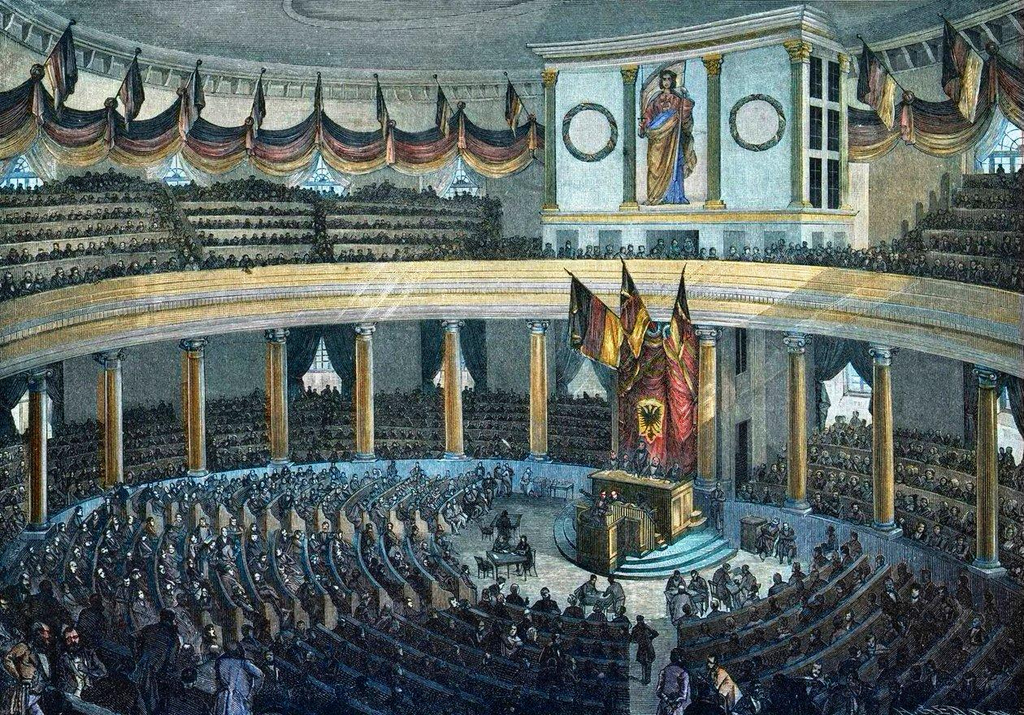
Important Features of Frankfurt Parliament
- It consisted of elected representatives from different German regions.
- It aimed to create a unified German nation.
- It drafted a constitution for a German nation-state.
- It proposed a constitutional monarchy.
- The crown was offered to the Prussian king, Friedrich Wilhelm IV.
However, the Prussian king rejected the offer because he did not want to accept authority from an elected assembly.
The assembly was eventually dissolved by military force.
Why Did the Frankfurt Parliament Fail?
- The Prussian king rejected the crown.
- The middle classes were divided.
- The assembly lacked military power.
- Conservative rulers opposed the movement.
- Workers and peasants were not adequately represented.
Role of Women in the Liberal Movement
- Women actively participated in the revolutionary movements of 1848.
- They formed political associations, participated in demonstrations and established newspapers.
- However, they were denied political rights.
- Women were allowed to attend the Frankfurt Parliament only as observers in the visitors’ gallery.
- This demonstrated the limitations of nineteenth-century liberalism.
7. The Making of Germany and Italy
After the failure of the liberal revolutions of 1848, nationalism became increasingly associated with conservative political leaders.
Germany and Italy were unified through the efforts of powerful monarchies, armies and diplomatic strategies.
A. Unification of Germany
- Before unification, Germany consisted of 39 independent states.
- Prussia became the leading force in the German unification movement.
- The chief minister of Prussia, Otto von Bismarck, played a major role in this process.
Otto von Bismarck and the Policy of Blood and Iron
Bismarck followed a policy known as Blood and Iron.
This meant that German unification would be achieved through military strength and strategic diplomacy rather than liberal debates.
He used the Prussian army to fight three major wars.
Three Wars of German Unification
- War against Denmark (1864).
- War against Austria (1866).
- War against France (1870–1871).
Prussia won all three wars.
Declaration of the German Empire
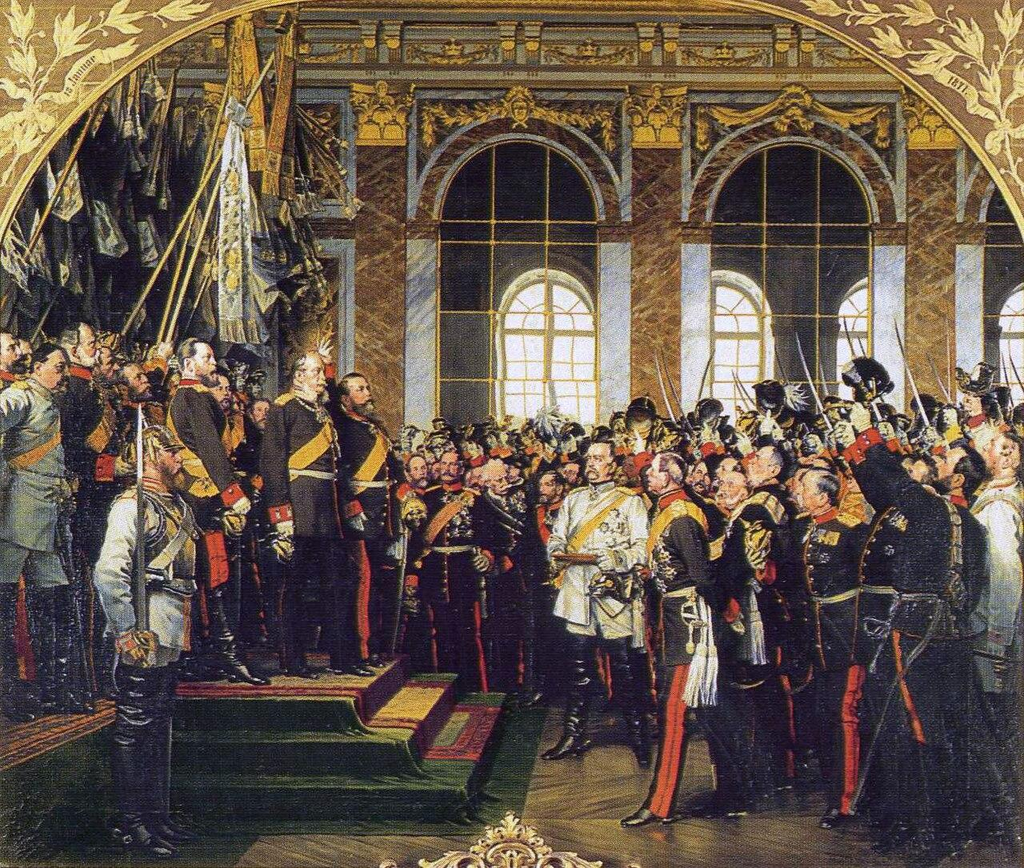
On 18 January 1871, William I, the King of Prussia, was proclaimed German Emperor at the Palace of Versailles in France.
This marked the completion of German unification.
Important Personalities:
- Otto von Bismarck – Chief architect of German unification.
- William I – First German Emperor.
- Prussia – Leading state in the unification process.
B. Unification of Italy
During the middle of the nineteenth century, Italy was divided into seven states.
Only Sardinia-Piedmont was ruled by an Italian princely house.
Italian nationalists wanted to unite all Italian-speaking territories into one nation.
Four important personalities played major roles in Italian unification.
1. Giuseppe Mazzini – The Revolutionary
- Born in Genoa.
- Founded Young Italy.
- Supported a united Italian republic.
- Inspired young Italians to fight for national unity.
2. Count Camillo de Cavour – The Diplomat
- Chief Minister of Sardinia-Piedmont.
- Used diplomacy and political alliances.
- Allied with France to defeat Austria in 1859.
- Played an important role in the unification movement.
3. Giuseppe Garibaldi – The Military Leader
- Led the famous Red Shirts.
- Organised armed volunteers.
- Captured Sicily and Naples.
- Helped unite southern Italy with the northern territories.
4. Victor Emmanuel II – The King
- King of Sardinia-Piedmont.
- Became the first king of united Italy in 1861.
Completion of Italian Unification
- In 1861, Victor Emmanuel II was proclaimed king of united Italy.
- Venetia was added in 1866, and Rome became part of Italy in 1870.
Remember: Mazzini provided the revolutionary ideas, Cavour used diplomacy, Garibaldi led military campaigns, and Victor Emmanuel II became the king.
8. The Strange Case of Britain: A Nation Forged Slowly
- Unlike Germany and Italy, Britain did not become a nation-state through a sudden revolution or a single unification war.
- The formation of the British nation-state was a gradual process.
- Before the eighteenth century, people in Britain identified themselves as English, Welsh, Scottish or Irish.
Important Events
Act of Union, 1707
The Act of Union united England and Scotland to form the United Kingdom of Great Britain.
England dominated the political institutions of the new state.
Ireland and the Act of Union, 1801
Ireland was forcibly incorporated into the United Kingdom in 1801.
The British government promoted a common British identity through:
- The Union Jack.
- The national anthem.
- The English language.
- National institutions and symbols.
However, the process also involved the suppression of Scottish, Welsh and Irish cultures and identities.
Exam Point: Britain’s national identity developed gradually through political consolidation, unlike the military unification of Germany and Italy.
9. Visualising the Nation: National Symbols and Allegories
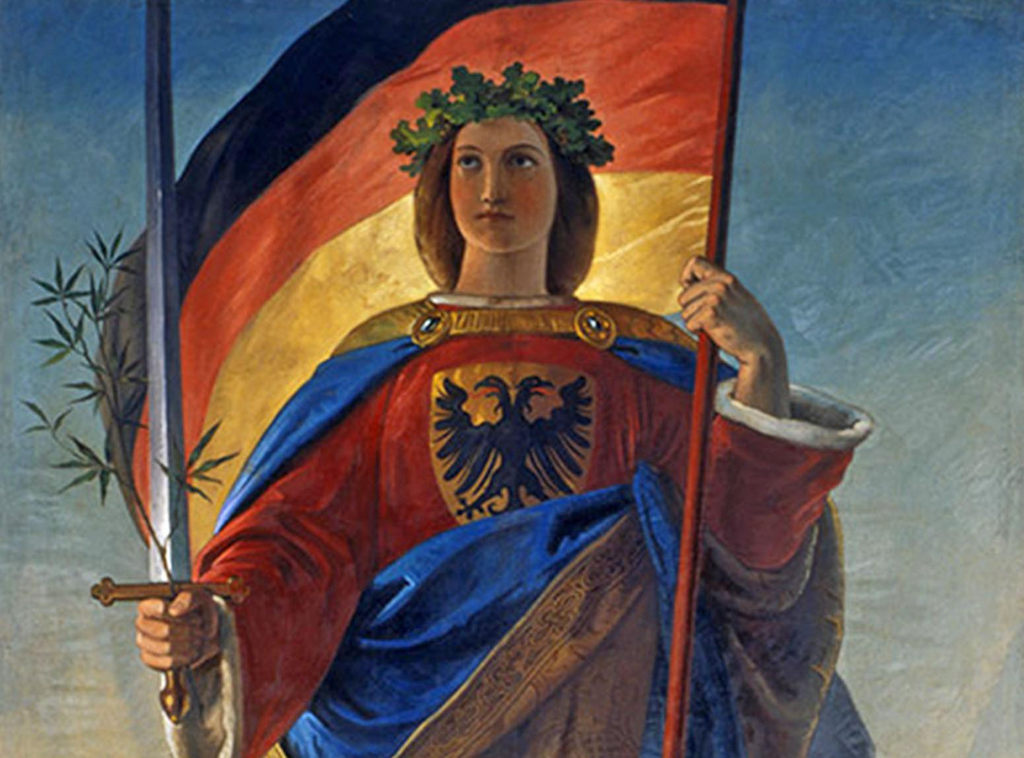
- During the nineteenth century, artists used female figures to represent nations.
- These figures were known as allegories.
- An allegory is a symbolic representation of an abstract idea through a human figure, object or image.
- Two famous female allegories were Marianne and Germania.
A. Marianne – The National Symbol of France
Marianne represented the French nation.
She symbolised liberty and the republic.
Important symbols associated with Marianne included:
- Red cap – Symbol of liberty.
- Tricolour – Symbol of the French nation.
- Cockade – Symbol of revolutionary freedom.
Her images were displayed on coins, stamps and public monuments.
B. Germania – The National Symbol of Germany
Germania represented the German nation.
She symbolised heroism, unity and national strength.
Important symbols associated with Germania:
| Symbol | Meaning |
|---|---|
| Crown of oak leaves | Heroism |
| Broken chains | Freedom |
| Sword | Readiness to fight |
| Olive branch around the sword | Willingness to make peace |
| Black, red and gold tricolour | Liberal-nationalist aspirations |
| Rays of the rising sun | Beginning of a new era |
Remember: Marianne represents France, while Germania represents Germany.
10. Nationalism and Imperialism: The Balkans
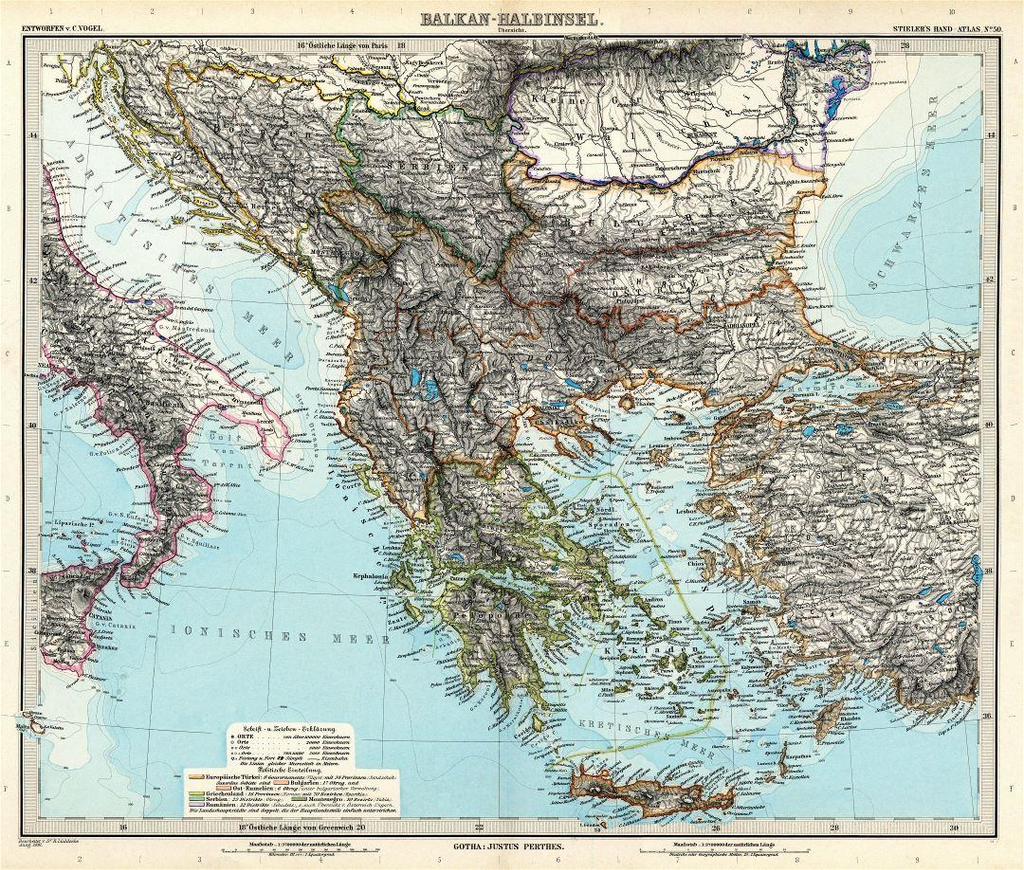
The Balkans became one of the most important areas of nationalist conflict in Europe during the late nineteenth century.
The Balkan region included modern-day countries such as Serbia, Bulgaria, Greece, Romania, Albania, Bosnia-Herzegovina and others.
Why Were the Balkans Important?
- The region had a large number of ethnic groups.
- Many people wanted independence from foreign rule.
- The Ottoman Empire controlled a large part of the region.
- Different European powers wanted political and economic influence.
As the Ottoman Empire weakened, nationalist groups demanded independence.
Major Causes of Conflict
- The decline of the Ottoman Empire.
- Growth of nationalist feelings.
- Rival territorial claims.
- Competition among European powers.
- Imperialist ambitions of Russia, Germany, Austria-Hungary and Britain.
The Balkan region became a centre of political tension and contributed to the conflicts that eventually led to the First World War.
Exam Point: Nationalism in the Balkans became closely linked with imperialism and international rivalry.
11. Important Dates and Events – Quick Revision Timeline
| Year | Important Event |
|---|---|
| 1707 | Act of Union between England and Scotland |
| 1789 | French Revolution |
| 1799 | Napoleon comes to power in France |
| 1801 | Ireland incorporated into the United Kingdom |
| 1804 | Napoleonic Civil Code introduced |
| 1815 | Congress of Vienna |
| 1821 | Greek War of Independence begins |
| 1830 | July Revolution in France |
| 1831 | Belgium becomes independent |
| 1832 | Greece recognised as an independent nation |
| 1834 | Zollverein established |
| 1848 | Frankfurt Parliament and liberal revolutions |
| 1859 | Cavour’s alliance with France against Austria |
| 1861 | Victor Emmanuel II becomes king of united Italy |
| 1864 | Prussia defeats Denmark |
| 1866 | Prussia defeats Austria; Venetia joins Italy |
| 1870 | Rome becomes part of Italy; Franco-Prussian War |
| 1871 | German Empire proclaimed at Versailles |
12. Important Personalities of the Chapter
| Personality | Country | Contribution |
|---|---|---|
| Napoleon Bonaparte | France | Introduced the Napoleonic Code |
| Giuseppe Mazzini | Italy | Founded Young Italy and Young Europe |
| Duke Metternich | Austria | Hosted the Congress of Vienna |
| Lord Byron | Britain | Supported Greek independence |
| Otto von Bismarck | Prussia/Germany | Led German unification |
| William I | Germany | First German Emperor |
| Count Cavour | Italy | Used diplomacy for Italian unification |
| Giuseppe Garibaldi | Italy | Led the Red Shirts |
| Victor Emmanuel II | Italy | First king of united Italy |
| Friedrich Wilhelm IV | Prussia | Rejected the crown offered by Frankfurt Parliament |
13. Important Terms and Definitions
1. Nationalism: A feeling of unity and loyalty towards one’s nation.
2. Nation-State: A state in which people share a common national identity and are governed by a central authority.
3. Liberalism: An ideology supporting individual freedom, equality before the law and constitutional government.
4. Conservatism: A political ideology supporting traditional institutions and established social and political systems.
5. Zollverein: A customs union established in 1834 under Prussian leadership to remove trade barriers among German states.
6. Napoleonic Code: The Civil Code introduced by Napoleon in 1804, which established equality before the law and protected property rights.
7. Romanticism: A cultural movement that promoted emotions, folk traditions and shared cultural heritage.
8. Allegory: A symbolic representation of an abstract idea through a human figure or object.
9. Suffrage: The right to vote in political elections.
10. Imperialism: A policy through which a powerful country extends its control over other territories or nations.
14. Important Questions and Answers
Q1. What was the main contribution of the French Revolution to nationalism?
Answer: The French Revolution transferred sovereignty from the monarchy to the people. It introduced national symbols, common laws, a common language and the idea of equal citizenship. These measures helped create a sense of national unity.
Q2. What was the Napoleonic Code?
Answer: The Napoleonic Code was introduced in 1804. It established equality before the law, abolished privileges based on birth, protected property rights and simplified administrative systems.
Q3. What was the Zollverein? Explain its importance.
Answer: The Zollverein was a customs union established in 1834 under Prussian leadership. It abolished customs barriers among many German states, reduced the number of currencies and encouraged economic cooperation. It helped strengthen German national unity.
Q4. What were the main decisions of the Congress of Vienna?
Answer: The Congress of Vienna was held in 1815 under the leadership of Duke Metternich. Its major decisions included:
- Restoration of the Bourbon monarchy in France.
- Establishment of states around France to prevent expansion.
- Restoration of conservative monarchies.
- Redistribution of territories among European powers.
Q5. Who was Giuseppe Mazzini?
Answer: Giuseppe Mazzini was an Italian revolutionary who supported a united and independent Italian republic. He founded Young Italy and Young Europe to spread nationalist ideas.
Q6. Why did the Frankfurt Parliament fail?
Answer: The Frankfurt Parliament failed because the Prussian king rejected the crown offered by the assembly, conservative forces opposed it, the middle classes were divided and the assembly lacked military support.
Q7. Explain the process of German unification.
Answer: German unification was led by Prussia under the leadership of Otto von Bismarck. Bismarck followed the policy of Blood and Iron and fought three wars against Denmark, Austria and France. On 18 January 1871, William I was proclaimed German Emperor at Versailles.
Q8. Explain the contribution of Garibaldi to Italian unification.
Answer: Giuseppe Garibaldi was an important Italian revolutionary and military leader. He organised the Red Shirts and led military campaigns in southern Italy. He captured Sicily and Naples and helped unite these territories with northern Italy.
Q9. What were Marianne and Germania?
Answer: Marianne and Germania were female allegories representing France and Germany respectively. Marianne symbolised liberty and the French Republic, while Germania symbolised German unity and national strength.
Q10. Why did the Balkans become a source of nationalist tension?
Answer: The Balkans became a centre of tension because the Ottoman Empire was weakening and different ethnic groups demanded independence. European powers also competed for influence and territory in the region.
15. Multiple Choice Questions (MCQs)
Test your understanding with these important questions.
1. In which year did the French Revolution begin?
A. 1776
B. 1789
C. 1815
D. 1848
Answer: B. 1789
2. Who introduced the Civil Code in 1804?
A. Bismarck
B. Mazzini
C. Napoleon Bonaparte
D. Metternich
Answer: C. Napoleon Bonaparte
3. What was the main objective of the Zollverein?
A. Military expansion
B. Removal of trade barriers
C. Religious reform
D. Establishment of monarchy
Answer: B. Removal of trade barriers
4. In which year was the Zollverein established?
A. 1815
B. 1821
C. 1834
D. 1848
Answer: C. 1834
5. Who hosted the Congress of Vienna?
A. Napoleon
B. Duke Metternich
C. Giuseppe Garibaldi
D. Otto von Bismarck
Answer: B. Duke Metternich
6. Who founded Young Italy?
A. Cavour
B. Garibaldi
C. Giuseppe Mazzini
D. Victor Emmanuel II
Answer: C. Giuseppe Mazzini
7. Where did the Frankfurt Parliament meet?
A. Berlin
B. Paris
C. Vienna
D. Church of St. Paul, Frankfurt
Answer: D. Church of St. Paul, Frankfurt
8. Who led the German unification movement?
A. Otto von Bismarck
B. Napoleon
C. Mazzini
D. Garibaldi
Answer: A. Otto von Bismarck
9. Which policy was followed by Bismarck?
A. Peace and Unity
B. Blood and Iron
C. Liberty and Equality
D. Non-violence
Answer: B. Blood and Iron
10. Who became the first king of united Italy?
A. Giuseppe Mazzini
B. Giuseppe Garibaldi
C. Victor Emmanuel II
D. Count Cavour
Answer: C. Victor Emmanuel II
11. Which female allegory represented France?
A. Germania
B. Marianne
C. Liberty Bell
D. Victoria
Answer: B. Marianne
12. Which female allegory represented Germany?
A. Marianne
B. Germania
C. Athena
D. Britannia
Answer: B. Germania
13. The Greek War of Independence began in:
A. 1789
B. 1815
C. 1821
D. 1848
Answer: C. 1821
14. Who led the Red Shirts?
A. Cavour
B. Garibaldi
C. Mazzini
D. Bismarck
Answer: B. Garibaldi
15. In which year was the German Empire proclaimed?
A. 1848
B. 1861
C. 1866
D. 1871
Answer: D. 1871
16. Quick Revision – Remember These Facts
- French Revolution – 1789.
- Napoleonic Code – 1804.
- Congress of Vienna – 1815.
- Zollverein – 1834.
- Frankfurt Parliament – 1848.
- German Unification – 1871.
- Italian Unification – 1861 (proclamation of the Kingdom of Italy).
- Mazzini – Young Italy.
- Bismarck – Blood and Iron.
- Cavour – Diplomacy.
- Garibaldi – Red Shirts.
- Victor Emmanuel II – First king of united Italy.
- Marianne – France.
- Germania – Germany.
- Balkan region – Centre of nationalist tensions.
Conclusion
The Rise of Nationalism in Europe explains how revolutionary ideas, political movements, cultural traditions and military campaigns transformed the political map of Europe.
The French Revolution introduced the idea of popular sovereignty, while Napoleon spread administrative reforms. Liberal and nationalist movements challenged conservative rulers, and the unification of Germany and Italy created powerful modern nation-states.
The chapter also demonstrates how nationalism could promote freedom and unity but could also lead to imperialism, rivalry and conflict.
For CBSE Class 10 students: Read every topic carefully, learn the important dates and personalities, practise the questions and MCQs, and revise the symbols of Marianne and Germania before your examination.
Keep learning with The Study Smart – Learn Smart, Score Better!