Introduction
Have you ever wondered how people measured time before clocks, watches and mobile phones were invented?
Long ago, people observed the Sun, Moon and stars to understand the passage of time. They noticed that the Sun rises and sets every day, the Moon changes its appearance regularly, and seasons repeat after a fixed period.
These observations helped humans develop calendars, measure days and months, predict seasons and understand the movement of celestial bodies.
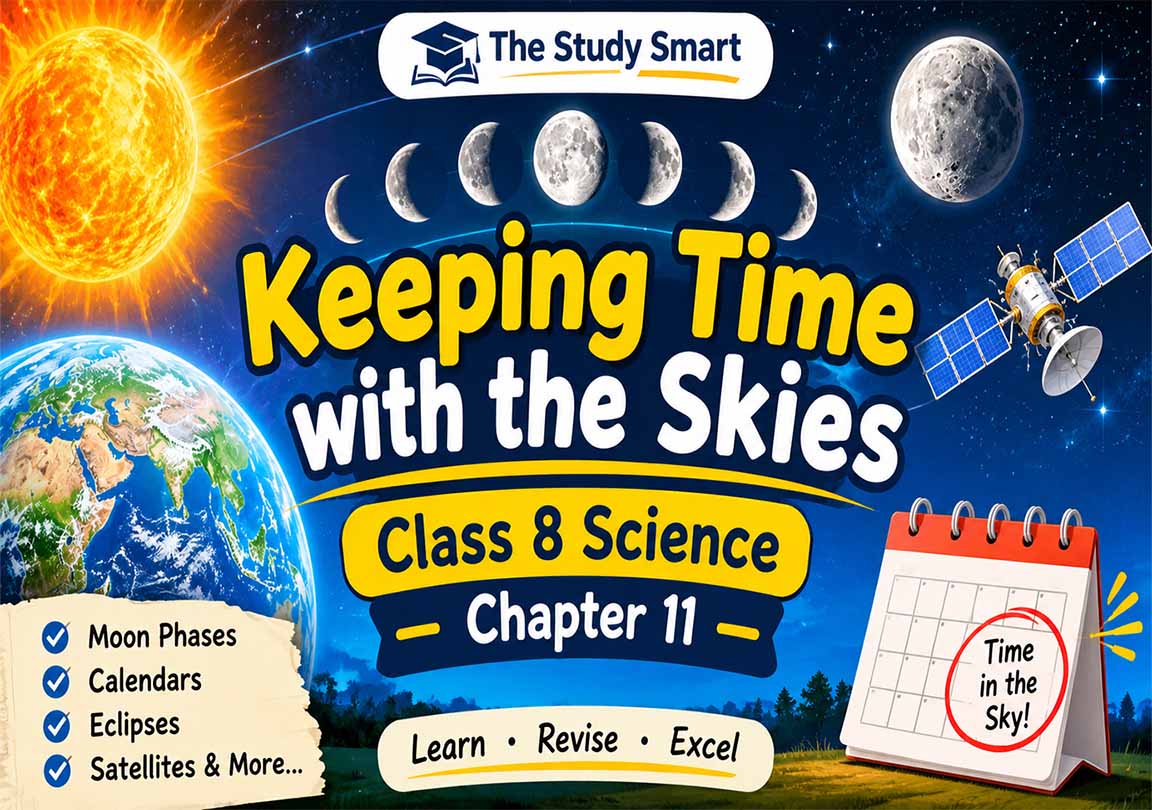
In this chapter, Keeping Time with the Skies, we will learn how the movements of the Sun, Earth and Moon help us measure time. We will also explore different types of calendars, Indian festivals, artificial satellites and India’s contribution to space science.
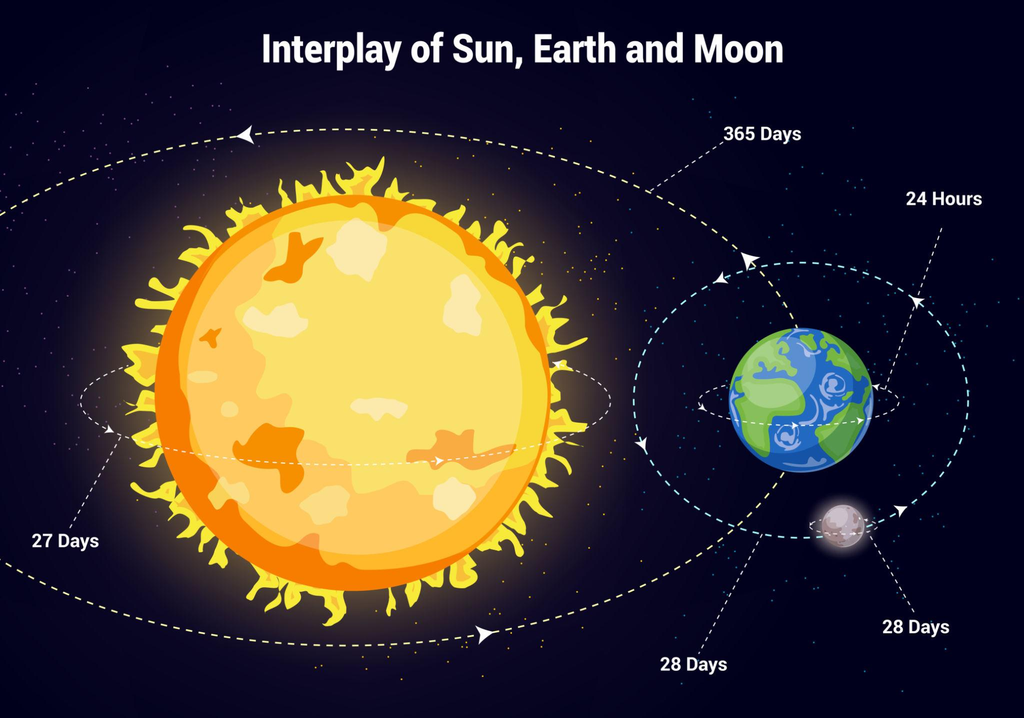
1. How Does the Moon’s Appearance Change and Why?
The Moon appears different on different nights. Sometimes it looks like a thin crescent, sometimes half of it is visible, and sometimes it appears as a complete bright circle.
The changing appearance of the Moon is called the phases of the Moon.
Why Does the Moon Change Its Shape?
The Moon does not produce its own light. It reflects the light received from the Sun.
- One half of the Moon is always illuminated by sunlight.
- The other half remains dark.
- As the Moon revolves around the Earth, we see different portions of its illuminated half.
- Therefore, the Moon appears to change its shape.
Important: The Moon does not actually change its shape. Only the portion illuminated by sunlight that we can see from Earth changes.
2. Phases of the Moon
The Moon takes approximately 29.5 days to complete one cycle of phases, from one New Moon to the next New Moon.
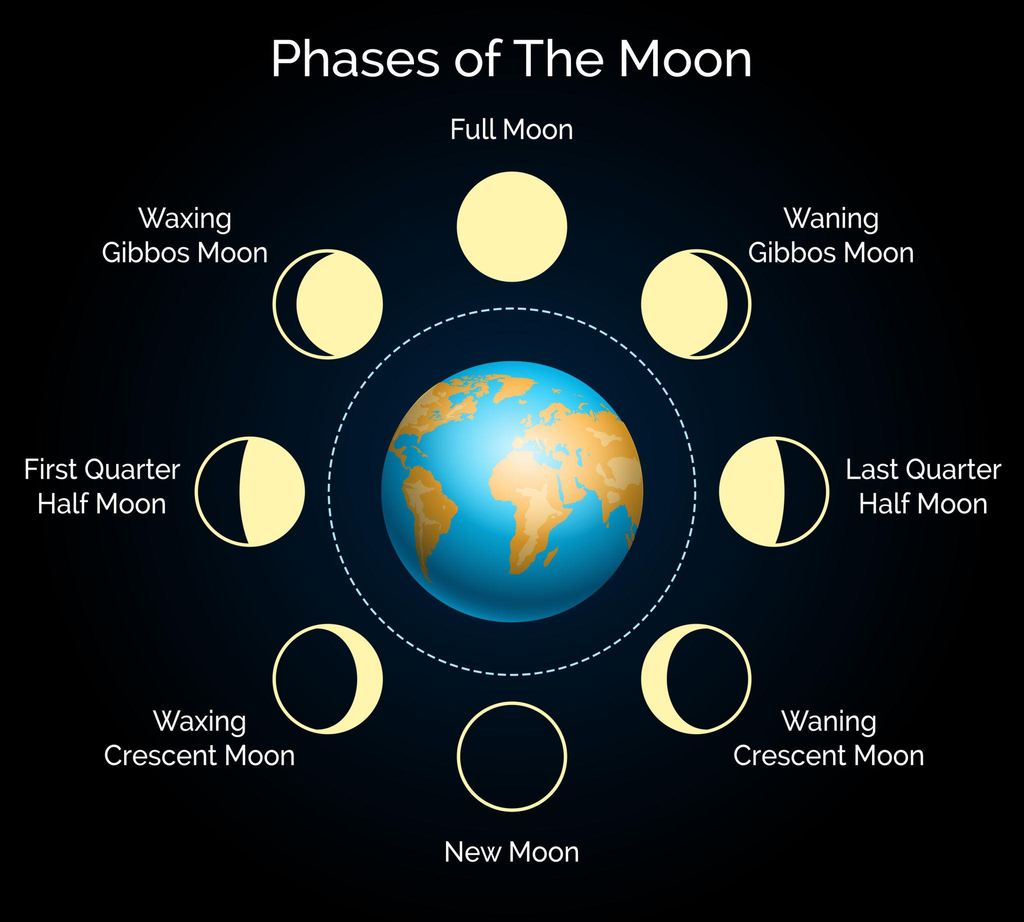
There are eight main phases of the Moon.
1. New Moon (Amavasya)
During the New Moon, the Moon is positioned approximately between the Earth and the Sun. The illuminated side faces away from Earth, so the Moon is generally not visible to us.
2. Waxing Crescent
A small curved portion of the Moon becomes visible after the New Moon. The illuminated portion gradually increases.
3. First Quarter
Approximately half of the Moon’s visible disc appears illuminated. This phase occurs during the waxing period.
4. Waxing Gibbous
More than half of the Moon’s visible surface is illuminated. The bright portion continues to increase.
5. Full Moon (Purnima)
During the Full Moon, the Earth-facing side of the Moon appears fully illuminated. The Moon looks like a bright circular disc.
6. Waning Gibbous
After the Full Moon, the illuminated portion starts decreasing, although more than half of the Moon remains visible.
7. Last or Third Quarter
Approximately half of the Moon’s visible disc is illuminated again, but the opposite half compared with the First Quarter.
8. Waning Crescent
Only a small curved portion remains visible. The illuminated portion continues decreasing until the next New Moon.
Remember the sequence:
New Moon → Waxing Crescent → First Quarter → Waxing Gibbous → Full Moon → Waning Gibbous → Third Quarter → Waning Crescent → New Moon.
3. Waxing and Waning of the Moon
The visible illuminated portion of the Moon increases and decreases during its monthly cycle.
Waxing Moon
When the illuminated portion of the Moon visible from Earth increases every day, the Moon is said to be waxing.
- It occurs between New Moon and Full Moon.
- The bright portion gradually increases.
- It is associated with Shukla Paksha in the traditional Indian lunar calendar.
Waning Moon
When the illuminated portion visible from Earth decreases every day, the Moon is said to be waning.
- It occurs between Full Moon and New Moon.
- The bright portion gradually decreases.
- It is associated with Krishna Paksha in the traditional Indian lunar calendar.
Difference between Waxing and Waning
| Waxing Moon | Waning Moon |
|---|---|
| Illuminated portion increases | Illuminated portion decreases |
| New Moon to Full Moon | Full Moon to New Moon |
| Shukla Paksha | Krishna Paksha |
4. Locating the Moon in the Sky
The Moon does not appear at exactly the same position in the sky every day.
This happens because the Moon revolves around the Earth while the Earth also rotates on its axis.
Important observations:
- On a Full Moon, the Moon is approximately opposite the Sun in the sky.
- A waxing Moon is generally easier to observe in the evening.
- A waning Moon is generally easier to observe in the morning.
- The Moon rises approximately 50 minutes later each day on average.
- The position of the Moon changes gradually because of its orbital movement.
Why Do People Around the Earth See Nearly the Same Moon Phase?
People living in different parts of the Earth generally see nearly the same phase of the Moon on a particular date.
This is because the Moon is very far from Earth compared with the size of our planet. Although different observers may see it at different times and from slightly different angles, the illuminated portion appears nearly the same.
5. How Did Calendars Come into Existence?
Before modern calendars were developed, people observed natural events to measure time.
They noticed three important repeating events:
- The Sun rises and sets every day.
- The Moon changes its appearance in a regular cycle.
- Seasons repeat after approximately one year.
These observations helped people develop the concepts of a day, month and year.
5.1 How Did We Get a Day?
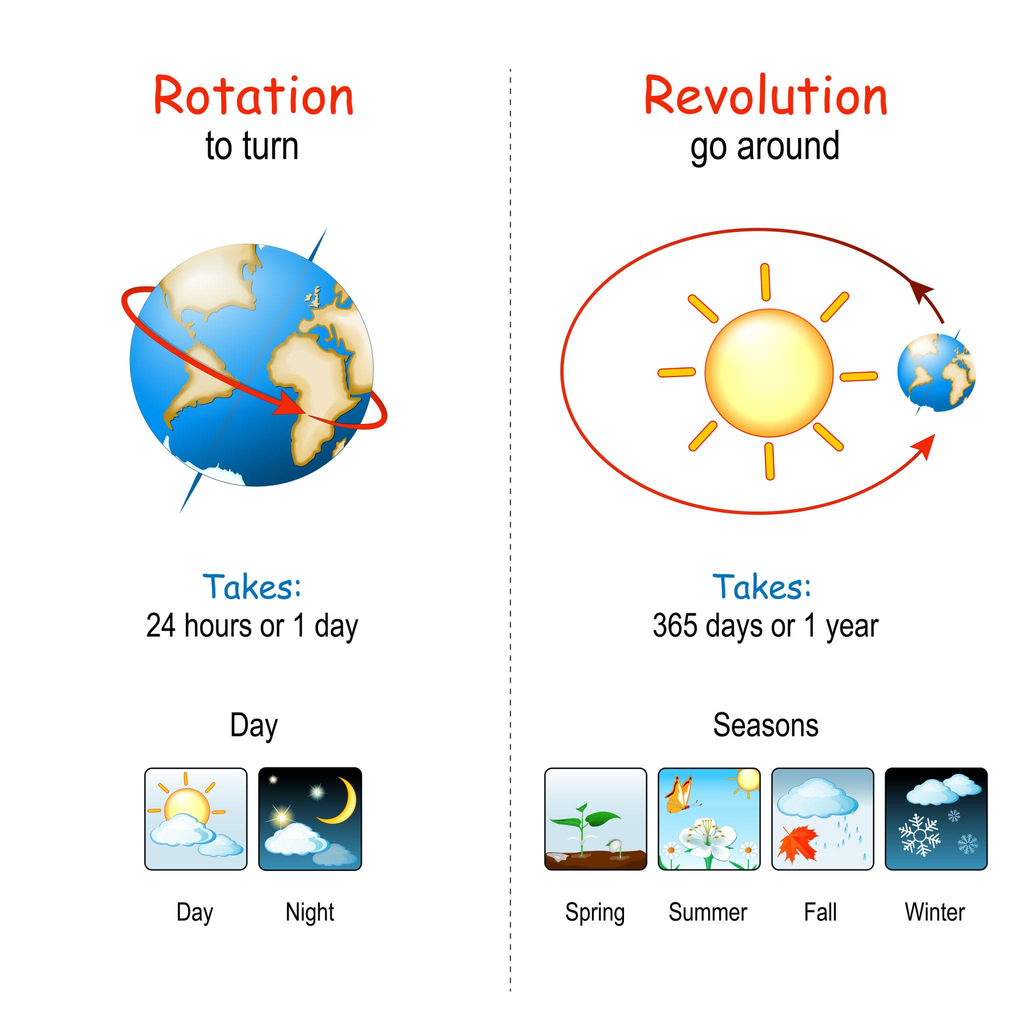
The Earth rotates on its imaginary axis.
One complete rotation takes approximately 24 hours.
Due to Earth’s rotation:
- The side facing the Sun experiences daytime.
- The side facing away from the Sun experiences nighttime.
The average time between two successive passages of the Sun across the local meridian is called a mean solar day.
Thus, Earth’s rotation forms the basis of our day.
5.2 How Did We Get a Month?
People observed that the appearance of the Moon changes regularly.
The Moon completes one cycle of phases in approximately 29.5 days.
This period became the basis for the lunar month.
5.3 How Did We Get a Year?
The Earth revolves around the Sun.
One complete revolution takes approximately 365¼ days.
During this period, the Earth experiences a complete cycle of seasons.
This period forms the basis of a year.
6. Lunar Calendar
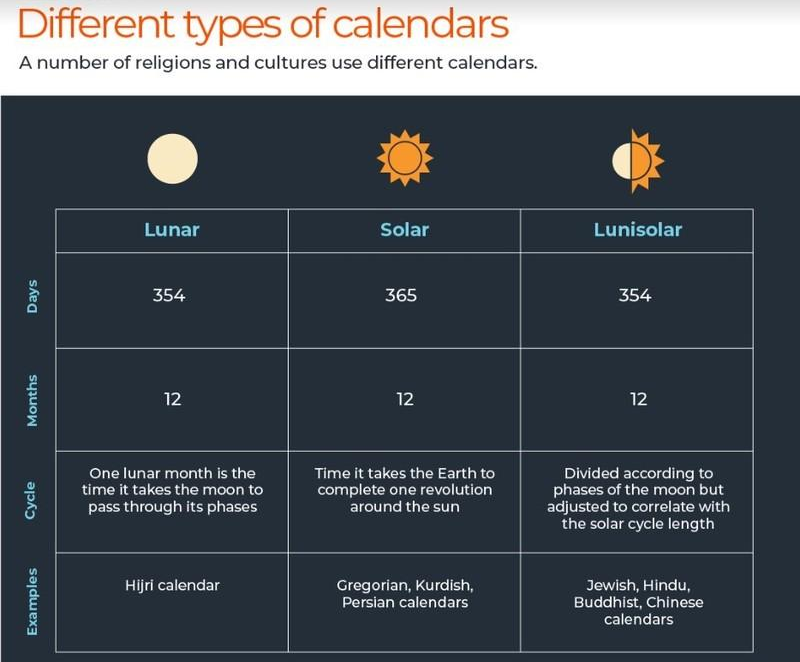
A lunar calendar is based on the phases of the Moon.
The time between two successive New Moons is approximately 29.5 days.
This period is called a lunar month.
A lunar calendar generally contains 12 lunar months.
Calculation:
- One lunar month ≈ 29.5 days
- 12 lunar months ≈ 354 days
- One solar year ≈ 365 days
Therefore, a lunar year is approximately 11 days shorter than a solar year.
Disadvantage of a Pure Lunar Calendar
Since the lunar year is shorter than the solar year, its months gradually shift through the seasons.
For example, a particular lunar month will not always occur in the same season.
7. Solar Calendar
A solar calendar is based on the Earth’s revolution around the Sun and the cycle of seasons.
The Gregorian calendar, which is commonly used around the world, is a solar calendar.
Important Features
- A normal solar year has 365 days.
- A leap year has 366 days.
- February normally has 28 days.
- February has 29 days in a leap year.
- The months have either 30 or 31 days, except February.
What Is a Tropical Year?
A tropical year is the time taken by the Earth to complete one seasonal cycle, measured between two successive vernal (spring) equinoxes.
It is approximately 365.2422 days.
The Gregorian calendar is designed to stay aligned with this seasonal cycle.
What Is a Sidereal Year?
A sidereal year is the time taken by the Earth to complete one revolution around the Sun when measured with respect to distant stars.
It is approximately 365.2564 days.
Difference Between Tropical Year and Sidereal Year
| Tropical Year | Sidereal Year |
|---|---|
| Based on seasonal cycle | Based on distant stars |
| Measured between successive vernal equinoxes | Measured relative to distant stars |
| Approximately 365.2422 days | Approximately 365.2564 days |
What Is a Leap Year?
The Earth takes approximately 365¼ days to complete one revolution around the Sun.
Our calendar normally counts only 365 days in a year. The extra quarter day accumulates over four years.
¼ + ¼ + ¼ + ¼ = 1 full day.
Therefore, one additional day is added to February approximately every four years.
A year with 366 days is called a leap year.
Leap Year Rule:
- A year divisible by 4 is generally a leap year.
- A century year must be divisible by 400 to be a leap year.
Examples:
- 2024 – Leap year
- 2025 – Not a leap year
- 2028 – Leap year
- 1900 – Not a leap year
- 2000 – Leap year
8. Luni-Solar Calendar
A luni-solar calendar combines the features of both lunar and solar calendars.
- The months are based on the Moon’s phases.
- Adjustments are made according to the Sun and seasons.
- An additional month may be introduced to keep the calendar aligned with the seasons.
Why Is an Extra Month Added?
A lunar year has approximately 354 days, whereas a solar year has approximately 365 days.
The difference is about 11 days each year.
After a few years, this difference becomes approximately one lunar month.
To correct this difference, some luni-solar calendars add an extra month called Adhika Maasa or an intercalary month.
This helps keep lunar months aligned with the seasons.
Amanta and Purnimanta Calendars
There are two traditional ways of calculating lunar months in India.
Amanta Calendar
- A month begins after the New Moon.
- It ends with the next New Moon.
Purnimanta Calendar
- A month begins after the Full Moon.
- It ends with the next Full Moon.
Both systems are used in different regions of India.
9. Our Scientific Heritage
Ancient Indian astronomers carefully observed the Sun, Moon, stars and planets.
They developed methods to calculate time, understand seasons and prepare calendars.
Uttarayan
Uttarayan refers to the apparent northward movement of the Sun in the sky from around December to June.
Dakshinayan
Dakshinayan refers to the apparent southward movement of the Sun in the sky from around June to December.
Solstices
A solstice occurs when the Sun reaches its greatest apparent northward or southward position in the sky.
- June Solstice: Around 21 June.
- December Solstice: Around 21 December.
Equinoxes
An equinox occurs when the Sun crosses the celestial equator.
During an equinox, day and night are approximately equal in length across much of the Earth.
There are two equinoxes each year:
- March Equinox
- September Equinox
Ancient Indian astronomical works such as the Surya Siddhanta contain important knowledge about astronomical calculations.
10. The Indian National Calendar
India uses the Indian National Calendar along with the Gregorian calendar for official purposes.
The Indian National Calendar is also known as the Saka Calendar.
It was recommended by the Calendar Reform Committee, chaired by Meghnad Saha.
It was adopted for official use from 22 March 1957 (corresponding to 1 Chaitra 1879 Saka Era).
Important Features
- It is a solar calendar.
- It has 12 months.
- A normal year contains 365 days.
- The first month is Chaitra.
- The normal calendar year begins on 22 March.
- During a Gregorian leap year, the calendar begins on 21 March.
- Chaitra has 30 days in a normal year and 31 days in a leap year.
- The second to sixth months have 31 days each.
- The remaining months have 30 days each.
Names of the 12 Months
- Chaitra
- Vaisakha
- Jyaistha
- Asadha
- Sravana
- Bhadra
- Asvina
- Kartika
- Agrahayana
- Pausa
- Magha
- Phalguna
11. Are Festivals Related to Astronomical Phenomena?
Yes. Many Indian festivals are associated with the movement of the Sun and the phases of the Moon.
The dates of several festivals change in the Gregorian calendar because they follow lunar or luni-solar calendars.
Examples of Festivals
Diwali
Diwali is celebrated on the New Moon day of the Kartika month in the traditional lunar calendar.
Holi
Holi is associated with the Full Moon of the Phalguna month.
Buddha Purnima
It is celebrated on the Full Moon day of the Vaisakha month.
Eid-ul-Fitr
It is celebrated after the completion of Ramadan. Its date is determined according to the Islamic lunar calendar and the sighting or calculation of the new crescent, depending on the community.
Makar Sankranti
It is associated with the Sun’s transition into Makara (Capricorn) in the sidereal zodiac.
Pongal
It is a harvest festival celebrated around the same time as Makar Sankranti.
Why Do Festival Dates Change Every Year?
Many festivals follow lunar or luni-solar calendars, whereas the Gregorian calendar follows the solar year.
Therefore, their dates may change from year to year when compared with the Gregorian calendar.
12. Natural and Artificial Satellites
A satellite is an object that revolves around a planet or another celestial body.
There are two major types of satellites.
Natural Satellites
Natural satellites are celestial bodies that naturally revolve around planets.
Examples:
- The Moon is the natural satellite of Earth.
- Phobos and Deimos are natural satellites of Mars.
Artificial Satellites
Artificial satellites are human-made objects launched into space to revolve around Earth or other celestial bodies.
They are used for communication, navigation, weather forecasting, scientific research and many other purposes.
Why Do We Launch Artificial Satellites?
Artificial satellites play an important role in modern life.
1. Communication
They help transmit television signals, telephone calls and internet services over long distances.
2. Weather Forecasting
Weather satellites observe clouds, storms, rainfall and cyclones.
3. Navigation
Navigation satellites help people determine their location and find directions.
4. Disaster Management
Satellite images help monitor floods, cyclones, forest fires and other natural disasters.
5. Scientific Research
Satellites help scientists study the Earth, Sun, Moon, planets and distant objects in space.
6. Environmental Monitoring
They help observe forests, oceans, glaciers, agricultural land and changes in the environment.
India’s Contribution to Space Science
India has made significant progress in space research through the Indian Space Research Organisation (ISRO).
Some important Indian satellites and space missions include:
- INSAT: Communication and meteorological services.
- GSAT: Communication satellites.
- CARTOSAT: Earth observation and mapping.
- AstroSat: India’s space observatory for astronomical research.
- Chandrayaan-1: India’s first lunar mission, launched in 2008.
- Chandrayaan-2: India’s lunar exploration mission.
- Aditya-L1: India’s first dedicated space-based solar observatory.
- NavIC: India’s regional satellite navigation system.
These missions have strengthened India’s contribution to space science and technology.
13. What Is Space Junk?
Space junk, also known as space debris, refers to unwanted human-made objects remaining in space.
Examples include:
- Old and non-functional satellites.
- Discarded rocket stages.
- Broken satellite parts.
- Small fragments produced by collisions.
Why Is Space Junk Dangerous?
- It can collide with working satellites.
- It can damage spacecraft.
- It increases the risk to astronauts.
- It makes space operations more difficult.
Scientists and space agencies are working to reduce and manage space debris.
14. Eclipses – An Additional Concept
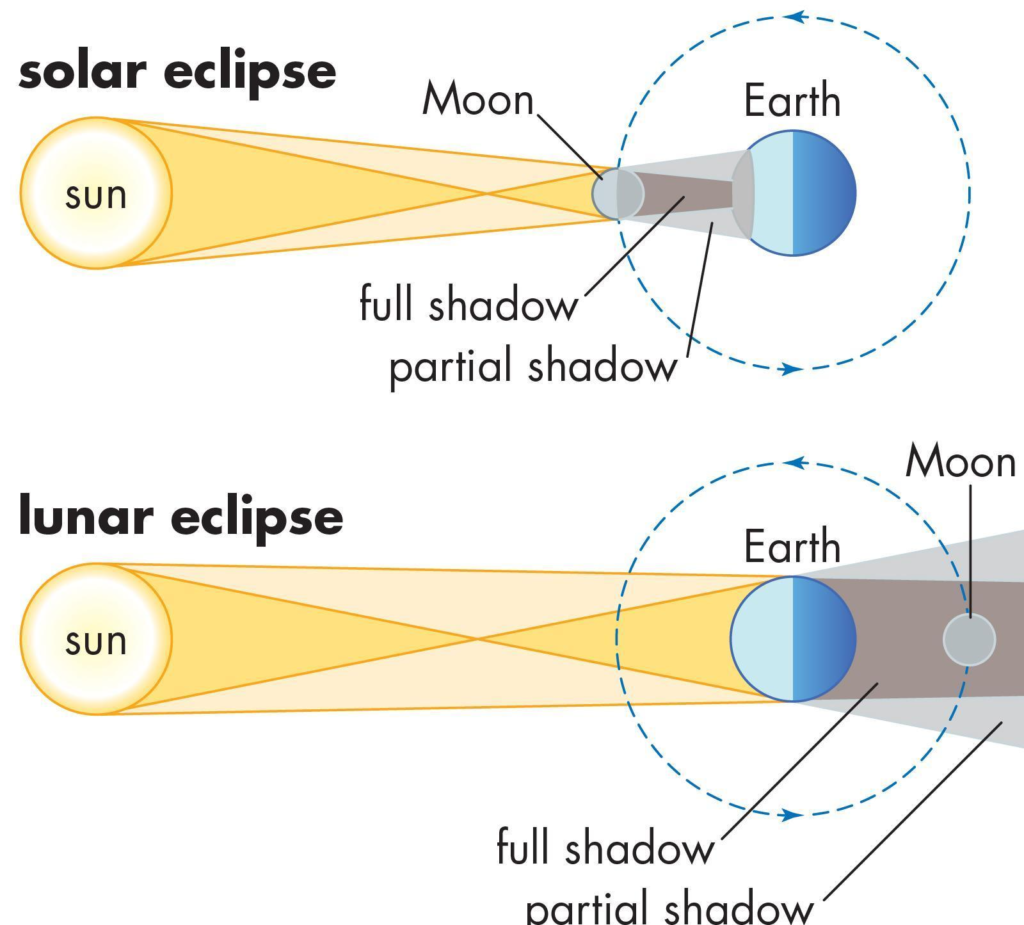
An eclipse occurs when the Sun, Earth and Moon come into a suitable alignment so that one celestial body blocks sunlight from reaching another or casts a shadow.
Solar Eclipse
A solar eclipse occurs when the Moon comes between the Sun and Earth and blocks some or all of the Sun’s light from reaching a part of Earth.
It occurs during a New Moon, when the alignment is suitable.
Important: Never look directly at the Sun during a solar eclipse without certified solar viewing protection.
Lunar Eclipse
A lunar eclipse occurs when the Earth comes between the Sun and Moon, and Earth’s shadow falls on the Moon.
It occurs during a Full Moon, when the alignment is suitable.
Difference Between Solar and Lunar Eclipse
| Solar Eclipse | Lunar Eclipse |
|---|---|
| Moon comes between Sun and Earth | Earth comes between Sun and Moon |
| Occurs at New Moon | Occurs at Full Moon |
| Moon’s shadow falls on Earth | Earth’s shadow falls on Moon |
Not every New Moon or Full Moon produces an eclipse because the Moon’s orbital plane is tilted relative to Earth’s orbital plane.
15. Important Definitions – Quick Revision
1. Celestial Bodies: Natural objects found in space, such as the Sun, Moon, stars and planets.
2. Rotation: The spinning movement of a celestial body around its own axis.
3. Revolution: The movement of one celestial body around another body.
4. Phases of the Moon: The changing appearance of the illuminated portion of the Moon as seen from Earth.
5. Waxing Moon: The Moon when its visible illuminated portion is increasing.
6. Waning Moon: The Moon when its visible illuminated portion is decreasing.
7. Lunar Calendar: A calendar based on the phases of the Moon.
8. Solar Calendar: A calendar based on Earth’s revolution around the Sun.
9. Luni-Solar Calendar: A calendar that combines lunar months with solar-year adjustments.
10. Leap Year: A year containing 366 days.
11. Adhika Maasa: An additional month inserted into certain traditional luni-solar calendars.
12. Satellite: An object that revolves around a planet or another celestial body.
13. Artificial Satellite: A human-made object launched into space for specific purposes.
14. Space Junk: Unwanted human-made objects and debris remaining in space.
15. Equinox: An event when the Sun crosses the celestial equator, making day and night approximately equal in length.
16. Solstice: An event when the Sun reaches its maximum apparent northward or southward position.
16. Important Differences for Examinations
Rotation vs Revolution
| Rotation | Revolution |
|---|---|
| Spinning around an axis | Movement around another body |
| Earth takes about 24 hours for one rotation | Earth takes about 365¼ days for one revolution around the Sun |
| Responsible for day and night | Forms the basis of the year |
Lunar vs Solar vs Luni-Solar Calendar
| Lunar Calendar | Solar Calendar | Luni-Solar Calendar |
|---|---|---|
| Based on Moon phases | Based on Earth’s revolution around Sun | Combines Moon and Sun |
| 12 months ≈ 354 days | Approximately 365 days | Adjusted to remain aligned with seasons |
| Months follow lunar cycles | Months follow solar year | Uses additional months when required |
17. Important Questions and Answers
Q1. Why does the Moon appear to change its shape?
Answer: The Moon revolves around Earth and reflects sunlight. As its position changes, we see different portions of its illuminated half. This causes the different phases of the Moon.
Q2. What is the time taken by the Moon to complete one cycle of phases?
Answer: Approximately 29.5 days.
Q3. What is meant by waxing and waning?
Answer: Waxing means an increase in the visible illuminated portion of the Moon, while waning means a decrease in the visible illuminated portion.
Q4. Why is a lunar year shorter than a solar year?
Answer: A lunar year has approximately 354 days, whereas a solar year has approximately 365 days. Therefore, the lunar year is about 11 days shorter.
Q5. What is a luni-solar calendar?
Answer: A luni-solar calendar is a calendar that uses Moon phases to calculate months and makes adjustments according to the Sun to remain aligned with seasons.
Q6. What is Adhika Maasa?
Answer: Adhika Maasa is an additional month inserted into certain traditional Indian luni-solar calendars to adjust the difference between lunar and solar years.
Q7. Why do we have leap years?
Answer: Earth takes approximately 365¼ days to revolve around the Sun. The extra quarter day accumulates over four years, so one additional day is added to February in a leap year.
Q8. What is the Indian National Calendar?
Answer: The Indian National Calendar, also known as the Saka Calendar, is India’s official national calendar. It is a solar calendar containing 12 months.
Q9. Give two examples of festivals associated with the Moon.
Answer: Diwali is associated with New Moon, while Holi is associated with Full Moon.
Q10. What is an artificial satellite?
Answer: An artificial satellite is a human-made object launched into space to revolve around Earth or another celestial body.
Q11. Mention four uses of artificial satellites.
Answer:
- Communication.
- Weather forecasting.
- Navigation.
- Disaster management.
Q12. What is space junk?
Answer: Space junk refers to unwanted human-made objects, such as old satellites and discarded rocket parts, that remain in space.
Q13. Differentiate between solar and lunar eclipses.
Answer: A solar eclipse occurs when the Moon comes between the Sun and Earth. A lunar eclipse occurs when Earth comes between the Sun and Moon.
Q14. What are solstices?
Answer: Solstices are astronomical events when the Sun reaches its greatest apparent northward or southward position in the sky.
Q15. What is an equinox?
Answer: An equinox occurs when the Sun crosses the celestial equator. Day and night are approximately equal in duration.
18. Chapter Summary – Keeping Time with the Skies
Let’s revise the most important points of this chapter:
- The Moon reflects sunlight and does not produce its own light.
- The Moon has eight main phases.
- One complete cycle of Moon phases takes approximately 29.5 days.
- Waxing means the illuminated portion increases.
- Waning means the illuminated portion decreases.
- Earth’s rotation takes approximately 24 hours.
- Earth’s revolution around the Sun takes approximately 365¼ days.
- A lunar year has approximately 354 days.
- A solar calendar is based on Earth’s revolution around the Sun.
- A luni-solar calendar combines lunar and solar cycles.
- Adhika Maasa is an additional month in certain Indian luni-solar calendars.
- The Indian National Calendar is also known as the Saka Calendar.
- Many Indian festivals are connected with lunar and solar events.
- Artificial satellites are useful for communication, weather forecasting, navigation and scientific research.
- Space junk can be dangerous to working satellites and spacecraft.
Final Words
The chapter Keeping Time with the Skies shows how carefully observing nature helped humans understand time and develop calendars.
From the changing phases of the Moon to modern artificial satellites, astronomy continues to play an important role in our everyday lives.
Students should understand the concepts, practise drawing the Moon phases and revise the differences between lunar, solar and luni-solar calendars.
Keep Learning, Keep Growing with The Study Smart!
Educational note: These are independently prepared study notes for revision and understanding. Students should also refer to their prescribed NCERT textbook and teacher’s instructions for the latest syllabus and examination requirements.