Introduction
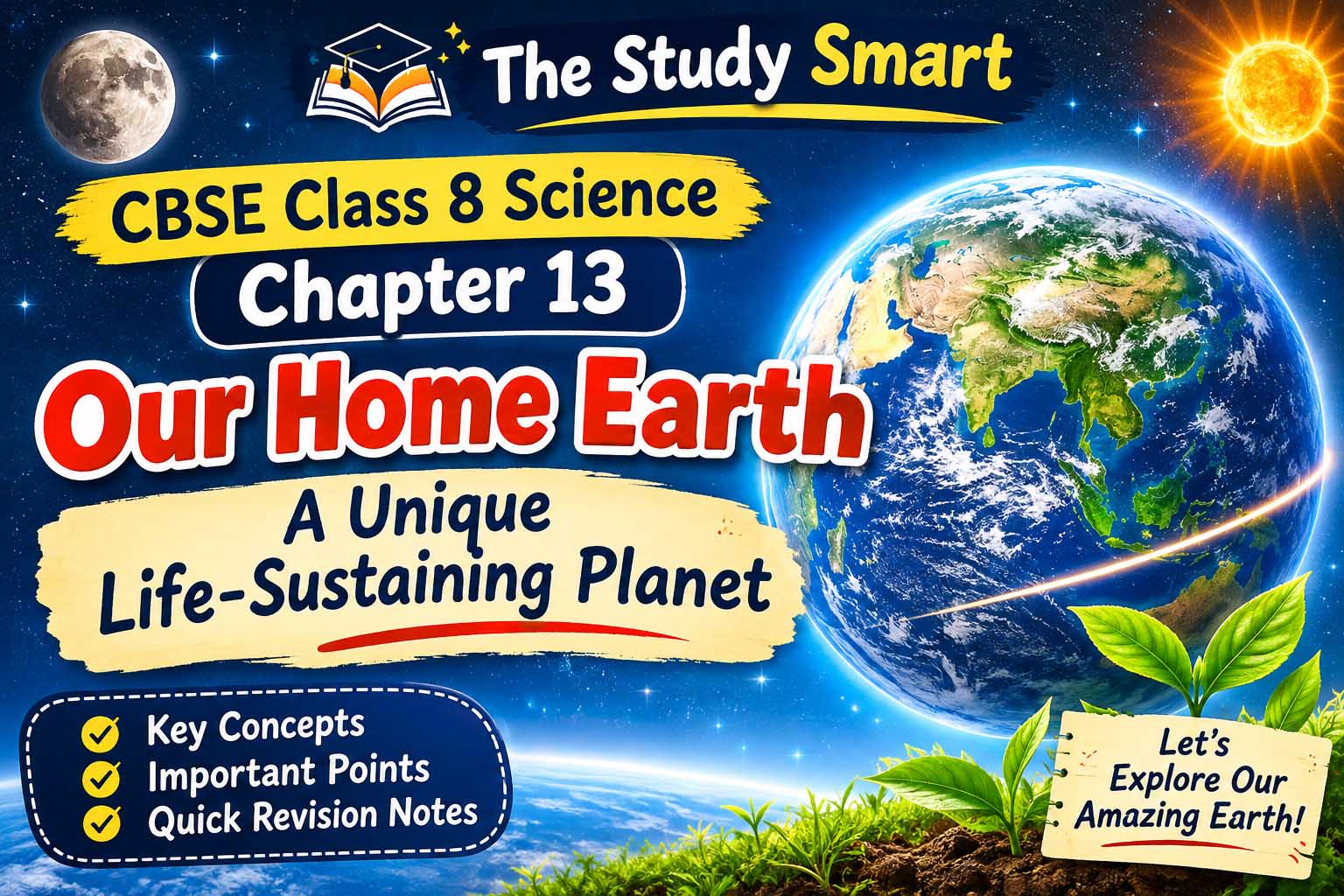
Earth is our home and the only planet known to support life. It provides everything necessary for the survival of living organisms, including air, water, sunlight, soil and a suitable temperature.
From high mountains and deep oceans to green forests and vast deserts, Earth has a variety of natural features that make it a unique planet. Unlike other planets in our solar system, Earth has the right conditions for plants, animals and human beings to survive.
In this chapter, we will learn why Earth is a life-sustaining planet, how its different natural systems work together, how living organisms reproduce, and what environmental threats we must address to protect our planet.
Table of Contents
- Earth – Our Home
- The Eight Planets of the Solar System
- The Greenhouse Effect
- Why Is Earth Suitable for Life?
- The Habitable Zone or Goldilocks Zone
- Earth’s Atmosphere, Ozone Layer and Magnetic Field
- The Four Spheres of Earth
- How Earth’s Spheres Interact
- Reproduction – Keeping Life Going
- Asexual Reproduction
- Sexual Reproduction
- Sexual Reproduction in Plants and Animals
- Threats to Life on Earth
- Ways to Protect Our Planet
- Important Definitions
- Quick Revision Notes
- Important Questions and Answers
- Multiple-Choice Questions (MCQs)
1. Earth – Our Home
Earth is the third planet from the Sun. It is the only planet known to support life.
Earth provides several essential resources required for survival:
- Air: Provides oxygen for respiration.
- Water: Essential for drinking, digestion and other life processes.
- Soil: Supports plant growth and agriculture.
- Sunlight: Provides energy for photosynthesis and helps maintain Earth’s temperature.
- Natural resources: Rocks, minerals, forests and other materials are used by living beings.
Earth’s Life-Supporting Surface
The outermost solid layer of Earth is called the crust. It is very thin compared with the entire planet.
All known life exists on or near this thin outer layer. We can compare Earth’s crust to the skin of an apple if the entire Earth is imagined as an apple.
Satellites help scientists observe Earth and study its forests, oceans, weather patterns, ocean temperatures and environmental changes.
2. The Eight Planets of the Solar System
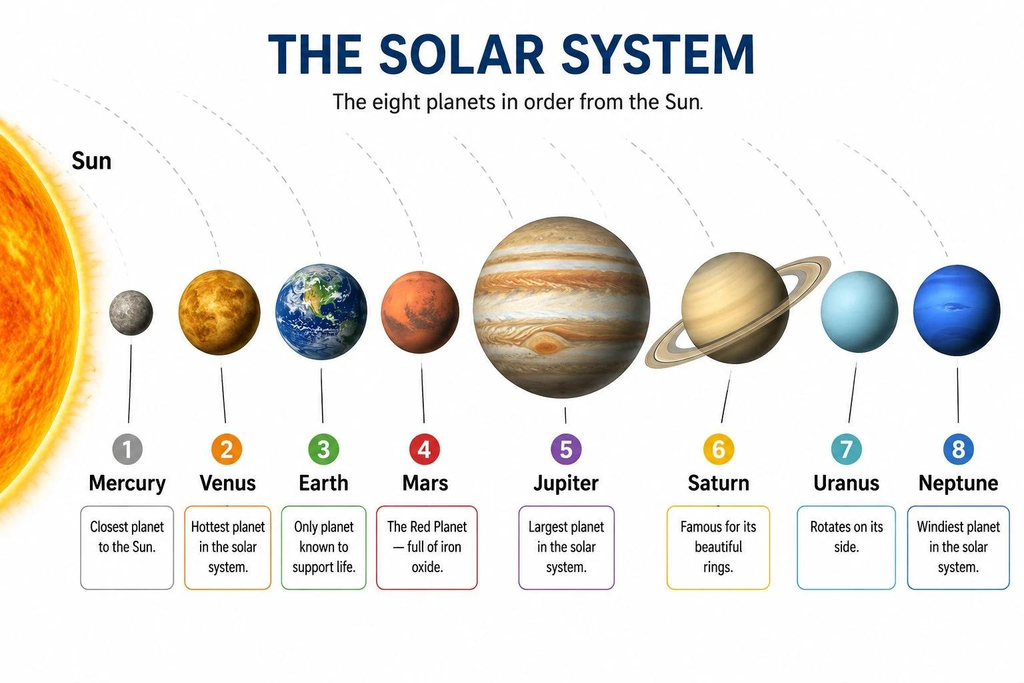
Our solar system consists of eight planets that revolve around the Sun in nearly circular orbits.
The planets in order of their distance from the Sun are:
- Mercury
- Venus
- Earth
- Mars
- Jupiter
- Saturn
- Uranus
- Neptune
Classification of Planets
The eight planets are divided into two major groups.
| Rocky Planets | Outer Giant Planets |
|---|---|
| Mercury | Jupiter |
| Venus | Saturn |
| Earth | Uranus |
| Mars | Neptune |
| Smaller and mainly rocky | Larger and mainly composed of gases and other volatile materials |
Important fact: Venus is the hottest planet in our solar system, even though Mercury is closer to the Sun.
This is because Venus has a very thick atmosphere containing a large amount of carbon dioxide, which traps heat.
3. The Greenhouse Effect
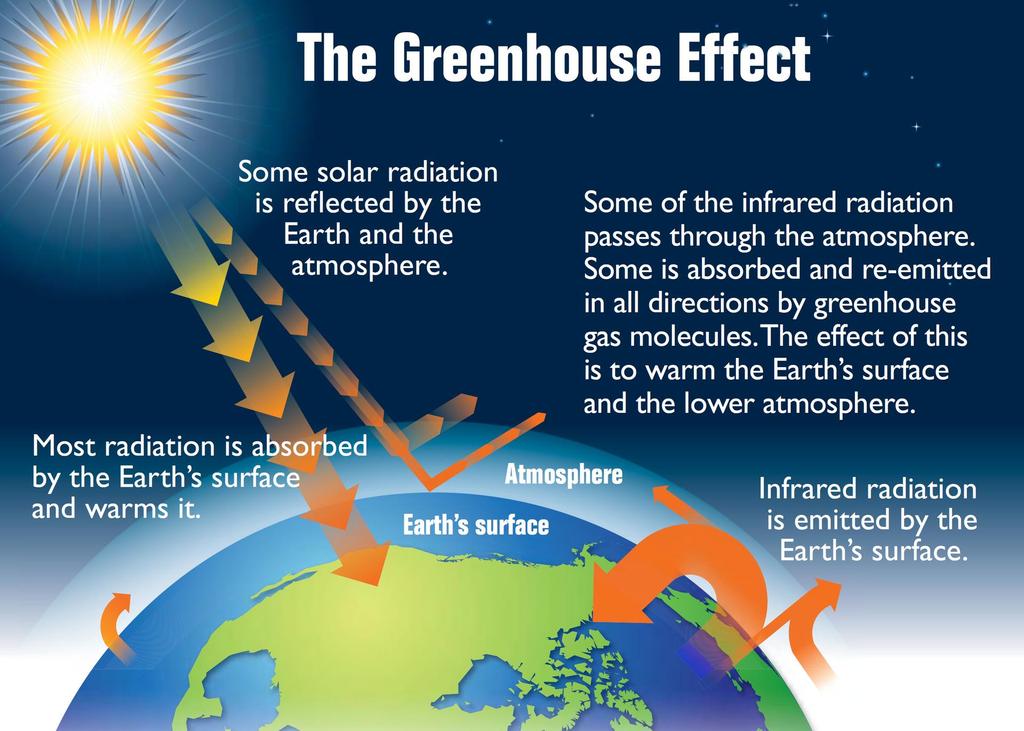
The greenhouse effect is a natural process in which certain gases in the atmosphere absorb and re-emit heat radiation, helping keep a planet warm.
How Does the Greenhouse Effect Work?
- Sunlight reaches Earth’s surface.
- Earth’s surface absorbs energy and becomes warm.
- The warmed surface releases energy as infrared radiation.
- Greenhouse gases absorb and re-emit some of this radiation.
- This process helps retain heat in the atmosphere.
Some important greenhouse gases are:
- Carbon dioxide (CO₂)
- Methane (CH₄)
- Water vapour
- Nitrous oxide (N₂O)
Importance of the Greenhouse Effect
The natural greenhouse effect helps maintain a temperature suitable for life. Without it, Earth would be much colder.
However, excessive greenhouse gases caused by human activities strengthen this effect and contribute to global warming.
Difference Between Atmospheric Greenhouse Effect and a Plant Greenhouse
| Atmospheric Greenhouse Effect | Plant Greenhouse |
|---|---|
| Caused by greenhouse gases in the atmosphere. | A structure usually made of glass or transparent material. |
| Gases absorb and re-emit infrared radiation. | The enclosed structure retains warmth by limiting heat loss. |
| Helps regulate a planet’s temperature. | Provides a warm environment for growing plants. |
4. Why Is Earth Suitable for Life?
Earth has several special features that make it suitable for life.
1. Suitable Distance from the Sun: Earth receives an appropriate amount of solar energy to maintain temperatures that allow liquid water to exist.
2. Availability of Liquid Water: Water is essential for all known forms of life. It supports biological processes and helps transport nutrients.
3. Suitable Atmosphere: Earth’s atmosphere contains oxygen for respiration and other gases that help maintain a suitable temperature.
4. Suitable Gravity: Earth’s gravity is strong enough to hold the atmosphere and water around the planet.
5. Protective Ozone Layer: The ozone layer absorbs much of the harmful ultraviolet radiation coming from the Sun.
6. Magnetic Field: Earth’s magnetic field helps protect the planet from charged particles carried by the solar wind.
7. Sunlight: Sunlight provides the energy required for photosynthesis and supports food chains.
These conditions work together to make Earth a life-sustaining planet.
5. The Habitable Zone or Goldilocks Zone
The habitable zone is the region around a star where conditions may allow liquid water to exist on a planet’s surface, provided other necessary conditions are present.
It is also called the Goldilocks Zone.
The name comes from the idea that conditions should be neither too hot nor too cold, but just right.
- If a planet is too close to its star, water may evaporate.
- If it is too far away, water may freeze.
- At a suitable distance, liquid water may exist.
Earth lies within the Sun’s habitable zone.
Is There Life on Mars?
Mars is an important planet for scientific research because scientists have found evidence that liquid water existed there in the past.
However, no confirmed evidence of life has been discovered on Mars so far.
India’s Mars Orbiter Mission, popularly known as Mangalyaan, was launched by ISRO in 2013 to study Mars and its atmosphere.
6. Earth’s Atmosphere, Ozone Layer and Magnetic Field
A. Atmosphere
The atmosphere is the blanket of gases surrounding Earth.
It is essential for life because it:
- Provides oxygen for respiration.
- Supplies carbon dioxide required by plants for photosynthesis.
- Helps regulate Earth’s temperature.
- Protects living organisms from some harmful radiation and small space objects.
Nitrogen makes up approximately 78% of dry air, while oxygen accounts for approximately 21%.
B. Ozone Layer
The ozone layer is a region of the stratosphere containing a relatively high concentration of ozone (O₃).
Its main function is to absorb much of the Sun’s harmful ultraviolet (UV) radiation.
Without this protection, living organisms would be exposed to greater levels of harmful UV radiation.
C. Earth’s Magnetic Field
Earth behaves like a giant magnet and is surrounded by a magnetic field.
The movement of electrically conducting molten material in Earth’s outer core helps generate this magnetic field.
The magnetic field:
- Deflects many charged particles from the solar wind.
- Helps protect Earth’s atmosphere.
- Provides protection against some harmful particles from space.
7. The Four Spheres of Earth
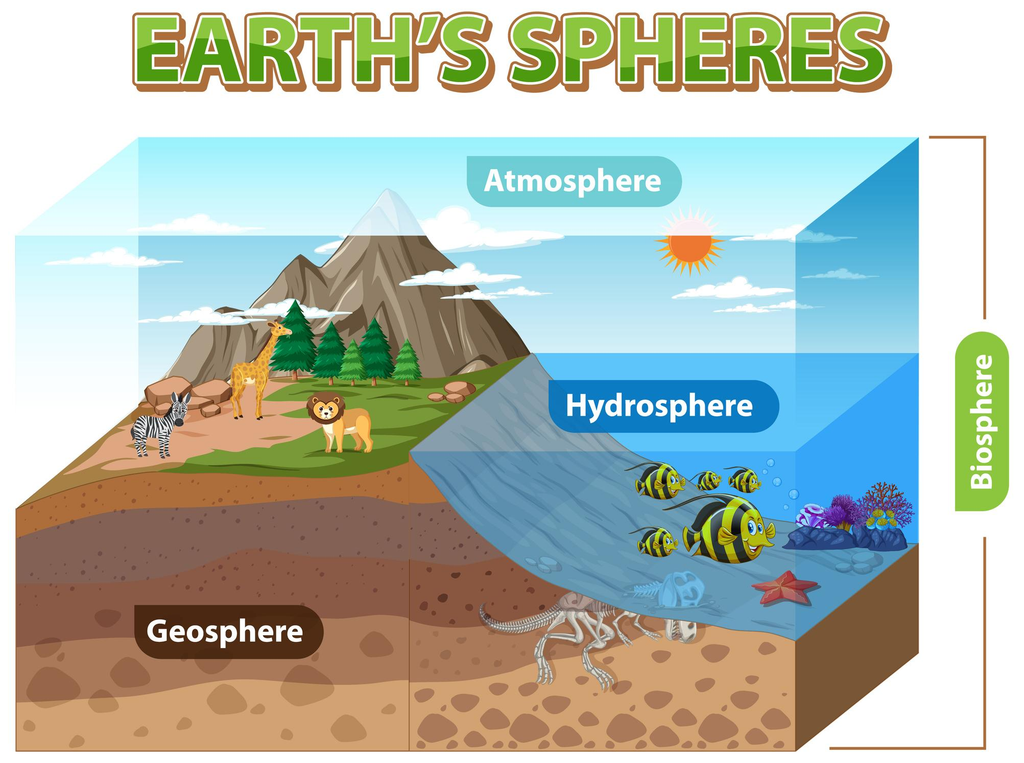
Earth consists of four interconnected natural systems known as its four spheres.
They are:
- Atmosphere
- Hydrosphere
- Geosphere
- Biosphere
A. Atmosphere
The atmosphere is the layer of gases surrounding Earth.
Examples and components:
- Oxygen
- Nitrogen
- Carbon dioxide
- Water vapour
Importance:
- Supports respiration.
- Provides carbon dioxide for photosynthesis.
- Helps maintain temperature.
- Influences weather and climate.
B. Hydrosphere
The hydrosphere includes all water present on Earth in liquid, solid and gaseous forms.
Examples:
- Oceans
- Seas
- Rivers
- Lakes
- Ponds
- Groundwater
- Glaciers
- Water vapour
Approximately 71% of Earth’s surface is covered with water.
That is why Earth appears blue when viewed from space and is known as the Blue Planet.
Importance:
- Essential for living organisms.
- Supports aquatic ecosystems.
- Helps regulate temperature.
- Transports nutrients.
- Supports agriculture.
C. Geosphere
The geosphere is the solid part of Earth. It includes rocks, soil, minerals and landforms.
Examples:
- Mountains
- Valleys
- Plains
- Rocks
- Soil
- Minerals
Importance:
- Provides land for living organisms.
- Supplies minerals and natural resources.
- Provides soil for agriculture.
- Creates different habitats.
The variety of landforms, rocks and soils is called geodiversity.
D. Biosphere
The biosphere includes all living organisms and the parts of Earth where they exist.
Examples:
- Plants
- Animals
- Human beings
- Bacteria
- Fungi
- Other microorganisms
Importance:
- Supports biodiversity.
- Maintains food chains.
- Helps recycle nutrients.
- Maintains ecological balance.
Comparison of Earth’s Four Spheres
| Sphere | Meaning | Examples |
|---|---|---|
| Atmosphere | Layer of gases | Oxygen, nitrogen, air |
| Hydrosphere | All water on Earth | Oceans, rivers, lakes |
| Geosphere | Solid part of Earth | Rocks, soil, minerals |
| Biosphere | Living organisms and their habitats | Plants, animals, humans |
8. How Do Earth’s Spheres Interact to Sustain Life?
Earth’s four spheres are interconnected. They do not function independently.
A change in one sphere can affect the other three.
Examples of Interaction
1. Plants and the Atmosphere
Plants absorb carbon dioxide from the atmosphere and release oxygen during photosynthesis.
2. Plants and the Hydrosphere
Plants absorb water from the soil to prepare food.
3. Hydrosphere and Atmosphere
Water evaporates from oceans, rivers and lakes, forms clouds and returns to Earth as precipitation.
4. Geosphere and Biosphere
Plants grow in soil and obtain essential minerals and nutrients from it.
5. Decomposers and Soil
Bacteria and fungi break down dead plants and animals and return nutrients to the soil.
Example: What Happens When Forests Are Destroyed?
Deforestation affects all four spheres:
- Atmosphere: Carbon dioxide levels may increase and local climate patterns may change.
- Hydrosphere: Water movement and rainfall patterns may be disturbed.
- Geosphere: Soil erosion increases.
- Biosphere: Animals and plants lose their natural habitats.
This shows that maintaining a balance among Earth’s spheres is essential for sustaining life.
9. Reproduction – Keeping Life Going
Reproduction is the biological process through which living organisms produce new individuals of their own kind.
It is essential because it ensures the continuity of life from one generation to the next.
During reproduction, genetic information is passed from parents to offspring.
Genetic information is stored in DNA and carries instructions that influence the development and characteristics of organisms.
There are two main types of reproduction:
- Asexual reproduction
- Sexual reproduction
10. Asexual Reproduction
Asexual reproduction is a type of reproduction in which a single parent produces offspring without the fusion of male and female gametes.
The offspring are generally genetically very similar to the parent.
Characteristics of Asexual Reproduction
- Only one parent is required.
- Fusion of gametes does not take place.
- It usually occurs quickly.
- Offspring are genetically very similar to the parent.
Examples of Asexual Reproduction
1. Binary Fission
In binary fission, one parent cell divides into two daughter cells.
Examples: Amoeba and many bacteria.
2. Budding
A small outgrowth called a bud develops on the parent organism and eventually separates to form a new individual.
Example: Hydra.
3. Vegetative Propagation
New plants develop from vegetative parts such as roots, stems or leaves.
Examples:
- Potato
- Ginger
- Money Plant
4. Fragmentation and Regeneration
Some organisms can produce new individuals from body fragments. Regeneration is the ability to regrow lost or damaged body parts; in certain organisms, a fragment can develop into a complete individual.
Example: Planaria.
11. Sexual Reproduction
Sexual reproduction involves the fusion of male and female gametes to form a zygote.
The offspring receive genetic information from both parents.
Characteristics of Sexual Reproduction
- Usually involves two parents.
- Male and female gametes are involved.
- Fertilisation takes place.
- Offspring show genetic variation.
- It helps introduce new combinations of characteristics.
Gametes
Gametes are specialised reproductive cells that carry genetic material.
| Male Gamete | Female Gamete |
|---|---|
| Sperm in animals | Egg or ovum in animals |
| Pollen carries the male reproductive cells in flowering plants | Egg cell is present in the ovule |
When the male and female gametes fuse, fertilisation takes place and a zygote is formed.
What Is a Zygote?
A zygote is the first cell formed after the fusion of male and female gametes.
It develops through repeated cell division and eventually forms a new organism.
Difference Between Asexual and Sexual Reproduction
| Asexual Reproduction | Sexual Reproduction |
|---|---|
| Usually involves one parent. | Usually involves two parents. |
| No fusion of gametes. | Fusion of male and female gametes occurs. |
| Offspring are generally genetically very similar to the parent. | Offspring show genetic variation. |
| Usually faster and simpler. | Generally involves more complex processes. |
| Examples: Amoeba, Hydra, Potato. | Examples: Humans, birds and flowering plants. |
12. Sexual Reproduction in Plants and Animals
A. Sexual Reproduction in Flowering Plants
Flowers are the reproductive structures of flowering plants.
The important parts involved in reproduction are:
Male Reproductive Part – Stamen
It consists of:
- Anther
- Filament
The anther produces pollen grains, which contain the male reproductive cells.
Female Reproductive Part – Pistil or Carpel
It consists of:
- Stigma
- Style
- Ovary
The ovary contains ovules, which contain the female reproductive cells.
Steps Involved in Sexual Reproduction in Plants
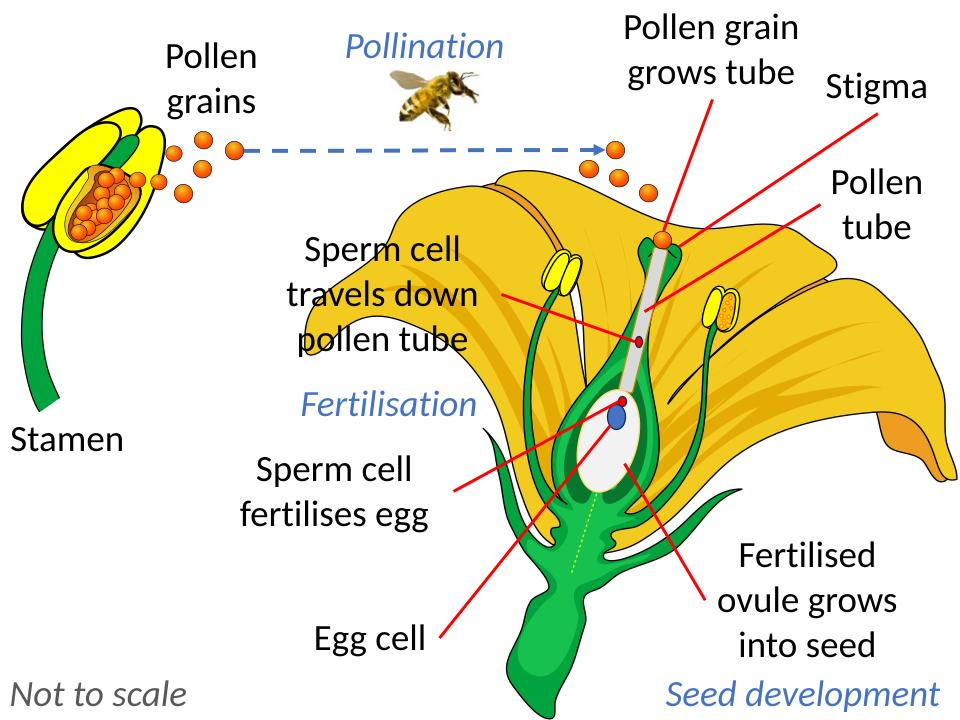
Step 1: Pollination
Pollination is the transfer of pollen grains from the anther to the stigma of a flower.
It may occur through:
- Wind
- Water
- Insects
- Birds and other animals
Step 2: Fertilisation
After pollination, a pollen tube grows towards the ovule. The male reproductive cell reaches the female reproductive cell and fuses with it.
This process is called fertilisation.
Step 3: Formation of Zygote
The fusion of male and female gametes forms a zygote.
Step 4: Formation of Seed and Fruit
After fertilisation:
- The ovule develops into a seed.
- The ovary generally develops into a fruit.
Step 5: Germination
Under suitable conditions of water, air and temperature, a seed germinates and develops into a new plant.
B. Sexual Reproduction in Animals
In animals, sexual reproduction generally involves the fusion of sperm and egg cells.
The process differs among animal groups.
External Fertilisation
In external fertilisation, the male and female gametes fuse outside the female’s body, usually in water.
Examples: Many fish and frogs.
Internal Fertilisation
In internal fertilisation, the male and female gametes fuse inside the female’s body.
Examples: Birds, reptiles and mammals.
In birds, the embryo develops inside an egg outside the mother’s body.
In most mammals, the embryo develops inside the mother’s body until birth.
13. Threats to Life on Earth
Earth is facing several environmental challenges due to natural processes and human activities.
Three major environmental challenges are collectively called the Triple Planetary Crisis.
They are:
- Climate change
- Biodiversity loss
- Pollution
A. Climate Change
Climate change refers to long-term changes in temperature, rainfall and other weather patterns.
Human activities such as burning fossil fuels, deforestation and industrial emissions increase greenhouse gases in the atmosphere.
Effects of Climate Change:
- Rising global temperatures.
- Melting glaciers and ice sheets.
- Rising sea levels.
- Extreme weather events.
- Changes in rainfall patterns.
- Threats to agriculture and wildlife.
B. Biodiversity Loss
Biodiversity refers to the variety of living organisms found on Earth.
Biodiversity loss occurs when plant and animal species decline or disappear.
Major Causes:
- Deforestation.
- Habitat destruction.
- Hunting and poaching.
- Pollution.
- Climate change.
- Overexploitation of natural resources.
Effects:
- Disturbance of food chains.
- Extinction of species.
- Loss of ecosystem balance.
- Reduction in natural resources.
C. Pollution
Pollution is the introduction of harmful substances into the environment.
There are different types of pollution.
| Type | Meaning | Example |
|---|---|---|
| Air Pollution | Contamination of air | Smoke from vehicles and factories |
| Water Pollution | Contamination of water | Industrial waste in rivers |
| Soil Pollution | Contamination of soil | Excessive chemicals and plastic waste |
| Noise Pollution | Excessive unwanted sound | Traffic and loudspeakers |
Pollution harms humans, animals, plants and ecosystems.
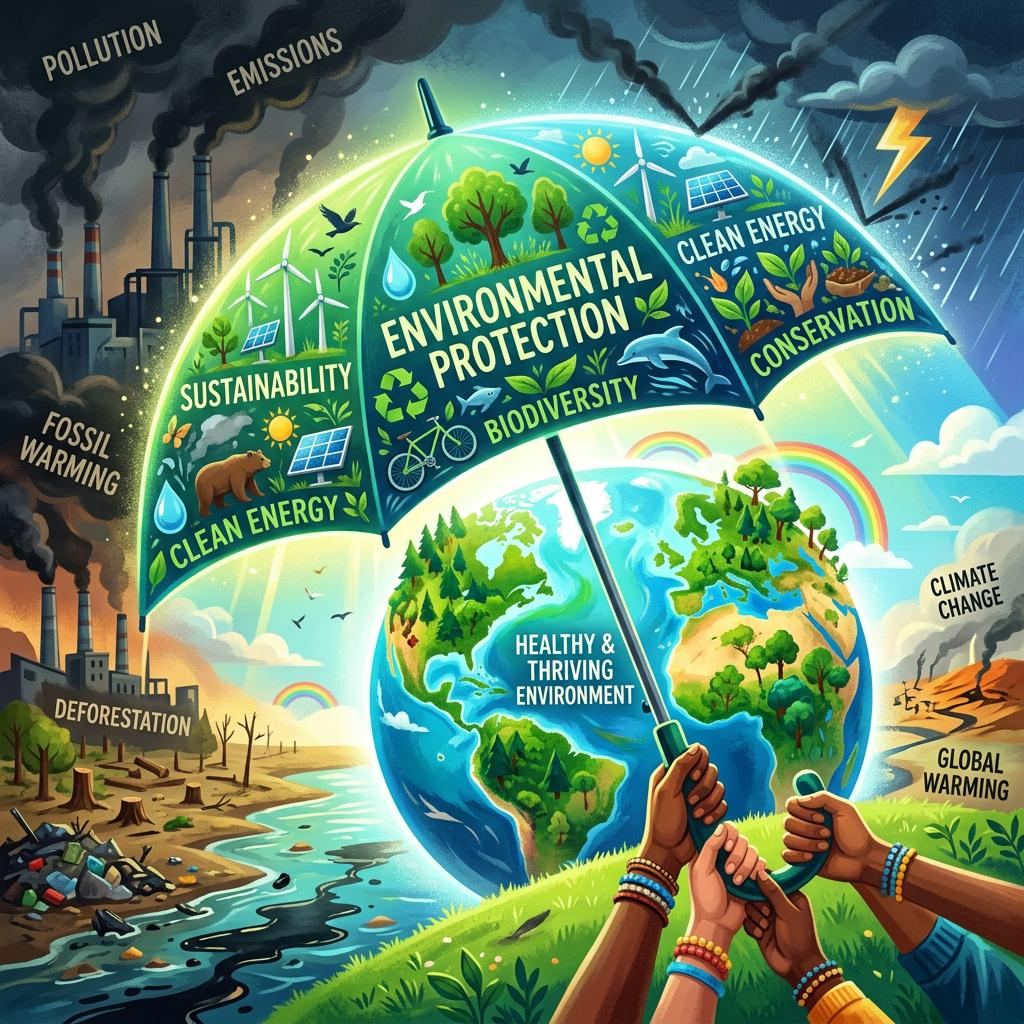
14. Ways to Protect Our Planet
Every individual has a responsibility to protect Earth.
We can help by following these practices:
- Plant more trees and protect forests.
- Save water and avoid unnecessary wastage.
- Reduce the use of single-use plastics.
- Follow the 3Rs – Reduce, Reuse and Recycle.
- Save electricity and use energy efficiently.
- Prefer renewable energy sources such as solar and wind energy.
- Use public transport, cycling or walking whenever possible.
- Keep rivers, lakes and other water bodies clean.
- Protect wildlife and natural habitats.
- Spread awareness about environmental conservation.
Remember: Small actions by individuals, when practised collectively, can make a significant difference to the future of our planet.
15. Important Definitions
| Term | Definition |
|---|---|
| Atmosphere | The layer of gases surrounding Earth. |
| Hydrosphere | All water present on Earth. |
| Geosphere | The solid part of Earth, including rocks, soil and minerals. |
| Biosphere | All living organisms and the regions where they exist. |
| Greenhouse Effect | The process in which atmospheric gases absorb and re-emit heat radiation. |
| Habitable Zone | The region around a star where conditions may allow liquid water on a planet’s surface. |
| Ozone Layer | A region of the atmosphere containing ozone that absorbs much of the Sun’s harmful UV radiation. |
| Magnetic Field | The region around Earth where its magnetic influence acts. |
| Geodiversity | The variety of landforms, rocks and soils. |
| Photosynthesis | The process by which green plants prepare food using sunlight, carbon dioxide and water. |
| Reproduction | The biological process through which organisms produce offspring. |
| Asexual Reproduction | Reproduction involving one parent without the fusion of gametes. |
| Sexual Reproduction | Reproduction involving the fusion of male and female gametes. |
| Gametes | Specialised reproductive cells. |
| Fertilisation | Fusion of male and female gametes. |
| Zygote | The first cell formed after fertilisation. |
| Pollination | Transfer of pollen grains from anther to stigma. |
| Climate Change | Long-term changes in temperature and weather patterns. |
| Biodiversity | Variety of living organisms in an area or on Earth. |
| Global Warming | The long-term rise in Earth’s average surface temperature, mainly driven by increased greenhouse gases. |
16. Quick Revision Notes
Revise these important points before your examination.
- Earth is the third planet from the Sun.
- Earth is the only planet currently known to support life.
- There are eight planets in our solar system.
- Venus is the hottest planet because of its thick carbon-dioxide-rich atmosphere.
- The greenhouse effect helps maintain Earth’s temperature.
- Earth lies in the Sun’s habitable zone.
- Earth is called the Blue Planet because approximately 71% of its surface is covered with water.
- The ozone layer absorbs much of the harmful ultraviolet radiation.
- Earth’s magnetic field helps protect it from charged particles from space.
- The four spheres are atmosphere, hydrosphere, geosphere and biosphere.
- Reproduction ensures the continuity of life.
- Asexual reproduction generally involves one parent.
- Sexual reproduction involves the fusion of male and female gametes.
- Pollination is followed by fertilisation in flowering plants.
- The zygote develops into a new organism.
- Climate change, biodiversity loss and pollution form the Triple Planetary Crisis.
17. Important Questions and Answers
Very Short Answer Questions (1 Mark)
Q1. Which planet is known as the Blue Planet?
Ans. Earth is known as the Blue Planet because approximately 71% of its surface is covered with water.
Q2. Which is the hottest planet in our solar system?
Ans. Venus is the hottest planet in our solar system.
Q3. What is the habitable zone?
Ans. The habitable zone is the region around a star where conditions may allow liquid water to exist on a planet’s surface.
Q4. Name the four spheres of Earth.
Ans. Atmosphere, hydrosphere, geosphere and biosphere.
Q5. What is a zygote?
Ans. A zygote is the first cell formed by the fusion of male and female gametes.
Q6. What is pollination?
Ans. Pollination is the transfer of pollen grains from the anther to the stigma of a flower.
Q7. Name two examples of asexual reproduction.
Ans. Binary fission in Amoeba and budding in Hydra.
Q8. What is the main function of the ozone layer?
Ans. It absorbs much of the harmful ultraviolet radiation from the Sun.
Short Answer Questions (2–3 Marks)
Q9. Why is Earth considered a unique planet?
Ans. Earth is considered unique because it has suitable temperature conditions, liquid water, a life-supporting atmosphere, appropriate gravity and a protective magnetic field. These conditions allow a wide variety of living organisms to survive.
Q10. Why is Venus hotter than Mercury?
Ans. Although Mercury is closer to the Sun, Venus is hotter because it has a thick atmosphere rich in carbon dioxide. This atmosphere traps heat through the greenhouse effect.
Q11. Explain the importance of the atmosphere.
Ans. The atmosphere:
- Provides oxygen for respiration.
- Supplies carbon dioxide for photosynthesis.
- Helps regulate Earth’s temperature.
- Protects living organisms from some harmful radiation.
Q12. What is the difference between asexual and sexual reproduction?
Ans. Asexual reproduction generally involves one parent and does not require the fusion of gametes. Sexual reproduction involves the fusion of male and female gametes and usually produces offspring with genetic variations.
Q13. How does Earth’s magnetic field protect life?
Ans. Earth’s magnetic field deflects many charged particles coming from the Sun and outer space. This helps protect the atmosphere and living organisms.
Q14. What is the Triple Planetary Crisis?
Ans. The Triple Planetary Crisis refers to three major environmental challenges:
- Climate change.
- Biodiversity loss.
- Pollution.
Long Answer Questions (4–5 Marks)
Q15. Explain the four spheres of Earth with examples.
Ans. Earth consists of four interconnected spheres:
- Atmosphere: The layer of gases surrounding Earth.
- Hydrosphere: All water present on Earth, including oceans, rivers and groundwater.
- Geosphere: The solid part of Earth, including soil, rocks and minerals.
- Biosphere: All living organisms and the areas where they live.
These spheres interact with one another to maintain the conditions necessary for life.
Q16. Explain how the four spheres interact to support life.
Ans. The four spheres work together in several ways. Plants absorb carbon dioxide from the atmosphere and water from the hydrosphere to prepare food. They obtain nutrients from the geosphere. Animals depend on plants and other animals for food. Decomposers break down dead organisms and return nutrients to the soil. These interactions maintain ecological balance.
Q17. Explain sexual reproduction in flowering plants.
Ans. Sexual reproduction in flowering plants takes place through the following stages:
- The anther produces pollen grains.
- Pollination transfers pollen grains to the stigma.
- A pollen tube grows towards the ovule.
- The male reproductive cell fuses with the female reproductive cell.
- A zygote is formed.
- The ovule develops into a seed and the ovary generally develops into a fruit.
- Under suitable conditions, the seed germinates into a new plant.
Q18. Explain the three major threats to life on Earth.
Ans. The three major threats are:
- Climate Change: Long-term changes in temperature and weather patterns, mainly intensified by human activities.
- Biodiversity Loss: Reduction in the variety of living organisms due to habitat destruction, pollution and other factors.
- Pollution: Contamination of air, water and soil by harmful substances.
These threats disturb ecological balance and endanger living organisms.
Q19. How can we protect Earth from environmental damage?
Ans. We can protect Earth by planting trees, conserving water, reducing plastic use, recycling waste, saving electricity, using renewable energy, protecting wildlife and preventing pollution.
18. Multiple-Choice Questions (MCQs)
1. Which planet is the third planet from the Sun?
A. Venus
B. Earth
C. Mars
D. Jupiter
Answer: B. Earth
2. Which planet is the hottest in the solar system?
A. Mercury
B. Mars
C. Venus
D. Jupiter
Answer: C. Venus
3. Which gas is mainly responsible for the enhanced greenhouse effect due to fossil fuel burning?
A. Oxygen
B. Carbon dioxide
C. Hydrogen
D. Helium
Answer: B. Carbon dioxide
4. Which sphere includes all the water on Earth?
A. Atmosphere
B. Biosphere
C. Hydrosphere
D. Geosphere
Answer: C. Hydrosphere
5. Which sphere includes rocks and minerals?
A. Geosphere
B. Biosphere
C. Atmosphere
D. Hydrosphere
Answer: A. Geosphere
6. What is the main function of the ozone layer?
A. Producing oxygen
B. Blocking much of the harmful UV radiation
C. Producing rain
D. Increasing gravity
Answer: B. Blocking much of the harmful UV radiation
7. Which organism reproduces through budding?
A. Hydra
B. Human
C. Fish
D. Bird
Answer: A. Hydra
8. Which process involves the fusion of male and female gametes?
A. Pollination
B. Germination
C. Fertilisation
D. Photosynthesis
Answer: C. Fertilisation
9. What is the first cell formed after fertilisation called?
A. Embryo
B. Zygote
C. Gamete
D. Seed
Answer: B. Zygote
10. Which of the following is NOT part of the Triple Planetary Crisis?
A. Climate change
B. Biodiversity loss
C. Pollution
D. Photosynthesis
Answer: D. Photosynthesis
Conclusion
Earth is a remarkable planet that provides all the essential conditions for life as we know it. Its atmosphere, water, land, magnetic field and living organisms work together to maintain a delicate environmental balance.
However, climate change, biodiversity loss and pollution are putting this balance at risk.
Protecting Earth is not just the responsibility of governments or environmental organisations. Every individual, including students, can contribute by adopting environmentally responsible habits.
Let us remember: Earth is our only home. Protecting it means protecting our future.
Study regularly, understand the concepts and keep learning with The Study Smart!