Introduction
Acids, Bases and Salts is one of the most important chapters in CBSE Class 10 Science. This chapter introduces students to the chemical nature of everyday substances and explains how acids and bases react with different materials to form new substances.
From the sour taste of lemon juice to the cleaning action of soap, from the use of baking soda in cooking to the importance of pH in our digestive system, acids, bases and salts are closely connected with our daily lives.
In this chapter, students will learn about the properties of acids and bases, chemical indicators, reactions of acids with metals and carbonates, the pH scale, neutralisation reactions and the preparation and uses of important salts such as baking soda, washing soda and bleaching powder.
These Class 10 Science Chapter 2 notes on Acids, Bases and Salts are designed to explain every important concept in simple language, with balanced chemical equations, examples, tables and examination-oriented questions.
Chapter Contents
- Understanding Acids and Bases
- Chemical Properties of Acids
- What Happens When Acids React with Metals?
- Reaction of Acids with Metal Carbonates and Hydrogen Carbonates
- Reaction of Acids with Metal Oxides
- Chemical Properties of Bases
- Reaction of Bases with Metals
- Reaction of Non-Metal Oxides with Bases
- What Is an Indicator?
- Reaction Between Acids and Bases – Neutralisation
- What Do All Acids and Bases Have in Common?
- Strength of Acids and Bases – The pH Scale
- Importance of pH in Everyday Life
- Salts and Their Properties
- Important Chemicals from Common Salt
- Water of Crystallisation
- Important Chemical Equations
- Important Questions and Answers
- Quick Revision Notes
1. Understanding Acids and Bases
We come across many substances in our daily lives that have different tastes and properties. Lemon juice tastes sour, soap solution feels slippery, and baking soda is commonly used in cooking.
These substances can be classified into two major groups: acids and bases.
What Are Acids?
Acids are substances that produce hydrogen ions (H⁺) when dissolved in water. More precisely, these hydrogen ions exist as hydronium ions (H₃O⁺) in aqueous solutions.
Examples of common acids:
| Acid | Chemical Formula | Common Source |
|---|---|---|
| Hydrochloric acid | HCl | Gastric juice |
| Sulphuric acid | H₂SO₄ | Batteries |
| Nitric acid | HNO₃ | Industrial chemicals |
| Acetic acid | CH₃COOH | Vinegar |
| Citric acid | C₆H₈O₇ | Lemon and oranges |
| Tartaric acid | C₄H₆O₆ | Tamarind and grapes |
| Lactic acid | C₃H₆O₃ | Curd |
Characteristics of Acids
- Acids generally have a sour taste.
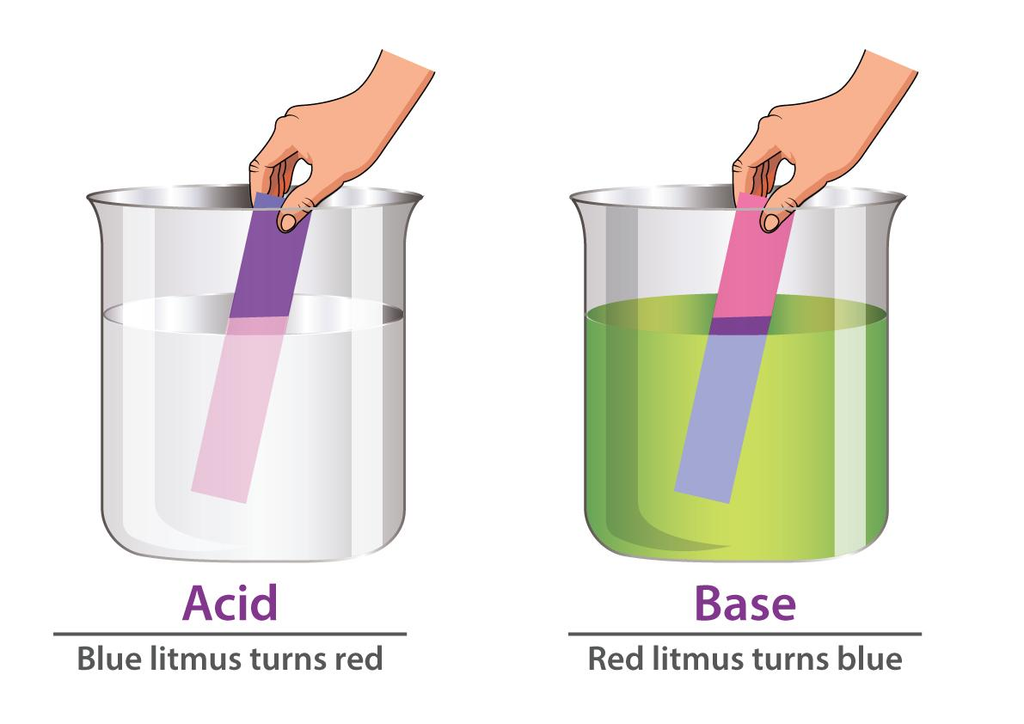
- They turn blue litmus paper red.
- They react with certain metals to release hydrogen gas.
- They react with metal carbonates to release carbon dioxide.
- Their aqueous solutions conduct electricity because they contain ions.
- They have a pH value below 7 at 25°C.
Important: Never taste laboratory acids or chemicals. Many acids are corrosive and can cause serious injuries.
What Are Bases?
Bases are substances that neutralise acids. According to the Arrhenius concept, bases produce hydroxide ions (OH⁻) in aqueous solutions.
A base that dissolves in water is called an alkali.
Examples of common bases:
| Base | Chemical Formula | Common Use |
|---|---|---|
| Sodium hydroxide | NaOH | Soap manufacturing |
| Potassium hydroxide | KOH | Manufacturing soft soaps |
| Calcium hydroxide | Ca(OH)₂ | Whitewashing |
| Magnesium hydroxide | Mg(OH)₂ | Antacid |
| Ammonium hydroxide | NH₄OH | Cleaning solutions |
Characteristics of Bases
- Bases generally have a bitter taste.
- They feel slippery or soapy to touch.
- They turn red litmus paper blue.
- They neutralise acids to form salt and water.
- Their aqueous solutions conduct electricity if ions are present.
- Their pH value is greater than 7 at 25°C.
Important: Never touch or taste laboratory bases. Strong bases can cause severe chemical burns.
Difference Between Acids and Bases
| Acids | Bases |
|---|---|
| Generally sour in taste | Generally bitter in taste |
| Turn blue litmus red | Turn red litmus blue |
| Produce H⁺ ions in water | Produce OH⁻ ions in water |
| pH is less than 7 | pH is greater than 7 |
| Neutralise bases | Neutralise acids |
2. Chemical Properties of Acids
Acids show several important chemical properties. Their reactions with metals, metal carbonates, metal hydrogen carbonates and metal oxides are particularly important for CBSE examinations.
2.1 Reaction of Acids with Metals
When an acid reacts with a reactive metal, a salt and hydrogen gas are generally produced.
General Reaction:
Metal + Acid → Salt + Hydrogen Gas
Example 1: Reaction of zinc with dilute sulphuric acid
Zn + H₂SO₄ → ZnSO₄ + H₂↑
In this reaction:
- Zinc reacts with dilute sulphuric acid.
- Zinc sulphate is formed.
- Hydrogen gas is released.
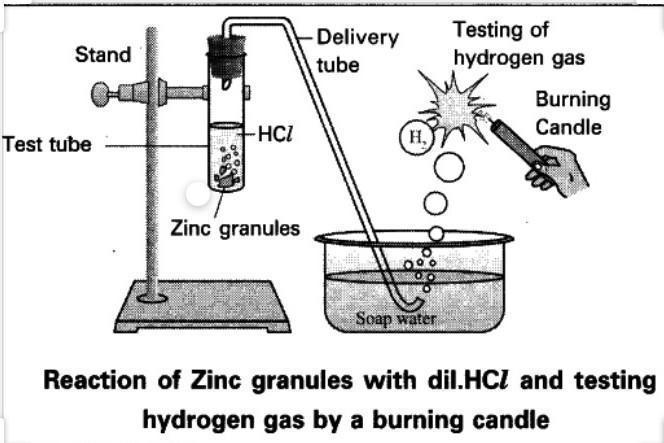
Example 2: Reaction of zinc with hydrochloric acid
Zn + 2HCl → ZnCl₂ + H₂↑
Test for Hydrogen Gas
Hydrogen gas can be identified by bringing a burning splint near the mouth of the test tube. It burns with a characteristic ‘pop’ sound.
This is called the pop test.
2.2 Reaction of Acids with Metal Carbonates
When an acid reacts with a metal carbonate, salt, water and carbon dioxide gas are formed.
General Reaction:
Metal Carbonate + Acid → Salt + Water + Carbon Dioxide
Example:
Na₂CO₃ + 2HCl → 2NaCl + H₂O + CO₂↑
Sodium carbonate reacts with hydrochloric acid to form sodium chloride, water and carbon dioxide.
2.3 Reaction of Acids with Metal Hydrogen Carbonates
Acids also react with metal hydrogen carbonates to produce salt, water and carbon dioxide.
Example: Reaction of sodium hydrogen carbonate with hydrochloric acid
NaHCO₃ + HCl → NaCl + H₂O + CO₂↑
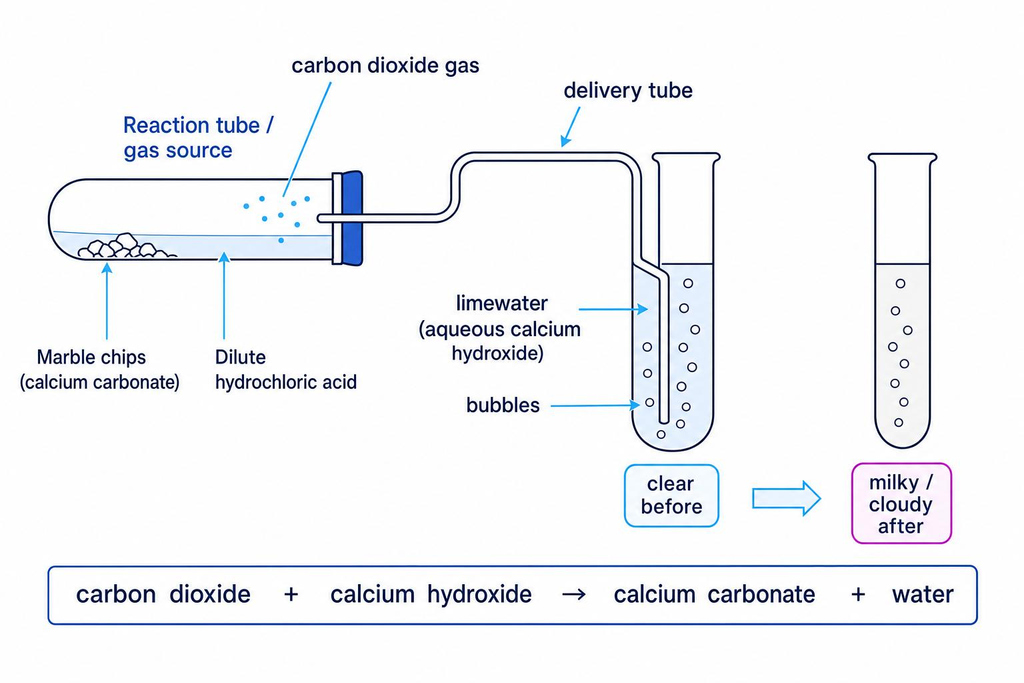
Test for Carbon Dioxide Gas
Carbon dioxide can be tested using lime water.
When carbon dioxide is passed through lime water, it turns milky due to the formation of insoluble calcium carbonate.
Ca(OH)₂ + CO₂ → CaCO₃↓ + H₂O
If excess carbon dioxide is passed through lime water, the milkiness disappears because soluble calcium hydrogen carbonate is formed.
CaCO₃ + CO₂ + H₂O → Ca(HCO₃)₂
2.4 Reaction of Acids with Metal Oxides
Metal oxides are generally basic in nature. They react with acids to produce salt and water.
General Reaction:
Metal Oxide + Acid → Salt + Water
Example: Reaction of copper oxide with hydrochloric acid
CuO + 2HCl → CuCl₂ + H₂O
Black copper oxide reacts with hydrochloric acid to form copper chloride and water.
This reaction demonstrates the basic nature of metal oxides.
3. Chemical Properties of Bases
Bases also undergo several important chemical reactions.
3.1 Reaction of Bases with Metals
Certain metals such as zinc and aluminium react with strong bases to produce hydrogen gas and a salt.
Example: Reaction of zinc with sodium hydroxide
Zn + 2NaOH → Na₂ZnO₂ + H₂↑
Here, sodium zincate and hydrogen gas are formed.
This reaction shows that certain metals can react with both acids and bases.
3.2 Reaction of Bases with Non-Metal Oxides
Non-metal oxides are generally acidic in nature. They react with bases to form salt and water.
Example: Reaction of carbon dioxide with calcium hydroxide
Ca(OH)₂ + CO₂ → CaCO₃ + H₂O
Carbon dioxide reacts with calcium hydroxide to form calcium carbonate and water.
This is the same reaction responsible for the milky appearance of lime water.
3.3 Reaction of Bases with Acids
Bases react with acids to form salt and water. This reaction is called neutralisation.
Example:
NaOH + HCl → NaCl + H₂O
Sodium hydroxide reacts with hydrochloric acid to form sodium chloride and water.
4. What Is an Indicator?
An indicator is a substance that changes its colour or other observable property in the presence of an acidic or basic solution.
Indicators are used to identify whether a substance is acidic or basic.
Types of Indicators
Indicators can be classified into three main categories.
A. Natural Indicators
Natural indicators are obtained from natural sources.
Examples:
- Litmus – obtained from lichens.
- Turmeric – obtained from the turmeric plant.
- China rose – obtained from hibiscus flowers.
Colour Changes:
| Natural Indicator | In Acidic Solution | In Basic Solution |
|---|---|---|
| Litmus | Red | Blue |
| Turmeric | Yellow | Reddish-brown |
| China rose | Dark pink/magenta | Green |
B. Synthetic Indicators
Synthetic indicators are prepared chemically.
Examples include:
- Phenolphthalein
- Methyl orange
| Indicator | In Acidic Solution | In Basic Solution |
|---|---|---|
| Phenolphthalein | Colourless | Pink |
| Methyl orange | Red | Yellow |
C. Olfactory Indicators
Olfactory indicators are substances whose smell changes or becomes difficult to detect in acidic or basic media.
Examples include:
- Onion
- Vanilla essence
- Clove oil
Example: The smell of onion becomes difficult to detect when it is placed in a basic solution, whereas it remains detectable in an acidic solution.
5. Reaction Between Acids and Bases – Neutralisation
Neutralisation is a chemical reaction in which an acid reacts with a base to form salt and water.
General Equation:
Acid + Base → Salt + Water
Example:
HCl + NaOH → NaCl + H₂O
Hydrochloric acid reacts with sodium hydroxide to form sodium chloride and water.
Ionic Explanation of Neutralisation
In aqueous solution:
H⁺ + OH⁻ → H₂O
Hydrogen ions from the acid combine with hydroxide ions from the base to form water.
Applications of Neutralisation
- Indigestion: Excess hydrochloric acid in the stomach can be neutralised by basic antacids such as magnesium hydroxide.
- Ant bites: An ant sting injects acidic substances, mainly formic acid. Mildly basic substances such as baking soda are commonly discussed as neutralising agents in school-level examples.
- Soil treatment: Acidic soil can be treated with quicklime (CaO), slaked lime [Ca(OH)₂] or chalk (CaCO₃).
- Industrial waste: Acidic or basic industrial wastes may be treated by suitable neutralisation processes before disposal.
6. What Do All Acids and Bases Have in Common?
What Do All Acids Have in Common?
All acids produce hydrogen ions (H⁺) in aqueous solution. These ions combine with water molecules to form hydronium ions.
HCl + H₂O → H₃O⁺ + Cl⁻
Hydrochloric acid produces hydronium ions when dissolved in water.
What Do All Bases Have in Common?
Bases that dissolve in water produce hydroxide ions (OH⁻).
NaOH → Na⁺ + OH⁻
These ions are responsible for the basic properties of the solution.
Why Do Acids Show Their Properties Only in Water?
Acids show their characteristic acidic behaviour when they ionise in water and produce hydrogen ions, which form hydronium ions.
For example, dry hydrogen chloride gas does not change dry blue litmus paper to red. However, it changes moist blue litmus paper to red because water is necessary for the formation of hydronium ions.
Important Equation:
HCl + H₂O → H₃O⁺ + Cl⁻
Why Do Acidic and Basic Solutions Conduct Electricity?
Acids and bases form ions in aqueous solutions. These ions carry electric current.
For example:
HCl → H⁺ + Cl⁻
NaOH → Na⁺ + OH⁻
The movement of these ions allows the solutions to conduct electricity.
7. Strength of Acids and Bases – The pH Scale
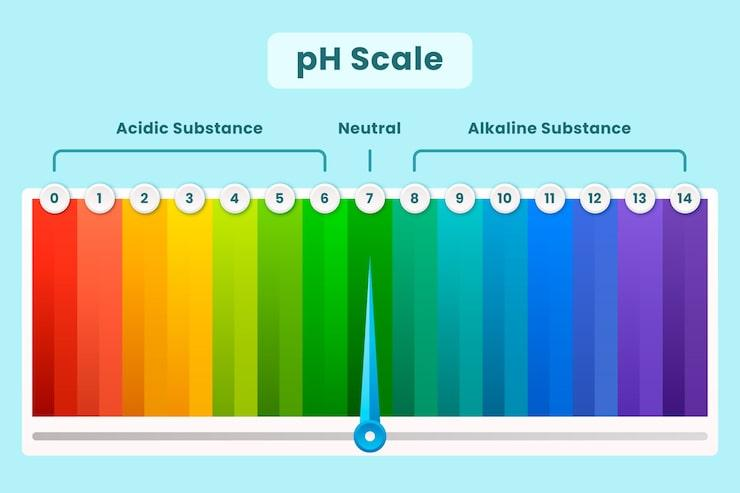
The pH scale is used to measure how acidic or basic a solution is.
The pH scale generally ranges from 0 to 14 for common aqueous solutions at room temperature.
| pH Value | Nature of Solution |
|---|---|
| Less than 7 | Acidic |
| Exactly 7 | Neutral |
| Greater than 7 | Basic |
A lower pH indicates a more acidic solution, while a higher pH indicates a more basic solution.
Understanding the pH Scale
- pH 1: Strongly acidic
- pH 3: Acidic
- pH 5: Weakly acidic
- pH 7: Neutral
- pH 9: Basic
- pH 11: More strongly basic
- pH 14: Strongly basic
Examples of Common Substances:
| Substance | Approximate pH |
|---|---|
| Stomach acid | 1–3 |
| Lemon juice | 2 |
| Vinegar | 2–3 |
| Orange juice | 3–4 |
| Tomato juice | 4 |
| Pure water | 7 |
| Blood | 7.4 |
| Baking soda solution | 8–9 |
| Soap solution | 9–10 |
The actual pH can vary depending on concentration and composition.
Universal Indicator
A universal indicator is a mixture of indicators that produces different colours at different pH values.
It helps estimate the pH of a solution.
The pH can also be measured more accurately using a pH meter.
Strong and Weak Acids
Strong acids ionise almost completely in water.
Examples:
- Hydrochloric acid (HCl)
- Nitric acid (HNO₃)
- Sulphuric acid (H₂SO₄)
Weak acids ionise only partially in water.
Examples:
- Acetic acid (CH₃COOH)
- Carbonic acid (H₂CO₃)
- Citric acid
Important Difference: Strength and concentration are not the same. Strength refers to the extent of ionisation, while concentration refers to the amount of acid or base present in a given volume of solution.
8. Importance of pH in Everyday Life
The pH of substances plays an important role in biological processes, agriculture and environmental protection.
8.1 pH in Our Digestive System
Our stomach produces hydrochloric acid, which helps in digestion and provides an acidic environment.
Sometimes, excess acid causes indigestion and discomfort.
Antacids such as magnesium hydroxide help neutralise excess stomach acid.
8.2 pH and Tooth Decay
Tooth enamel is mainly made of calcium phosphate.
When the pH in the mouth falls below approximately 5.5, tooth enamel begins to dissolve more easily.
Bacteria in the mouth produce acids by breaking down sugars present in food.
Brushing teeth regularly and using appropriate toothpaste help maintain oral hygiene.
8.3 pH of Soil
Plants grow properly only within a suitable pH range.
Some plants grow better in slightly acidic soil, while others prefer neutral or slightly alkaline soil.
Farmers test the pH of soil to determine whether it needs treatment.
Acidic soil can be treated with:
- Quicklime (CaO)
- Slaked lime [Ca(OH)₂]
- Chalk (CaCO₃)
8.4 pH and Self-Defence by Animals and Plants
Some animals and plants use acidic or irritating substances for protection.
For example, an ant sting contains formic acid, which causes irritation.
8.5 pH of Rainwater
Normal rainwater is slightly acidic because carbon dioxide dissolves in it and forms weak carbonic acid.
When the pH of rainwater falls below approximately 5.6 due to pollutants such as sulphur dioxide and nitrogen oxides, it is generally called acid rain.
Effects of Acid Rain:
- It damages buildings and monuments.
- It affects aquatic life.
- It changes soil chemistry.
- It damages plants and forests.
9. Salts and Their Properties
A salt is an ionic compound formed when the hydrogen ion of an acid is replaced by a metal ion or ammonium ion.
Salts are commonly produced through acid-base neutralisation reactions.
Examples:
| Salt | Chemical Formula |
|---|---|
| Sodium chloride | NaCl |
| Copper sulphate | CuSO₄ |
| Sodium carbonate | Na₂CO₃ |
| Sodium hydrogen carbonate | NaHCO₃ |
| Calcium sulphate | CaSO₄ |
| Potassium nitrate | KNO₃ |
Nature of Salts
Salts may be acidic, basic or neutral in aqueous solution.
Examples:
- Sodium chloride: Neutral
- Ammonium chloride: Acidic
- Sodium carbonate: Basic
The nature of a salt solution depends on the acid and base from which the salt is formed.
10. Important Chemicals from Common Salt
Common salt, chemically known as sodium chloride (NaCl), is an important raw material used in the preparation of many useful chemicals.
10.1 Sodium Hydroxide – Chlor-Alkali Process
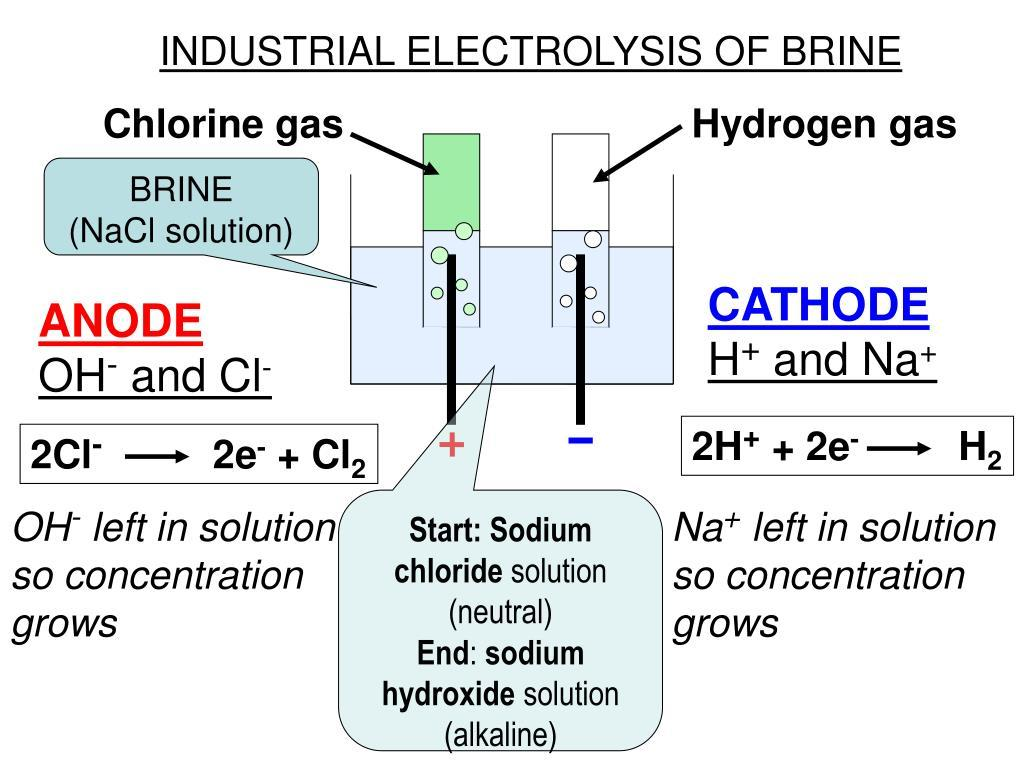
When electricity is passed through an aqueous solution of sodium chloride (brine), it decomposes to form sodium hydroxide, chlorine gas and hydrogen gas.
This process is known as the chlor-alkali process.
Chemical Equation:
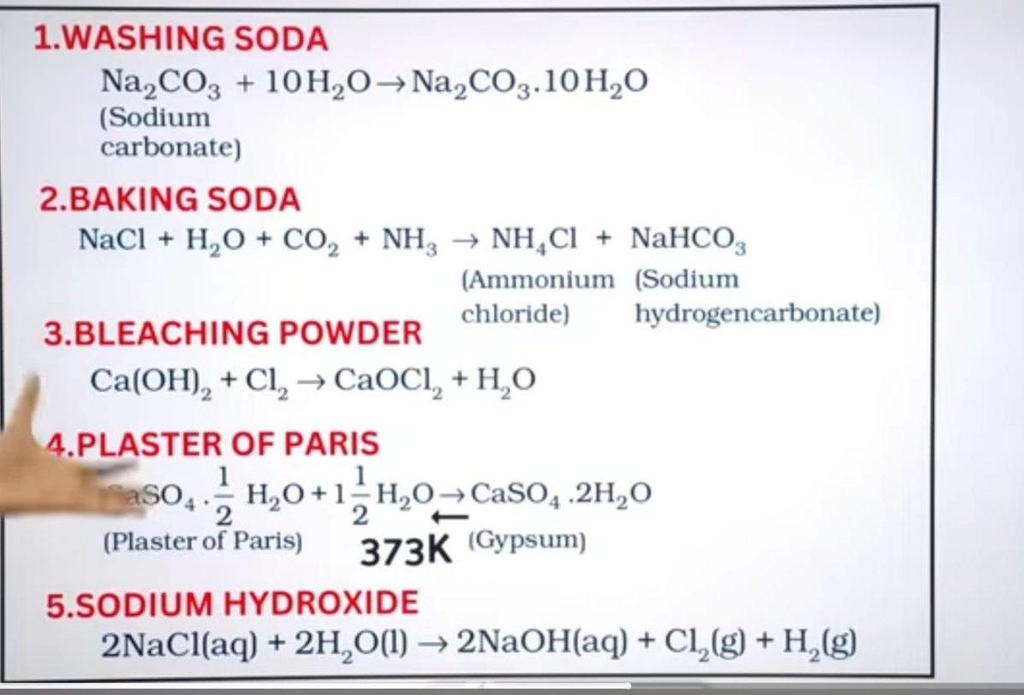
2NaCl + 2H₂O → 2NaOH + Cl₂ + H₂
Products formed:
- Sodium hydroxide (NaOH)
- Chlorine gas (Cl₂)
- Hydrogen gas (H₂)
Uses of Sodium Hydroxide:
- Manufacturing soaps and detergents.
- Making paper.
- Manufacturing artificial fibres.
- Degreasing metals.
Uses of Chlorine:
- Disinfecting drinking water.
- Manufacturing bleaching powder.
- Producing PVC and other chemicals.
Uses of Hydrogen:
- Manufacturing ammonia.
- Hydrogenation of vegetable oils.
- Use as a fuel in certain applications.
10.2 Bleaching Powder
Bleaching powder is commonly represented by the formula CaOCl₂.
It is prepared by passing chlorine gas over dry slaked lime.
Chemical Equation:
Ca(OH)₂ + Cl₂ → CaOCl₂ + H₂O
Uses of Bleaching Powder:
- Bleaching cotton and linen in textile industries.
- Bleaching wood pulp in paper industries.
- Disinfecting drinking water.
- Used as an oxidising agent in chemical industries.
10.3 Baking Soda
Baking soda is chemically known as sodium hydrogen carbonate or sodium bicarbonate.
Chemical Formula: NaHCO₃
It is a mild basic salt.
Preparation:
NaCl + H₂O + CO₂ + NH₃ → NH₄Cl + NaHCO₃
Sodium chloride, water, carbon dioxide and ammonia react to form sodium hydrogen carbonate and ammonium chloride.
Reaction on Heating:
When baking soda is heated, it decomposes to form sodium carbonate, carbon dioxide and water.
2NaHCO₃ → Na₂CO₃ + CO₂ + H₂O
Uses of Baking Soda:
- Used in baking powder.
- Used in antacids.
- Used in soda-acid fire extinguishers.
- Used in certain food preparations.
What Is Baking Powder?
Baking powder is a mixture of baking soda and a mild edible acid, commonly tartaric acid.
When baking powder is heated or mixed with moisture, carbon dioxide gas is released.
This gas makes cakes and bread soft and spongy.
Why Is Tartaric Acid Added?
During heating, baking soda produces sodium carbonate, which is basic and may give food a bitter taste.
Tartaric acid neutralises the sodium carbonate and improves the taste of the food.
10.4 Washing Soda
Washing soda is chemically known as sodium carbonate decahydrate.
Chemical Formula: Na₂CO₃·10H₂O
It is obtained by recrystallisation of sodium carbonate.
Uses of Washing Soda:
- Used as a cleaning agent for domestic purposes.
- Used for removing permanent hardness of water.
- Used in glass, soap and paper industries.
- Used in the manufacture of other sodium compounds.
11. Water of Crystallisation
Water of crystallisation refers to the fixed number of water molecules present in one formula unit of a crystalline salt.
These water molecules are an essential part of the crystal structure.
Example: Copper Sulphate Crystals
Copper sulphate crystals contain five molecules of water of crystallisation.
Formula: CuSO₄·5H₂O
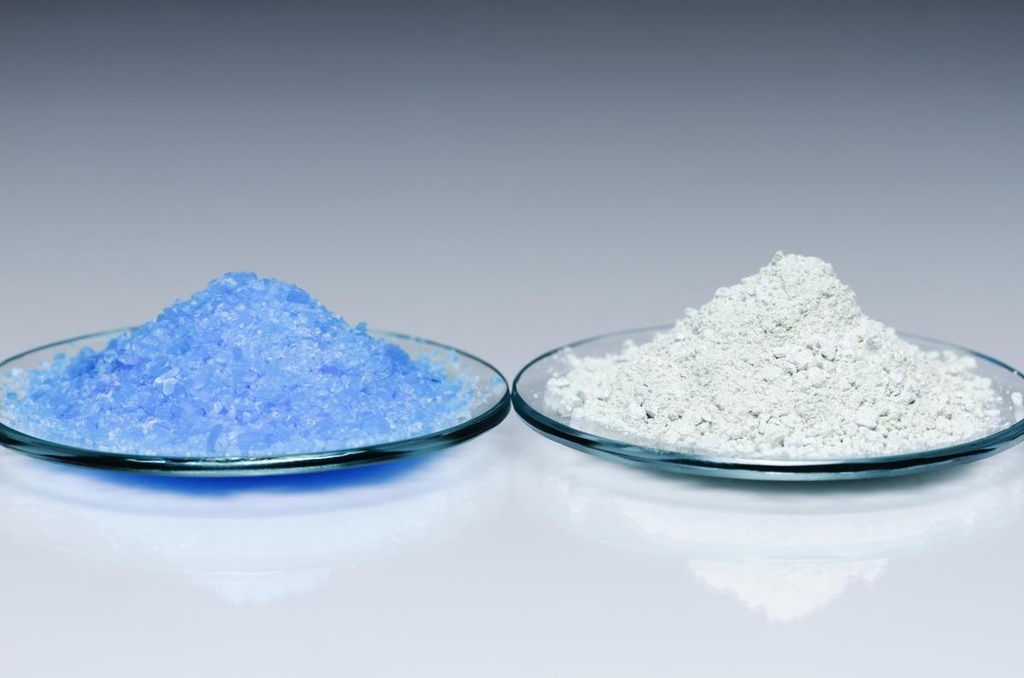
Hydrated copper sulphate crystals are blue in colour.
When heated, they lose water of crystallisation and become white anhydrous copper sulphate.
CuSO₄·5H₂O → CuSO₄ + 5H₂O
When water is added again, the white anhydrous copper sulphate becomes blue.
Example: Washing Soda
Washing soda contains ten molecules of water of crystallisation.
Na₂CO₃·10H₂O
Example: Gypsum
Gypsum contains two molecules of water of crystallisation.
CaSO₄·2H₂O
12. Plaster of Paris
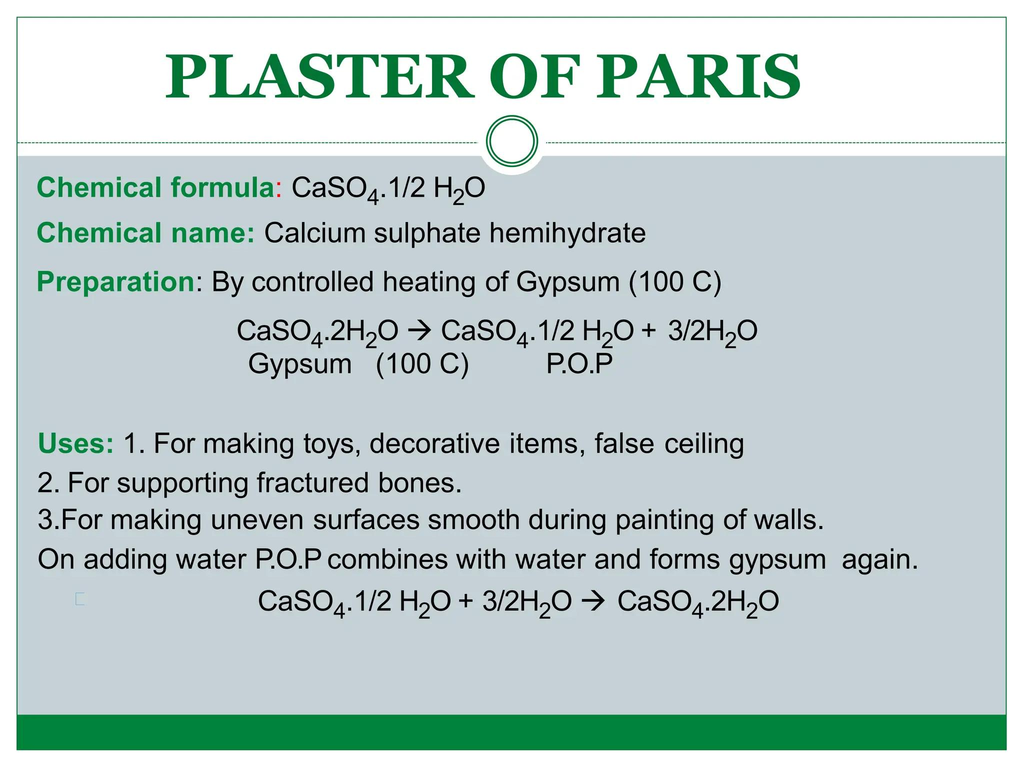
Plaster of Paris is an important compound prepared by heating gypsum at about 373 K (100°C).
Chemical Formula: CaSO₄·½H₂O
It is also called calcium sulphate hemihydrate.
Preparation of Plaster of Paris
When gypsum is heated at approximately 373 K, it loses part of its water of crystallisation and forms Plaster of Paris.
2(CaSO₄·2H₂O) → 2(CaSO₄·½H₂O) + 3H₂O
Properties of Plaster of Paris
- It is a white powder.
- It forms a hard solid when mixed with water.
- It sets into a solid mass due to the formation of gypsum.
- It should be stored in a moisture-proof container.
Setting of Plaster of Paris
When Plaster of Paris is mixed with water, it changes back into gypsum and becomes hard.
CaSO₄·½H₂O + 1½H₂O → CaSO₄·2H₂O
Uses of Plaster of Paris
- Making plaster casts for fractured bones.
- Making toys and decorative materials.
- Making statues and models.
- Preparing smooth surfaces on walls and ceilings.
- Making false ceilings and decorative designs.
13. Important Chemical Equations – Quick Revision
The following equations are particularly useful for examination preparation.
| No. | Chemical Reaction |
|---|---|
| 1 | Zn + H₂SO₄ → ZnSO₄ + H₂ |
| 2 | Zn + 2HCl → ZnCl₂ + H₂ |
| 3 | Na₂CO₃ + 2HCl → 2NaCl + H₂O + CO₂ |
| 4 | NaHCO₃ + HCl → NaCl + H₂O + CO₂ |
| 5 | Ca(OH)₂ + CO₂ → CaCO₃ + H₂O |
| 6 | CuO + 2HCl → CuCl₂ + H₂O |
| 7 | NaOH + HCl → NaCl + H₂O |
| 8 | Zn + 2NaOH → Na₂ZnO₂ + H₂ |
| 9 | 2NaCl + 2H₂O → 2NaOH + Cl₂ + H₂ |
| 10 | Ca(OH)₂ + Cl₂ → CaOCl₂ + H₂O |
| 11 | 2NaHCO₃ → Na₂CO₃ + CO₂ + H₂O |
| 12 | CuSO₄·5H₂O → CuSO₄ + 5H₂O |
Exam Tip: Practise writing these equations without looking at the notes. Pay particular attention to the balancing of equations and the physical states of substances where required.
14. Important Questions and Answers for CBSE Class 10
Q1. Why does dry HCl gas not change the colour of dry blue litmus paper?
Answer: Dry HCl gas does not produce hydrogen ions in the absence of water. Since hydronium ions are formed only in the presence of water, dry HCl gas does not show acidic behaviour on dry litmus paper.
Q2. Why should curd and sour substances not be kept in brass or copper vessels?
Answer: Curd and other sour substances contain acids. These acids can react with copper or brass and form harmful metal compounds that may contaminate the food.
Q3. Why does an aqueous solution of acid conduct electricity?
Answer: Acids ionise in water to produce ions. These ions carry electric current through the solution.
Q4. What happens when an acid reacts with a metal?
Answer: An acid reacts with a suitable reactive metal to produce a salt and hydrogen gas.
Example:
Zn + 2HCl → ZnCl₂ + H₂
Q5. What happens when an acid reacts with a metal carbonate?
Answer: An acid reacts with a metal carbonate to form salt, water and carbon dioxide.
Example:
Na₂CO₃ + 2HCl → 2NaCl + H₂O + CO₂
Q6. What is neutralisation? Give an example.
Answer: Neutralisation is the reaction between an acid and a base to produce salt and water.
Example:
HCl + NaOH → NaCl + H₂O
Q7. What is the pH of a neutral solution?
Answer: The pH of a neutral solution is 7 at 25°C.
Q8. Why does tooth decay start when the pH of the mouth falls below 5.5?
Answer: Tooth enamel begins to dissolve more readily when the pH in the mouth falls below approximately 5.5. Acids produced by bacteria can therefore damage tooth enamel and cause tooth decay.
Q9. What is the chemical name and formula of baking soda?
Answer: The chemical name of baking soda is sodium hydrogen carbonate or sodium bicarbonate. Its chemical formula is NaHCO₃.
Q10. What is the chemical name and formula of washing soda?
Answer: Washing soda is sodium carbonate decahydrate. Its chemical formula is Na₂CO₃·10H₂O.
Q11. What is the chlor-alkali process?
Answer: The process of electrolysis of an aqueous solution of sodium chloride (brine) to produce sodium hydroxide, chlorine and hydrogen is called the chlor-alkali process.
Q12. Why is it called the chlor-alkali process?
Answer: Chlorine is produced at the anode, while sodium hydroxide, an alkali, is formed in the solution. Hence, the process is called the chlor-alkali process.
Q13. What is Plaster of Paris?
Answer: Plaster of Paris is calcium sulphate hemihydrate. Its chemical formula is CaSO₄·½H₂O.
Q14. How is Plaster of Paris prepared?
Answer: It is prepared by heating gypsum at approximately 373 K (100°C), causing it to lose part of its water of crystallisation.
Q15. What is water of crystallisation?
Answer: Water of crystallisation is the fixed number of water molecules present in one formula unit of a crystalline salt.
Q16. Why do copper sulphate crystals turn white on heating?
Answer: Blue copper sulphate crystals contain five water molecules of crystallisation. On heating, they lose this water and become white anhydrous copper sulphate.
Q17. Why is baking powder used in making cakes?
Answer: Baking powder releases carbon dioxide gas when heated or mixed with moisture. The gas makes cakes and bread soft, fluffy and spongy.
Q18. What happens when carbon dioxide is passed through lime water?
Answer: Lime water turns milky due to the formation of insoluble calcium carbonate.
Ca(OH)₂ + CO₂ → CaCO₃ + H₂O
Q19. What is an amphoteric oxide? Give two examples.
Answer: An amphoteric oxide is an oxide that reacts with both acids and bases to form salt and water.
Examples:
- Zinc oxide (ZnO)
- Aluminium oxide (Al₂O₃)
Q20. Why is sodium hydrogen carbonate used as an antacid?
Answer: Sodium hydrogen carbonate is mildly basic. It can neutralise excess hydrochloric acid in the stomach and provide relief from acidity.
15. Important One-Mark Questions
- What is the chemical formula of hydrochloric acid?
Answer: HCl - Which gas is released when acids react with metals?
Answer: Hydrogen gas. - Which gas turns lime water milky?
Answer: Carbon dioxide. - What is the pH of pure water at 25°C?
Answer: 7. - Which indicator turns pink in a basic solution?
Answer: Phenolphthalein. - What is the chemical formula of bleaching powder?
Answer: CaOCl₂. - What is the chemical formula of baking soda?
Answer: NaHCO₃. - What is the chemical formula of washing soda?
Answer: Na₂CO₃·10H₂O. - What is the chemical formula of Plaster of Paris?
Answer: CaSO₄·½H₂O. - Which acid is present in vinegar?
Answer: Acetic acid. - Which acid is present in lemons?
Answer: Citric acid. - Which gas is produced during the chlor-alkali process at the anode?
Answer: Chlorine gas. - Which salt is used for removing permanent hardness of water?
Answer: Washing soda. - What is the colour of hydrated copper sulphate crystals?
Answer: Blue. - Which acid is present in the human stomach?
Answer: Hydrochloric acid.
16. Quick Revision Notes – Acids, Bases and Salts
Before your examination, revise the following important points:
- Acids produce H⁺ ions in aqueous solution.
- Bases produce OH⁻ ions in aqueous solution.
- Acids turn blue litmus red.
- Bases turn red litmus blue.
- Acids react with metals to produce hydrogen gas.
- Acids react with metal carbonates to produce carbon dioxide.
- Carbon dioxide turns lime water milky.
- Acid + Base → Salt + Water.
- pH less than 7 indicates an acidic solution.
- pH equal to 7 indicates a neutral solution at 25°C.
- pH greater than 7 indicates a basic solution.
- Baking soda: NaHCO₃.
- Washing soda: Na₂CO₃·10H₂O.
- Bleaching powder: CaOCl₂.
- Plaster of Paris: CaSO₄·½H₂O.
- Gypsum: CaSO₄·2H₂O.
- Water of crystallisation is the fixed number of water molecules in a crystalline salt.
- The chlor-alkali process produces sodium hydroxide, chlorine and hydrogen.
17. How to Prepare This Chapter for the CBSE Board Examination
To prepare effectively for this chapter, follow these steps:
Step 1: Understand the concepts
Read the NCERT textbook carefully and understand the chemical properties of acids and bases.
Step 2: Practise chemical equations
Write and balance all important reactions. Learn the products formed in each reaction.
Step 3: Learn indicator colour changes
Prepare a small table showing the colour changes of litmus, turmeric, China rose, phenolphthalein and methyl orange.
Step 4: Understand the pH scale
Practise questions related to acidic, basic and neutral substances.
Step 5: Memorise important salts
Learn the chemical formula, preparation and uses of baking soda, washing soda, bleaching powder and Plaster of Paris.
Step 6: Practise textbook questions
Solve all NCERT in-text and exercise questions, followed by previous-year and competency-based questions.
Conclusion
Acids, Bases and Salts is an important chapter in CBSE Class 10 Science because it connects chemistry with everyday life. Understanding chemical reactions, indicators, pH, neutralisation and important salts will help students build a strong foundation in chemistry.
Students should focus on understanding the concepts rather than simply memorising definitions and equations. Regular revision and practice of chemical reactions will make this chapter easier to understand and help in examination preparation.
Keep learning, keep practising and keep improving with The Study Smart!
More Study Resources from The Study Smart
Explore more Class 10 Science notes, NCERT solutions, important questions, MCQs and board examination preparation materials on The Study Smart.