Atoms are the building blocks of matter. Everything around us, including air, water, plants, animals and even our own bodies, is made up of atoms. But have you ever wondered what is present inside an atom?
In Class 9 Science Chapter 8 – Journey Inside the Atom, we explore how scientists discovered the internal structure of atoms. This chapter explains the development of atomic theory, the discovery of electrons, protons and neutrons, and different atomic models proposed by scientists.
These notes cover the important concepts, definitions, diagrams, formulas, solved numerical problems and examination-oriented questions to help students prepare effectively for their CBSE Class 9 Science examinations.
Table of Contents
- Introduction to Atoms
- Roots of Atomic Theory
- Dalton’s Atomic Theory
- Discovery of Subatomic Particles
- Thomson’s Atomic Model
- Rutherford’s Gold Foil Experiment
- Rutherford’s Atomic Model and Its Limitations
- Bohr’s Atomic Model
- Discovery of Neutron
- Symbols of Elements
- Atomic Number and Mass Number
- Electronic Configuration
- Valency
- Isotopes and Isobars
- Average Atomic Mass
- Important Formulas
- Important Questions and Answers
- Solved Numericals
- Quick Revision Notes
1. Introduction to Atoms
Everything around us is made up of matter. Matter consists of extremely small particles called atoms.
Atoms are so tiny that they cannot be seen with the naked eye.
Both living and non-living things are made up of atoms.
For example:
- Human body → Organs → Tissues → Cells → Proteins → Atoms.
- House → Rooms → Walls → Bricks → Materials → Atoms.
The important question is: Are atoms indivisible, or are they made up of smaller particles?
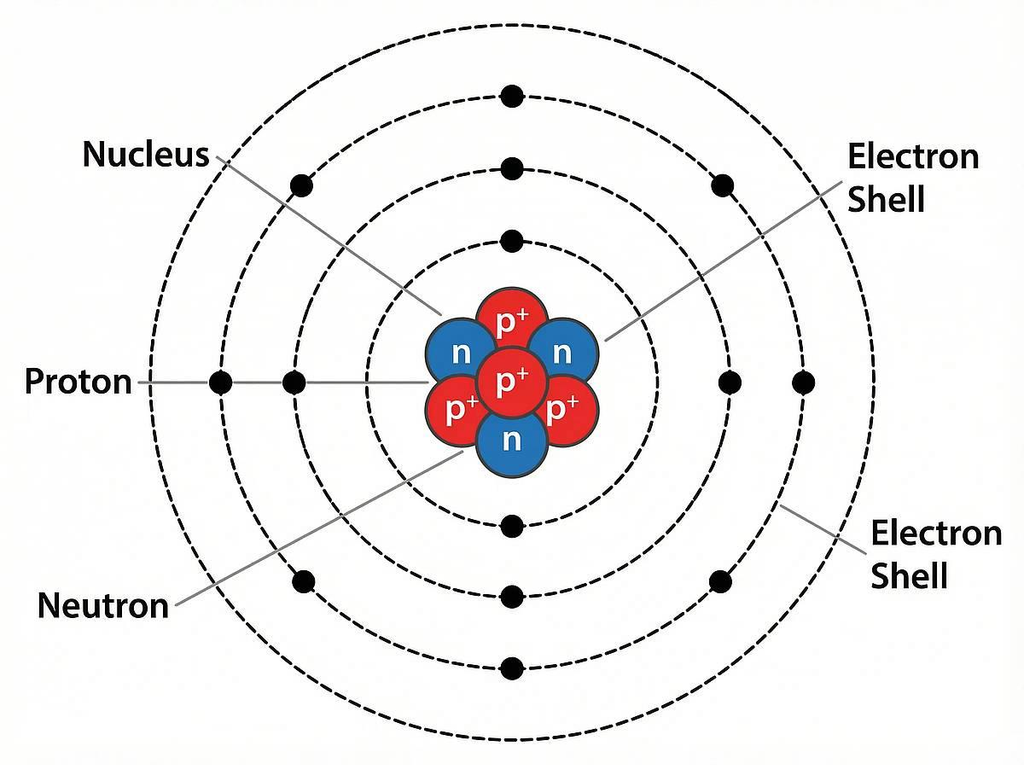
Scientists discovered that atoms contain three main subatomic particles:
- Electron
- Proton
- Neutron
2. Roots of Atomic Theory
The idea that matter is made up of very small particles dates back more than 2,000 years.
Acharya Kanada
Acharya Kanada, an ancient Indian philosopher, proposed that if matter is divided repeatedly, we eventually reach the smallest indivisible particles called Parmanus.
His ideas are recorded in the Sanskrit text Vaisesika Sutras.
According to his concept, two parmanus could combine to form a dyad, while three could form a triad.
Leucippus and Democritus
Ancient Greek philosophers Leucippus and Democritus proposed that matter consists of indivisible particles called Atomos, meaning indivisible.
John Dalton’s Atomic Theory (1808)
John Dalton proposed the first scientific atomic theory based on experimental observations.
Main postulates:
- All matter is made up of extremely small particles called atoms.
- Atoms of the same element were considered identical in mass and properties.
- Atoms of different elements have different properties.
- Atoms combine in simple whole-number ratios to form compounds.
- Atoms can neither be created nor destroyed in a chemical reaction.
Limitations of Dalton’s Atomic Theory
- Atoms are divisible into electrons, protons and neutrons.
- Atoms of the same element may have different masses because of isotopes.
- Atoms of different elements may have the same mass number because of isobars.
3. Discovery of Electron – J. J. Thomson
In 1897, J. J. Thomson performed an experiment using a glass discharge tube containing gas at very low pressure.
He passed electricity through the tube using two electrodes.
He observed rays travelling from the negative electrode (cathode) towards the positive electrode (anode). These were called cathode rays.
From his experiments, Thomson concluded that:
- Cathode rays consist of negatively charged particles.
- These particles are called electrons.
- Electrons are present in all atoms.
- Electrons have a negative charge.
Charge of an electron = −1.602 × 10⁻¹⁹ C.
Mass of an electron ≈ 9.1 × 10⁻³¹ kg.
4. Thomson’s Atomic Model
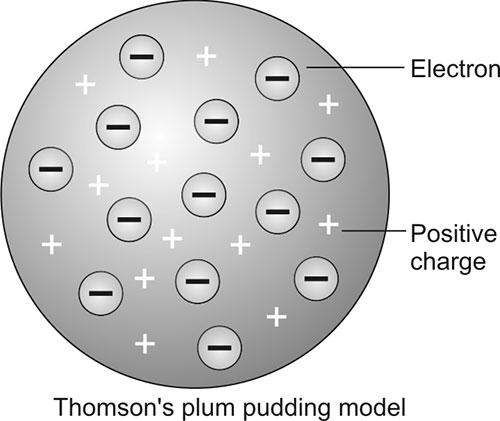
Thomson proposed the Plum Pudding Model in 1904.
According to this model:
- An atom is a sphere of positive charge.
- Electrons are embedded throughout the positively charged sphere.
- The positive and negative charges balance each other.
- Therefore, an atom is electrically neutral.
It is also compared to a watermelon, where the red pulp represents positive charge and the seeds represent electrons.
Limitation: Thomson’s model could not explain the observations of Rutherford’s gold foil experiment.
5. Rutherford’s Gold Foil Experiment
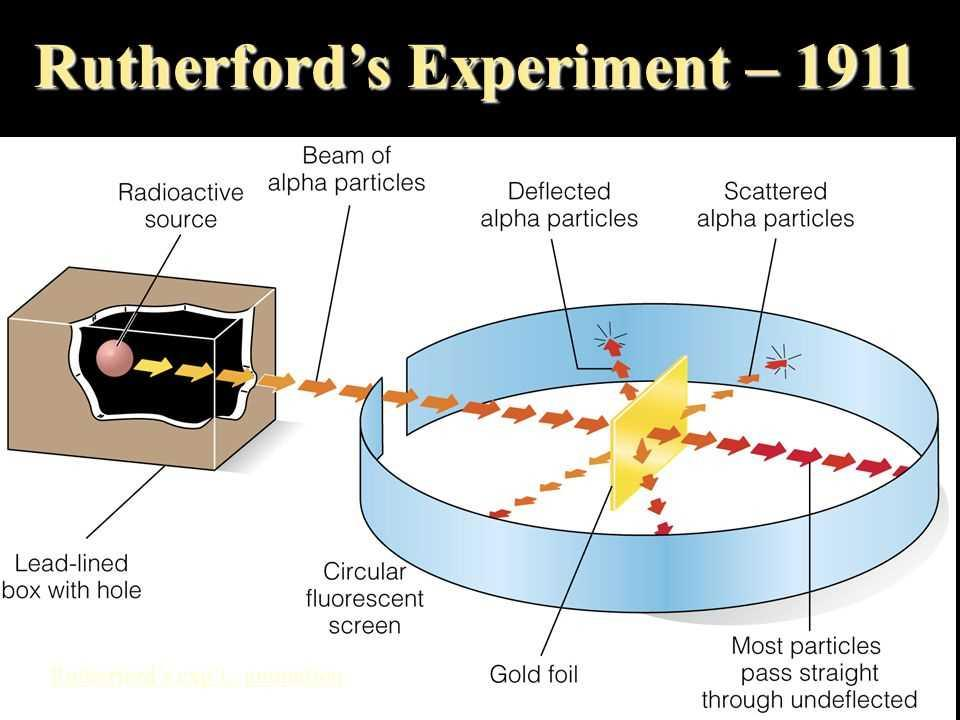
In 1911, Ernest Rutherford, with the help of Geiger and Marsden, conducted the famous gold foil experiment.
Experimental Setup
A narrow beam of positively charged alpha particles was directed towards a very thin sheet of gold foil.
A fluorescent screen was placed around the foil to detect the scattered alpha particles.
Observations
Rutherford made three important observations:
- Most alpha particles passed straight through the gold foil without any deflection.
- Some alpha particles were deflected through small or large angles.
- A very small number of alpha particles bounced back.
Conclusions
From these observations, Rutherford concluded:
- Most of the atom is empty space.
- The positive charge of an atom is concentrated in a very small region.
- This central region is called the nucleus.
- The nucleus contains most of the mass of the atom.
- Electrons revolve around the nucleus.
Important: The gold foil experiment disproved Thomson’s Plum Pudding Model and led to the discovery of the atomic nucleus.
6. Rutherford’s Atomic Model
According to Rutherford’s atomic model:
- An atom has a small, dense and positively charged nucleus at its centre.
- Almost the entire mass of an atom is concentrated in the nucleus.
- Electrons revolve around the nucleus.
- Most of the atom is empty space.
Limitations of Rutherford’s Model
Rutherford’s model could not explain the stability of an atom.
According to classical physics, a revolving electron should continuously lose energy and eventually spiral into the nucleus.
If this happened, atoms would collapse. However, atoms are stable in nature.
Therefore, a better atomic model was required.
7. Bohr’s Atomic Model
In 1913, Niels Bohr proposed a new atomic model to explain the stability of atoms.
Main postulates:
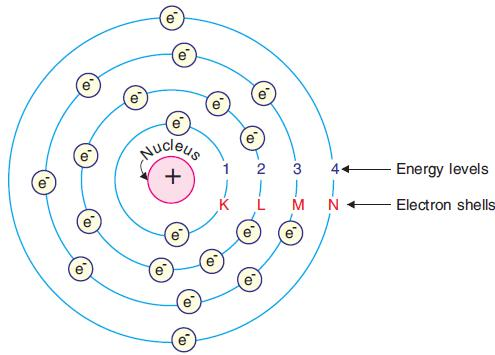
- Electrons revolve around the nucleus in fixed circular paths called shells or energy levels.
- These shells are represented by K, L, M and N.
- Each shell has a definite energy.
- Electrons do not lose energy while moving in their permitted shells.
- Electrons can move from one shell to another by absorbing or releasing a fixed amount of energy.
- The energy of shells increases as we move away from the nucleus.
Shell arrangement:
- K shell – First shell (n = 1)
- L shell – Second shell (n = 2)
- M shell – Third shell (n = 3)
- N shell – Fourth shell (n = 4)
Bohr’s model explained the stability of atoms by proposing that electrons do not lose energy while occupying stationary states.
8. Discovery of Neutron
In 1932, James Chadwick discovered the neutron.
A neutron is a subatomic particle that:
- Has no electrical charge.
- Has a mass nearly equal to that of a proton.
- Is present inside the nucleus of an atom.
Ordinary hydrogen (protium) is an exception because its nucleus contains only one proton and no neutron.
Comparison of Subatomic Particles
| Particle | Symbol | Relative Charge | Location |
|---|---|---|---|
| Electron | e⁻ | −1 | Outside nucleus |
| Proton | p⁺ | +1 | Nucleus |
| Neutron | n⁰ | 0 | Nucleus |
The mass of an electron is approximately 1/1836 of the mass of a proton. Therefore, its contribution is generally ignored while calculating the mass number.
9. Symbols of Elements
Scientists use chemical symbols to represent elements.
In 1813, Berzelius suggested using alphabetic symbols derived from the names of elements.
Rules for Writing Chemical Symbols
- The first letter of a symbol is always capital.
- The second letter, if present, is always small.
- Symbols may be derived from English or Latin names.
- Every element has a unique chemical symbol.
Examples:
| Element | Symbol |
|---|---|
| Hydrogen | H |
| Oxygen | O |
| Carbon | C |
| Sodium | Na |
| Potassium | K |
| Iron | Fe |
| Copper | Cu |
| Silver | Ag |
| Gold | Au |
| Mercury | Hg |
| Lead | Pb |
Remember: Co represents cobalt, whereas CO represents carbon monoxide.
10. Atomic Number (Z)
The atomic number of an element is the number of protons present in the nucleus of its atom.
It is represented by the letter Z.
Atomic Number (Z) = Number of Protons
For a neutral atom:
Number of protons = Number of electrons.
Examples:
- Hydrogen: Z = 1
- Helium: Z = 2
- Lithium: Z = 3
- Carbon: Z = 6
- Oxygen: Z = 8
- Sodium: Z = 11
The atomic number determines the identity of an element.
11. Mass Number (A)
The mass number is the total number of protons and neutrons present in the nucleus of an atom.
Mass Number (A) = Number of Protons + Number of Neutrons
Therefore:
Number of Neutrons = A − Z
Protons and neutrons together are called nucleons.
Example:
For chlorine-35:
- Atomic number = 17
- Mass number = 35
- Protons = 17
- Electrons = 17 (neutral atom)
- Neutrons = 35 − 17 = 18
Representation of an Atom
An atom is represented as:
¹²₆C
Here:
- 12 represents the mass number.
- 6 represents the atomic number.
- C represents the element carbon.
12. Electronic Configuration
The arrangement of electrons in different shells of an atom is called its electronic configuration.
According to the Bohr-Bury rules:
- The maximum number of electrons in a shell is given by 2n².
- The outermost shell cannot contain more than 8 electrons.
- Electrons are filled in shells step by step, starting from the innermost shell.
Formula: Maximum Number of Electrons
Maximum electrons = 2n²
Here, n represents the shell number.
| Shell | n | Maximum Electrons |
|---|---|---|
| K | 1 | 2 |
| L | 2 | 8 |
| M | 3 | 18 |
| N | 4 | 32 |
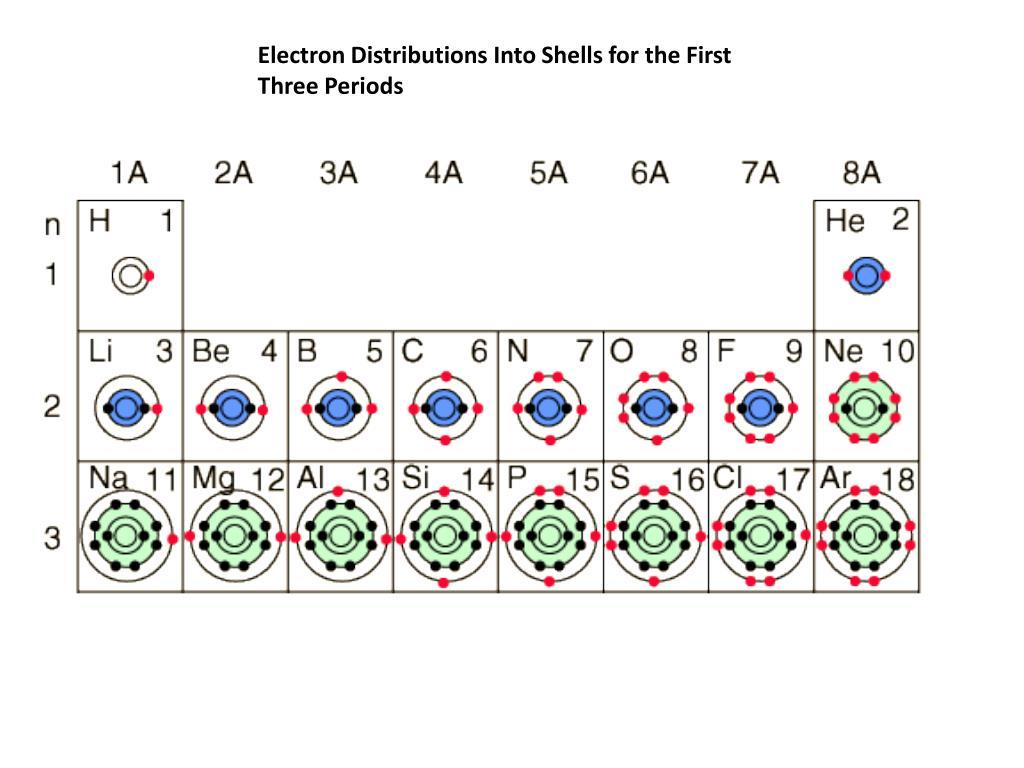
For the first 18 elements, the usual electronic configurations follow the pattern 2, 8, 8.
Electronic Configuration of the First 18 Elements
| Element | Atomic Number | Electronic Configuration |
|---|---|---|
| Hydrogen | 1 | 1 |
| Helium | 2 | 2 |
| Lithium | 3 | 2, 1 |
| Beryllium | 4 | 2, 2 |
| Boron | 5 | 2, 3 |
| Carbon | 6 | 2, 4 |
| Nitrogen | 7 | 2, 5 |
| Oxygen | 8 | 2, 6 |
| Fluorine | 9 | 2, 7 |
| Neon | 10 | 2, 8 |
| Sodium | 11 | 2, 8, 1 |
| Magnesium | 12 | 2, 8, 2 |
| Aluminium | 13 | 2, 8, 3 |
| Silicon | 14 | 2, 8, 4 |
| Phosphorus | 15 | 2, 8, 5 |
| Sulphur | 16 | 2, 8, 6 |
| Chlorine | 17 | 2, 8, 7 |
| Argon | 18 | 2, 8, 8 |
Examples beyond the first 18 elements:
- Potassium (Z = 19): 2, 8, 8, 1
- Calcium (Z = 20): 2, 8, 8, 2
13. Valency
The combining capacity of an atom is called its valency.
Atoms generally lose, gain or share electrons to complete their outermost shell and attain a stable electronic configuration.
The outermost shell is called the valence shell, and the electrons present in it are called valence electrons.
Octet Rule
Atoms with eight electrons in their outermost shell are generally stable.
Helium is stable with two electrons, known as a duplet.
Rules for Calculating Valency
- If valence electrons are fewer than 4, valency is generally equal to the number of valence electrons.
- If valence electrons are more than 4, valency = 8 − number of valence electrons.
- If an atom has 4 valence electrons, it generally shares 4 electrons.
- If the outermost shell is complete, valency is zero.
Examples:
| Element | Electronic Configuration | Valence Electrons | Valency |
|---|---|---|---|
| Sodium | 2, 8, 1 | 1 | 1 |
| Magnesium | 2, 8, 2 | 2 | 2 |
| Aluminium | 2, 8, 3 | 3 | 3 |
| Carbon | 2, 4 | 4 | 4 |
| Oxygen | 2, 6 | 6 | 2 |
| Chlorine | 2, 8, 7 | 7 | 1 |
| Neon | 2, 8 | 8 | 0 |
14. Isotopes
Isotopes are atoms of the same element having the same atomic number but different mass numbers.
They have the same number of protons but different numbers of neutrons.
Examples of Isotopes
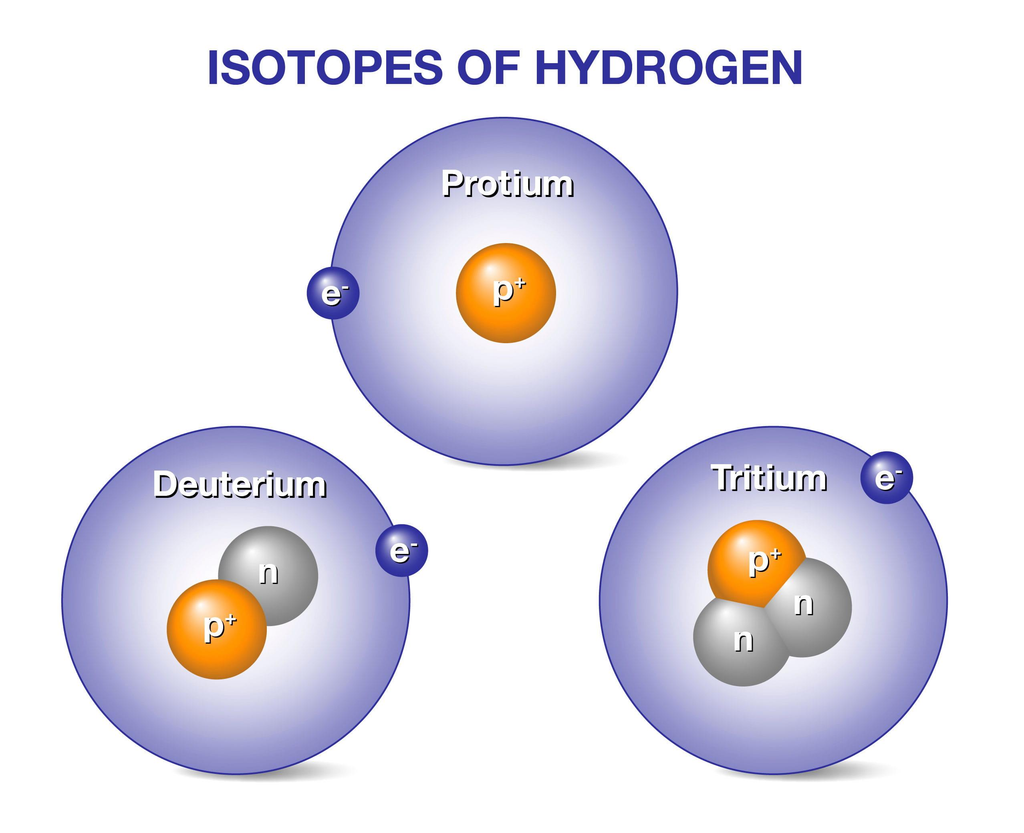
Hydrogen has three isotopes:
- Protium (Hydrogen-1): 1 proton, 0 neutrons.
- Deuterium (Hydrogen-2): 1 proton, 1 neutron.
- Tritium (Hydrogen-3): 1 proton, 2 neutrons.
Carbon also has three commonly discussed isotopes:
- Carbon-12
- Carbon-13
- Carbon-14
Properties of Isotopes
- They have the same atomic number.
- They have different mass numbers.
- They have the same number of electrons in neutral atoms.
- They generally have similar chemical properties.
- Their physical properties may differ.
Uses of Isotopes
| Isotope | Application |
|---|---|
| Uranium-235 | Fuel in nuclear reactors |
| Cobalt-60 | Radiation treatment of cancer |
| Iodine-131 | Treatment of certain thyroid disorders |
| Carbon-14 | Dating ancient fossils and artefacts |
15. Average Atomic Mass
Some elements occur naturally as a mixture of isotopes.
The average atomic mass is calculated by considering the relative abundance of each isotope.
Average Atomic Mass = Σ (Isotopic Mass × Percentage Abundance / 100)
Example: Chlorine
Chlorine has two major isotopes:
- Chlorine-35: 75%
- Chlorine-37: 25%
Average atomic mass:
= (35 × 75/100) + (37 × 25/100)
= 26.25 + 9.25
= 35.5 u
Remember that 35.5 u is the weighted average mass, not the mass of an individual chlorine atom.
16. Isobars
Isobars are atoms of different elements having the same mass number but different atomic numbers.
Example:
- Argon-40: Atomic number 18
- Potassium-40: Atomic number 19
- Calcium-40: Atomic number 20
All have a mass number of 40.
Difference Between Isotopes and Isobars
| Basis | Isotopes | Isobars |
|---|---|---|
| Atomic number | Same | Different |
| Mass number | Different | Same |
| Element | Same | Different |
| Example | C-12 and C-14 | Ar-40 and Ca-40 |
17. Important Formulas – Quick Revision
| Concept | Formula |
|---|---|
| Atomic number | Z = Number of protons |
| Mass number | A = Protons + Neutrons |
| Number of neutrons | n = A − Z |
| Electrons in neutral atom | e = p = Z |
| Maximum electrons in a shell | 2n² |
| Average atomic mass | Σ (Isotopic mass × % abundance / 100) |
18. Important Questions and Answers
Very Short Answer Questions
Q1. Who discovered the electron?
Ans. J. J. Thomson discovered the electron in 1897.
Q2. Who discovered the neutron?
Ans. James Chadwick discovered the neutron in 1932.
Q3. What is the charge of a proton?
Ans. A proton has a relative positive charge of +1.
Q4. Which subatomic particle has no charge?
Ans. Neutron.
Q5. What is the atomic number?
Ans. The number of protons present in the nucleus of an atom.
Q6. What is the mass number?
Ans. The total number of protons and neutrons present in the nucleus.
Q7. What is the maximum number of electrons in the K shell?
Ans. Two electrons.
Q8. What is the valency of neon?
Ans. Zero, because its outermost shell is complete.
Short Answer Questions
Q9. Why is an atom electrically neutral?
Ans. An atom is electrically neutral because the number of positively charged protons is equal to the number of negatively charged electrons.
Q10. Why did Rutherford conclude that most of an atom is empty space?
Ans. Most alpha particles passed straight through the gold foil without any deflection. This showed that most of the volume of an atom is empty space.
Q11. Why did Rutherford’s model fail to explain atomic stability?
Ans. According to classical physics, revolving electrons should continuously lose energy and eventually fall into the nucleus. This would make the atom unstable. Rutherford’s model could not explain why atoms remain stable.
Q12. How did Bohr explain the stability of an atom?
Ans. Bohr proposed that electrons revolve in fixed energy levels called stationary states. They do not lose energy while remaining in these permitted shells.
Q13. Why do isotopes have similar chemical properties?
Ans. Isotopes have the same atomic number and the same electronic configuration in neutral atoms. Therefore, they have the same chemical properties.
Q14. Why can the mass of electrons be ignored while calculating the mass number?
Ans. The mass of an electron is approximately 1/1836 of the mass of a proton. Its contribution is negligible compared with protons and neutrons.
Q15. Why is the atomic number important?
Ans. Atomic number determines the identity of an element because it represents the number of protons in its nucleus.
Long Answer Questions
Q16. Explain Rutherford’s gold foil experiment with observations and conclusions.
Ans.
Rutherford directed a narrow beam of positively charged alpha particles towards a very thin gold foil.
Observations:
- Most alpha particles passed straight through.
- Some alpha particles were deflected.
- A very few particles bounced back.
Conclusions:
- Most of the atom is empty space.
- Positive charge is concentrated in a tiny central region.
- The central region is called the nucleus.
- Most of the atomic mass is concentrated in the nucleus.
Q17. Explain Bohr’s atomic model.
Ans.
- Electrons revolve around the nucleus in fixed circular paths.
- These paths are called shells or energy levels.
- Each shell has a definite energy.
- Electrons do not lose energy while occupying a stationary shell.
- Electrons absorb or release energy when they move between shells.
Q18. Differentiate between Thomson’s and Rutherford’s atomic models.
Ans.
| Thomson’s Model | Rutherford’s Model |
|---|---|
| Positive charge is spread throughout the atom. | Positive charge is concentrated in a tiny nucleus. |
| Electrons are embedded in the positive sphere. | Electrons revolve around the nucleus. |
| No nucleus is proposed. | A small, dense nucleus is present. |
| Could not explain gold foil observations. | Explained the gold foil observations. |
19. Solved Numericals
Numerical 1:
An atom has atomic number 26 and mass number 56. Find the number of protons, electrons and neutrons.
Solution:
Atomic number (Z) = 26
Mass number (A) = 56
Protons = 26
Electrons = 26 (neutral atom)
Neutrons = A − Z
= 56 − 26
= 30
Answer: Protons = 26, Electrons = 26, Neutrons = 30.
Numerical 2:
An atom contains 20 protons and has a mass number of 40. Find its number of neutrons.
Solution:
Neutrons = Mass number − Protons
= 40 − 20
= 20
Answer: 20 neutrons.
Numerical 3:
An atom has 18 neutrons and atomic number 17. Find its mass number.
Solution:
Mass number = Protons + Neutrons
= 17 + 18
= 35
Answer: 35.
Numerical 4:
Calculate the average atomic mass of boron if B-10 has an abundance of 20% and B-11 has an abundance of 80%.
Solution:
Average atomic mass
= (10 × 20/100) + (11 × 80/100)
= 2 + 8.8
= 10.8 u
Answer: 10.8 u.
Numerical 5:
Find the electronic configuration and valency of an element having atomic number 16.
Solution:
Atomic number = 16
Number of electrons = 16
Electronic configuration = 2, 8, 6
Valence electrons = 6
Valency = 8 − 6 = 2
Answer: Electronic configuration = 2, 8, 6; Valency = 2.
20. Quick Revision – Journey Inside the Atom
- Acharya Kanada proposed the concept of parmanu.
- Democritus used the term atomos.
- John Dalton proposed atomic theory in 1808.
- J. J. Thomson discovered the electron in 1897.
- Rutherford proposed the nuclear model in 1911.
- Niels Bohr proposed his atomic model in 1913.
- James Chadwick discovered the neutron in 1932.
- Atomic number = Number of protons.
- Mass number = Protons + Neutrons.
- Electronic configuration represents the arrangement of electrons in shells.
- Valency is the combining capacity of an atom.
- Isotopes have the same atomic number but different mass numbers.
- Isobars have the same mass number but different atomic numbers.
Conclusion
The chapter Journey Inside the Atom explains how our understanding of atomic structure developed through the contributions of several scientists. From the early idea of indivisible particles to the discovery of electrons, protons and neutrons, each experiment helped scientists understand the structure of matter more clearly.
Students should pay special attention to Rutherford’s gold foil experiment, Bohr’s atomic model, atomic number, mass number, electronic configuration, valency, isotopes and isobars.
Regular practice of diagrams, definitions and numerical problems will help students develop a strong understanding of this chapter.
Keep learning, keep exploring and make science interesting!