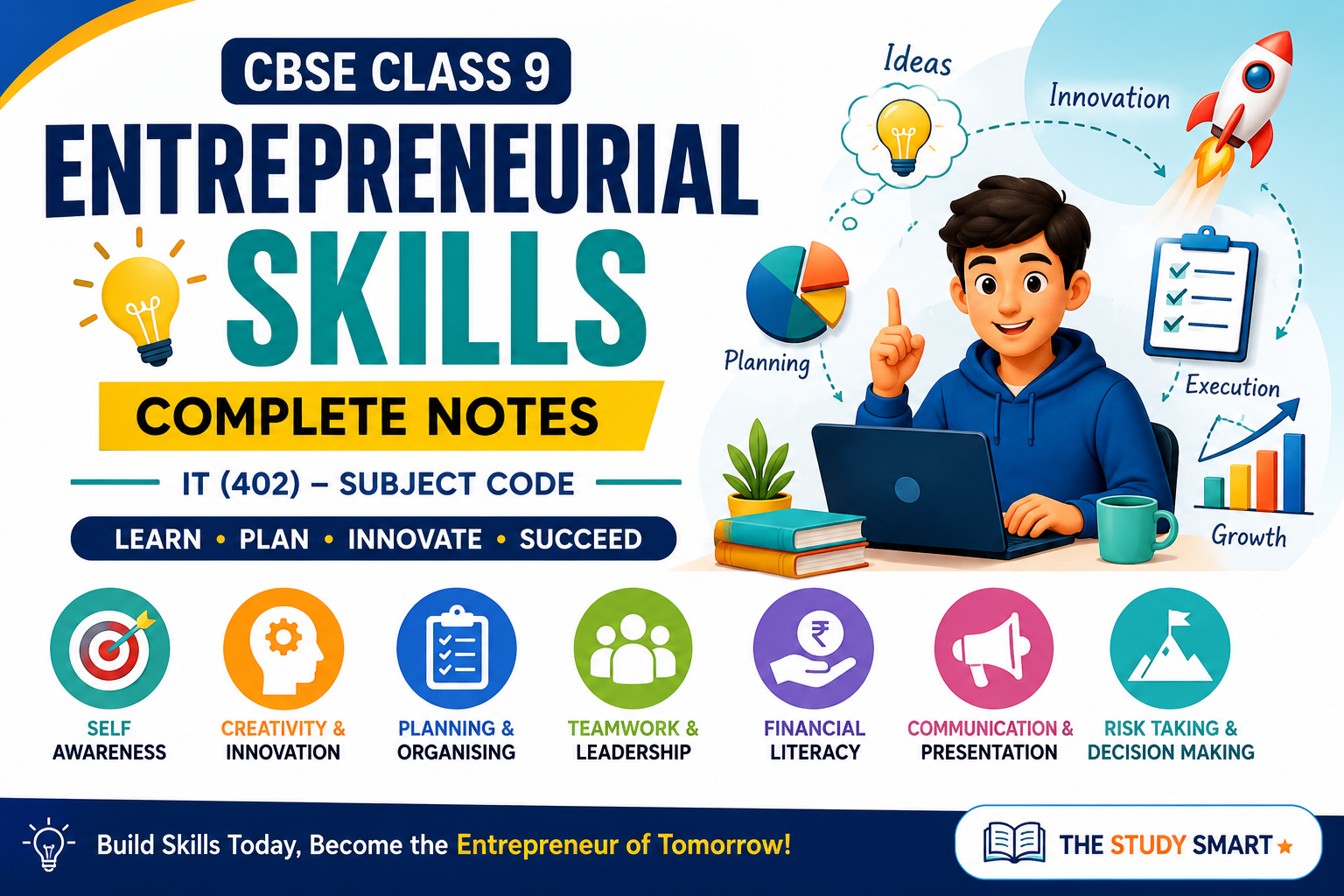
Entrepreneurship is an important skill that helps people turn their ideas into useful products and services. It encourages creativity, innovation, problem-solving and independent thinking.
In Class 9 Information Technology (402), Entrepreneurial Skills is included in the Employability Skills section. This chapter introduces students to the meaning of entrepreneurship, qualities of successful entrepreneurs, different types of business activities and the process of starting a business.
These notes explain the important concepts in simple language to help students understand the chapter and prepare for examinations.
1. What is Entrepreneurship?
Before understanding entrepreneurship, let us learn three important terms: entrepreneur, entrepreneurship and enterprise.
1.1 Who is an Entrepreneur?
An entrepreneur is a person who is self-employed, is willing to take calculated risks and introduces a new idea to start a business.
An entrepreneur identifies opportunities, develops ideas and makes efforts to establish a business.
Example: A person who starts an online business selling handmade products by using a new marketing idea can be called an entrepreneur.
1.2 What is Entrepreneurship?
Entrepreneurship is the process of developing a business plan, launching and running a business by using innovation to meet customer needs and earn profit.
It involves identifying opportunities, arranging resources, taking calculated risks and managing business activities.
1.3 What is an Enterprise?
An enterprise is a project or business undertaking started to fulfil a need of society. It is established and managed by an entrepreneur.
Example: A business that develops affordable learning applications for students is an enterprise.
Difference Between Entrepreneur, Entrepreneurship and Enterprise
| Term | Meaning |
|---|---|
| Entrepreneur | A person who starts and manages a business by taking calculated risks. |
| Entrepreneurship | The process of developing, starting and running a business. |
| Enterprise | The business or undertaking started by an entrepreneur. |
2. Role of Entrepreneurship
Entrepreneurship plays an important role in the economic and social development of a country. It creates business opportunities, generates employment and improves people’s standard of living.
The major roles of entrepreneurship are:
2.1 Economic Development
Entrepreneurs establish businesses, invest money and create economic activities. As businesses grow, they contribute to the growth of the economy.
2.2 Social Development and Creation of Jobs
When a business expands, it requires more workers. This creates employment opportunities and helps people earn their livelihood.
2.3 Improved Standard of Living
Entrepreneurs introduce useful products and services that make people’s lives easier and more comfortable.
Example: Mobile phones, online services and modern farming equipment help people perform daily activities more efficiently.
2.4 Optimal Use of Resources
Entrepreneurs try to use available resources effectively. They find better ways to reduce unnecessary costs, improve productivity and increase profits.
3. Qualities of a Successful Entrepreneur
A successful entrepreneur needs several personal and professional qualities. These qualities help them face challenges, make decisions and achieve business goals.
Important qualities include:
3.1 Patience
An entrepreneur must be patient because success does not always come quickly. Building a business requires time, effort and continuous improvement.
3.2 Positivity
A positive attitude helps entrepreneurs remain hopeful and motivated even when they face difficulties or take risks.
3.3 Hard Work and Perseverance
Entrepreneurs must work continuously towards their goals. They should not give up easily when they face problems or failures.
3.4 Confidence
Confidence helps entrepreneurs take important decisions, communicate their ideas and face challenges.
3.5 Open to Trial and Error
Entrepreneurs should be willing to experiment with new ideas. They learn from mistakes and improve their products or services.
3.6 Creativity and Innovation
Creativity helps entrepreneurs develop new ideas, while innovation helps them convert those ideas into useful products, services or business methods.
Remember: A successful entrepreneur is patient, positive, hardworking, confident, creative and willing to learn from mistakes.
4. Entrepreneurship and Wage Employment
People can earn money either by starting and managing their own businesses or by working for someone else.
These are two different ways of earning a livelihood.
4.1 What is Wage Employment?
Wage employment is a type of employment in which a person works for an employer and receives payment in return for their work.
There are two parties involved:
- Employer: The person or organisation that provides work and pays wages or salary.
- Employee: The person who works for the employer and receives payment.
Example: A teacher working in a school for a monthly salary is a wage-employed person.
4.2 Characteristics of Entrepreneurship
Some important characteristics of entrepreneurship are:
- Ability to take calculated risks.
- Belief in hard work and discipline.
- Adaptability and flexibility.
- Knowledge of products and services.
- Understanding customer needs and market demand.
- Money management and financial literacy.
- Effective planning and execution.
4.3 Difference Between Entrepreneurship and Wage Employment
| Entrepreneurship | Wage Employment |
|---|---|
| A person starts and manages their own business. | A person works for an employer. |
| The entrepreneur takes calculated business risks. | The employee generally has less direct business risk. |
| Income depends on business performance. | Income is generally received as wages or salary. |
| The entrepreneur makes business decisions. | The employee performs assigned duties. |
| The entrepreneur is responsible for managing the business. | The employer is responsible for managing the organisation. |
4.4 Benefits of Entrepreneurship
Entrepreneurship offers several benefits:
- Work according to your interests: A person can start a business based on their hobbies, interests and abilities.
- Be your own boss: Entrepreneurs can make decisions about their own businesses.
- Earn profits: Entrepreneurs can earn profits from successful business activities.
- Choose the level of risk: Entrepreneurs can decide which business opportunities and calculated risks they are willing to take.
5. Types of Business Activities
Business activities can be divided into three major types:
- Product Business
- Service Business
- Hybrid Business
5.1 Product Business
A product-based business is one in which sellers sell physical goods to customers.
These products can generally be seen and touched.
Examples:
- A sports shop selling cricket bats and footballs.
- A bookshop selling textbooks.
- A furniture shop selling tables and chairs.
5.2 Service Business
A service-based business provides services or helps customers complete particular tasks.
A service is generally an activity or experience rather than a physical product.
Examples:
- A cricket coaching centre.
- A beauty salon.
- A computer repair centre.
- A tuition centre.
5.3 Hybrid Business
A hybrid business offers both products and services to customers.
Example: A sports academy that provides cricket coaching and also sells sports equipment is a hybrid business.
Difference Between Product Business and Service Business
| Product Business | Service Business |
|---|---|
| Products can be seen and touched. | Services cannot generally be seen or touched. |
| Customers pay for physical goods. | Customers pay for an activity or service. |
| Products can usually be stored. | Services cannot usually be stored. |
| Products can be manufactured and transported. | Services are generally provided when required by customers. |
| Product quality and quantity can be standardised. | Service quality may vary depending on the situation. |
5.4 Types of Product-Based Businesses
Product-based businesses can be further divided into two types:
1. Manufacturing Business
Manufacturing businesses produce goods and sell them to customers or other businesses.
Examples include:
- A factory manufacturing clothes.
- A company producing mobile phones.
- A bakery producing biscuits and cakes.
2. Trade Business
Trade businesses buy products from manufacturers or suppliers and sell them to customers.
They may also be involved in transporting products from factories to warehouses and shops.
Examples include:
- A grocery shop.
- A mobile phone showroom.
- A stationery shop.
6. Entrepreneurship Development Process
Entrepreneurship development is the process of improving the skills, knowledge and abilities of entrepreneurs.
It helps people understand how to identify business opportunities, plan activities, arrange resources and manage a business.
Entrepreneurship development can take place through formal and informal learning.
- Formal learning: Training programmes and organised learning activities that develop entrepreneurial knowledge and skills.
- Informal learning: Learning through personal experiences, observation and practical activities.
6.1 Steps to Start a Business
Starting a business requires planning and preparation. The important steps are:
Step 1: Come Up with a Business Idea
The first step is to identify a business idea. The idea should address a customer need or solve a problem.
Step 2: Arrange Money and Materials
After selecting an idea, the entrepreneur needs to arrange the money, raw materials, tools and other resources required to start the business.
Step 3: Understand Customer Needs
An entrepreneur must understand what customers want, what problems they face and what they expect from a product or service.
Step 4: Improve the Product or Service
The entrepreneur should collect feedback and continuously improve the product or service to satisfy customers.
7. Important Terms to Remember
| Term | Meaning |
|---|---|
| Entrepreneur | A person who starts a business by taking calculated risks and introducing ideas. |
| Entrepreneurship | The process of starting and running a business. |
| Enterprise | A business or undertaking started by an entrepreneur. |
| Innovation | Introducing a new or improved idea, product or method. |
| Wage Employment | Working for an employer in return for wages or salary. |
| Product Business | A business that sells physical goods. |
| Service Business | A business that provides services to customers. |
| Hybrid Business | A business that sells products as well as services. |
| Manufacturing | Producing goods for sale. |
| Trade | Buying and selling goods. |
| Entrepreneurship Development | Improving the skills and knowledge of entrepreneurs. |
8. Quick Revision – Important Points
- An entrepreneur is a person who starts and manages a business by taking calculated risks.
- Entrepreneurship is the process of developing, launching and running a business.
- An enterprise is the business or undertaking started by an entrepreneur.
- Entrepreneurship supports economic development and creates employment opportunities.
- Patience, positivity, hard work, confidence and creativity are important entrepreneurial qualities.
- Wage employment involves working for an employer in return for wages or salary.
- There are three types of business activities: product, service and hybrid.
- Manufacturing businesses produce goods, whereas trade businesses buy and sell goods.
- Entrepreneurship development improves the knowledge and skills of entrepreneurs.
- The basic steps of starting a business include developing an idea, arranging resources, understanding customer needs and improving the product or service.
9. Frequently Asked Questions (FAQs)
Q1. Who is an entrepreneur?
An entrepreneur is a person who is self-employed, takes calculated risks and introduces new ideas to start a business.
Q2. What is entrepreneurship?
Entrepreneurship is the process of developing a business plan, launching and running a business using innovation to meet customer needs and earn profit.
Q3. What is an enterprise?
An enterprise is a project or business undertaking started by an entrepreneur to fulfil a need of society.
Q4. Write any four qualities of a successful entrepreneur.
Patience, positivity, hard work and confidence are four important qualities of a successful entrepreneur.
Q5. What are the three types of business activities?
The three types are product business, service business and hybrid business.
Q6. What is a hybrid business? Give an example.
A hybrid business sells both products and services. For example, a sports academy that provides coaching and sells sports equipment.
Q7. What is wage employment?
Wage employment is a type of employment in which a person works for an employer and receives wages or salary.
Q8. What is entrepreneurship development?
Entrepreneurship development is the process of improving the knowledge, skills and abilities of entrepreneurs.
Q9. What are manufacturing businesses?
Manufacturing businesses produce goods and sell them to customers or other businesses.
Q10. Mention the four basic steps of starting a business.
- Developing a business idea.
- Arranging money and materials.
- Understanding customer needs.
- Improving the product or service.
10. Practice Questions
Test your understanding of the chapter with the following questions.
A. Multiple Choice Questions (MCQs)
1. A person who starts a business by taking calculated risks is called a:
(a) Employee
(b) Customer
(c) Entrepreneur
(d) Supplier
2. Which of the following is NOT a quality of a successful entrepreneur?
(a) Patience
(b) Confidence
(c) Giving up easily
(d) Hard work
3. A business that sells both products and services is known as:
(a) Product business
(b) Service business
(c) Hybrid business
(d) Manufacturing business
4. Which of the following is an example of a service business?
(a) Furniture shop
(b) Cricket coaching centre
(c) Grocery shop
(d) Bookshop
5. Businesses that make products and sell them are called:
(a) Trade businesses
(b) Manufacturing businesses
(c) Service businesses
(d) Hybrid businesses
B. Fill in the Blanks
- A person who starts a business by taking calculated risks is called an __________.
- The process of starting and running a business is called __________.
- A business that offers both products and services is called a __________ business.
- Businesses that buy and sell products are known as __________ businesses.
- __________ helps entrepreneurs develop new and original ideas.
C. True or False
- All self-employed people are entrepreneurs.
- Entrepreneurship helps create employment opportunities.
- A service can usually be stored in a warehouse.
- A hybrid business offers both products and services.
- Confidence is an important quality of an entrepreneur.
D. Short Answer Questions
- Define entrepreneurship.
- What is an enterprise?
- Write any four roles of entrepreneurship.
- Explain any four qualities of a successful entrepreneur.
- What is wage employment?
- Differentiate between product business and service business.
- What is entrepreneurship development?
- Explain manufacturing and trade businesses.
E. Long Answer Questions
- Explain the role of entrepreneurship in the economic and social development of a country.
- Describe the important qualities of a successful entrepreneur.
- Explain the three types of business activities with suitable examples.
- Differentiate between entrepreneurship and wage employment.
- Explain the four basic steps involved in starting a business.
11. Answer Key
MCQ Answers
| Question | Correct Answer |
|---|---|
| 1 | (c) Entrepreneur |
| 2 | (c) Giving up easily |
| 3 | (c) Hybrid business |
| 4 | (b) Cricket coaching centre |
| 5 | (b) Manufacturing businesses |
Fill in the Blanks
- Entrepreneur
- Entrepreneurship
- Hybrid
- Trade
- Creativity
True or False
- False
- True
- False
- True
- True
Conclusion
Entrepreneurial skills help students develop creativity, confidence, problem-solving abilities and a positive attitude towards new opportunities. Understanding entrepreneurship at an early stage can encourage students to think independently and identify ways to solve real-life problems.
Students should revise the definitions, qualities of entrepreneurs, types of business activities and steps involved in starting a business to prepare effectively for their examinations.
Keep learning with The Study Smart – Learn Smart, Score Better!