Introduction
Everything around us is made up of matter. The air we breathe, the water we drink, the food we eat and the objects we use every day are all made up of tiny particles called atoms.
In the previous chapter, Journey Inside the Atom, we studied the structure of atoms and their subatomic particles – electrons, protons and neutrons. We also learnt about electronic configuration and how atoms achieve stability by completing their outermost electron shells.
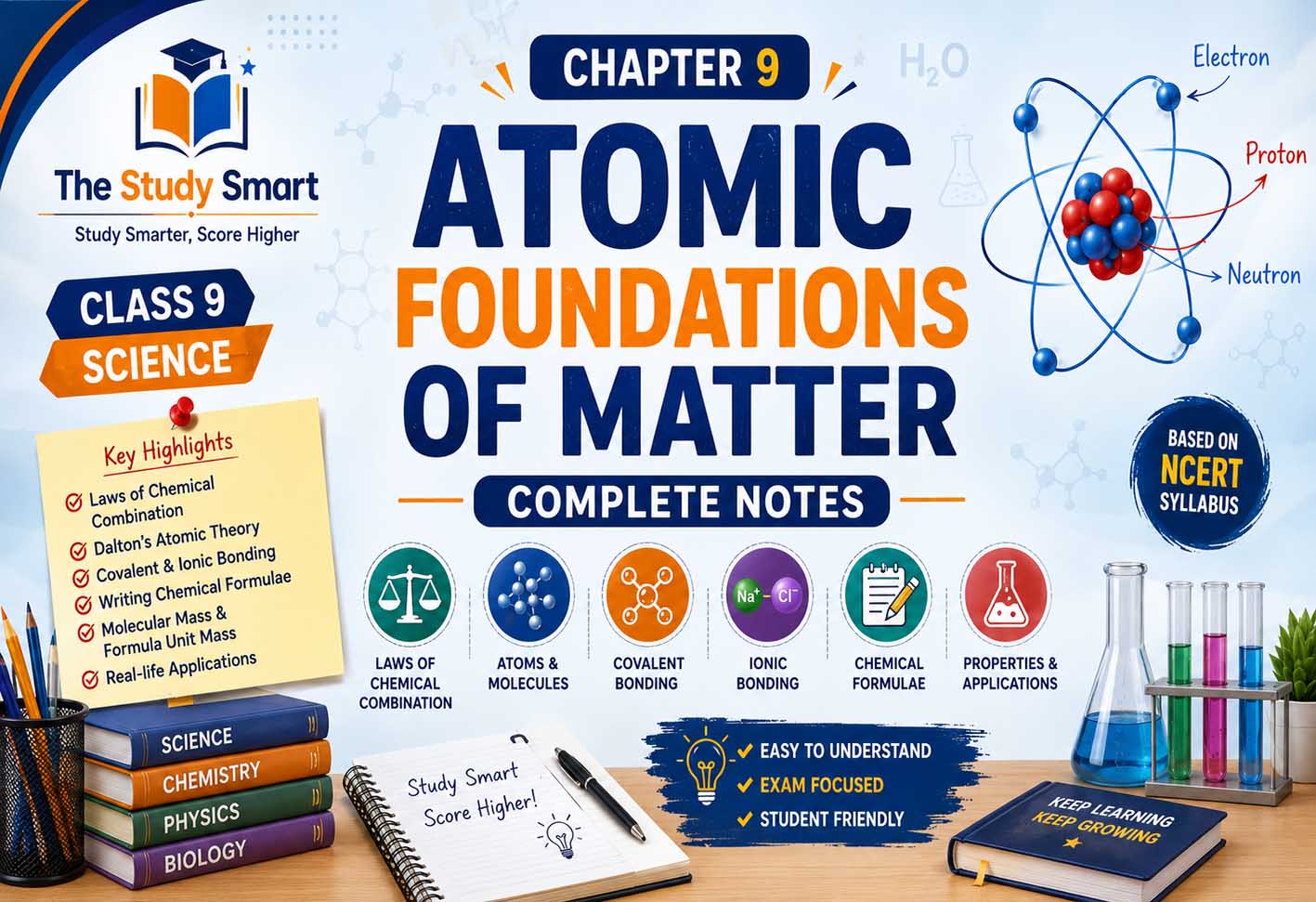
In this chapter, we will understand how atoms combine to form molecules and compounds, why chemical reactions follow certain laws, and how chemical bonds are formed.
The chapter covers the following important concepts:
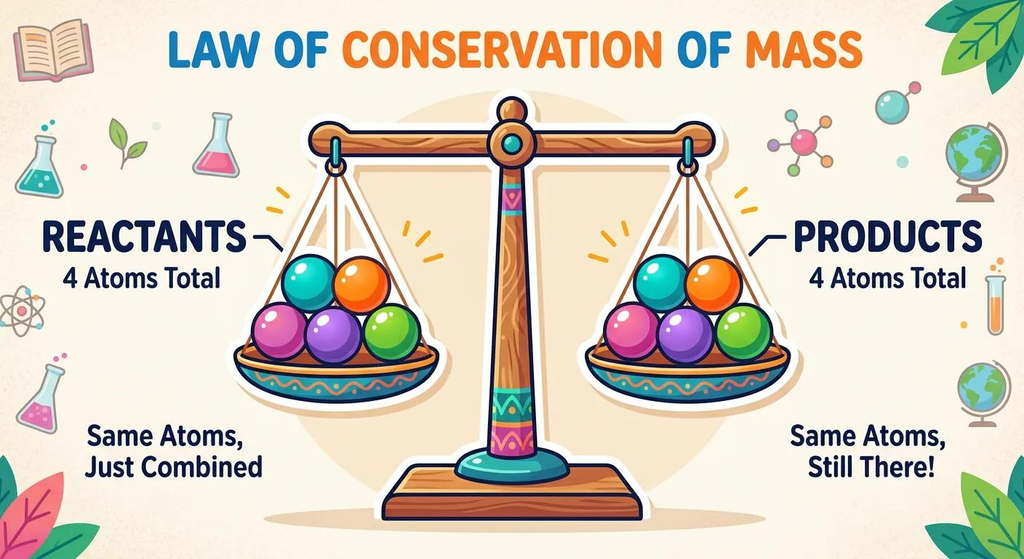
- Law of Conservation of Mass
- Law of Constant Proportions
- Dalton’s Atomic Theory
- How Atoms Combine
- Covalent Bonding
- Ionic Bonding
- Naming Chemical Compounds
- Writing Chemical Formulae
- Properties of Ionic and Covalent Compounds
- Molecular Mass and Formula Unit Mass
1. Law of Conservation of Mass
Before understanding this law, let us consider an interesting example.
Hydrogen and oxygen are gases. Hydrogen burns, while oxygen supports combustion. However, when these two gases combine chemically, they form water, which is a liquid and can extinguish fire.
This shows that a compound may have completely different properties from the elements that form it.
But an important question arises: Does the total mass change when substances undergo a chemical reaction?
Physical Changes and Conservation of Mass
A physical change is a change in which the physical properties of a substance, such as its shape, size or state, change without forming a new substance.
Example: Dissolving salt in water
When common salt is added to water and stirred, it dissolves to form a salt solution.
The mass of the solution is equal to the sum of the masses of the salt and water taken.
Mass of solution = Mass of water + Mass of salt
Therefore, there is practically no change in the total mass during this physical change.
Other examples include:
- Tearing a piece of paper.
- Melting ice into water.
- Dissolving sugar in water.
Conservation of Mass During a Chemical Change
A chemical change results in the formation of one or more new substances.
Consider the reaction between vinegar and baking soda.
Vinegar + Baking soda → Carbon dioxide + Other substances
During this reaction, carbon dioxide gas is produced. We can demonstrate the conservation of mass using two experimental arrangements.
Experiment 1: Open system
- Take vinegar in a conical flask.
- Place baking soda in a balloon.
- Weigh the flask, balloon and their contents together.
- Transfer the baking soda into the vinegar.
- Observe the reaction and weigh the contents again.
Observation: The final reading is lower than the initial reading because carbon dioxide gas escapes into the surroundings.
Experiment 2: Closed system
- Take vinegar in a conical flask.
- Place baking soda inside a balloon.
- Fix the balloon securely to the mouth of the flask without mixing the substances.
- Weigh the complete arrangement.
- Lift the balloon so that the baking soda falls into the vinegar.
- Allow the reaction to take place and weigh the arrangement again.
Observation: The balloon inflates because carbon dioxide is produced. The final mass remains equal to the initial mass because the gas is trapped inside the closed arrangement.
Statement of the Law
The Law of Conservation of Mass states that:
Matter can neither be created nor destroyed in a chemical reaction.
In other words:
Total mass of reactants = Total mass of products
This law was proposed by Antoine Lavoisier in 1789. He is known as the Father of Modern Chemistry.
Example 1: Verification of Conservation of Mass
A reaction takes place in a closed container. The following substances are involved:
| Substance | Mass |
|---|---|
| Calcium carbonate | 4.0 g |
| Hydrochloric acid | 2.92 g |
| Carbon dioxide formed | 1.76 g |
| Water formed | 0.72 g |
| Calcium chloride formed | 4.44 g |
Solution:
Total mass of reactants:
= 4.0 + 2.92
= 6.92 g
Total mass of products:
= 1.76 + 0.72 + 4.44
= 6.92 g
Since:
Mass of reactants = Mass of products
Therefore, the Law of Conservation of Mass is verified.
Example 2: Finding the Mass of a Product
12 g of carbon combines with 32 g of oxygen to form 44 g of carbon dioxide.
If 2.4 g of carbon reacts completely with oxygen, calculate the mass of carbon dioxide formed.
Solution:
12 g of carbon produces 44 g of carbon dioxide.
Therefore, 1 g of carbon produces:
= 44 ÷ 12 g
For 2.4 g of carbon:
= (44 ÷ 12) × 2.4
= 8.8 g
Answer: 8.8 g of carbon dioxide is formed.
2. Law of Constant Proportions
Have you ever wondered whether water collected from a river, ocean or borewell has the same chemical composition?
Pure water, irrespective of its source, always contains hydrogen and oxygen in a fixed ratio by mass.
Statement of the Law
The Law of Constant Proportions states that:
In a chemical compound, the constituent elements are always present in a fixed ratio by mass, irrespective of the source or method of preparation of the compound.
This law was proposed by Joseph Louis Proust. It is also known as:
- Law of Definite Proportions
- Proust’s Law
Example: Composition of Water
Water has the chemical formula H₂O.
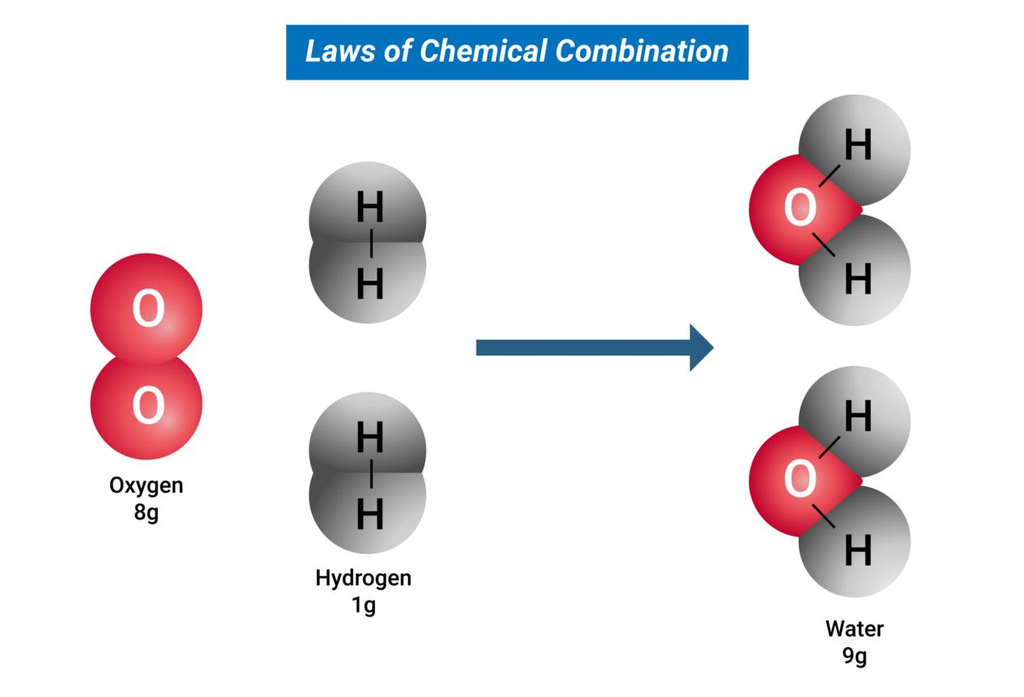
The mass ratio of hydrogen to oxygen in water is always:
Hydrogen : Oxygen = 1 : 8
This means:
| Mass of water | Hydrogen | Oxygen |
|---|---|---|
| 9 g | 1 g | 8 g |
| 18 g | 2 g | 16 g |
| 27 g | 3 g | 24 g |
The ratio remains unchanged, irrespective of the source of pure water.
Example: Sodium Chloride
Sodium chloride (NaCl) contains sodium and chlorine in the mass ratio of 23 : 35.5.
If 46 g of sodium reacts completely, calculate the mass of chlorine required.
Solution:
23 g sodium requires 35.5 g chlorine.
46 g sodium requires:
= (35.5 ÷ 23) × 46
= 71 g
Answer: 71 g of chlorine.
Important Difference: Conservation of Mass vs Constant Proportions
| Law of Conservation of Mass | Law of Constant Proportions |
|---|---|
| Deals with total mass during a chemical reaction. | Deals with the composition of a compound. |
| Total mass of reactants equals total mass of products. | Elements are present in a fixed ratio by mass. |
| Proposed by Antoine Lavoisier. | Proposed by Joseph Proust. |
| Example: Mass before and after a reaction remains constant in a closed system. | Example: Hydrogen and oxygen in water are always in a 1:8 mass ratio. |
3. Dalton’s Atomic Theory
The two laws discussed above helped scientists understand how matter behaves during chemical reactions.
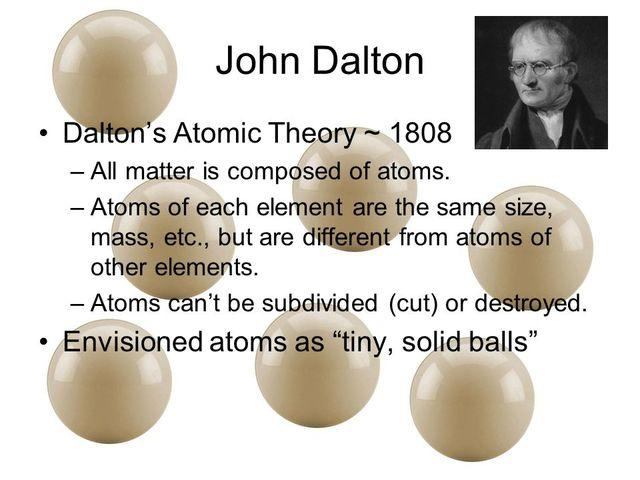
John Dalton proposed an atomic theory to explain these observations. He presented his atomic theory in 1808.
A postulate is a fundamental assumption accepted as true without formal proof, from which further ideas are developed.
Postulates of Dalton’s Atomic Theory
According to John Dalton:
- All matter is made up of extremely tiny particles called atoms, which participate in chemical reactions.
- Atoms are indivisible particles that cannot be created or destroyed during a chemical reaction.
- Atoms of the same element are identical in mass and chemical properties.
- Atoms of different elements have different masses and chemical properties.
- Atoms combine in simple whole-number ratios to form compounds.
- The relative number and kinds of atoms remain constant in a given compound.
Examples
Formation of Water
Hydrogen and oxygen atoms combine to form water. The atoms are rearranged during the reaction but are not created or destroyed.
Formation of Magnesium Oxide
Magnesium reacts with oxygen to form magnesium oxide, a white powder.
Magnesium + Oxygen → Magnesium oxide
The magnesium and oxygen atoms combine to form a new compound.
Importance of Dalton’s Atomic Theory
- It helped explain the Law of Conservation of Mass.
- It explained why elements combine in fixed proportions.
- It established the importance of atoms in chemical reactions.
- It provided a foundation for the modern understanding of matter.
4. How Do Atoms Combine?
Atoms combine with one another to achieve a more stable electronic configuration.
You have already learnt that atoms with a complete outermost shell are generally stable.
- Atoms are generally stable when their outermost shell contains eight electrons.
- If the K-shell is the outermost shell, two electrons make it complete.
This is known as the octet rule, while the completion of two electrons in the K-shell is called the duplet configuration.
Atoms achieve stability mainly through two processes:
- Sharing of electrons.
- Transfer of electrons.
The force that holds atoms together is called a chemical bond.
When atoms combine, the resulting arrangement has lower total energy than the separate atoms, making the arrangement more stable.
5. Covalent Bond – Bonding by Sharing of Electrons
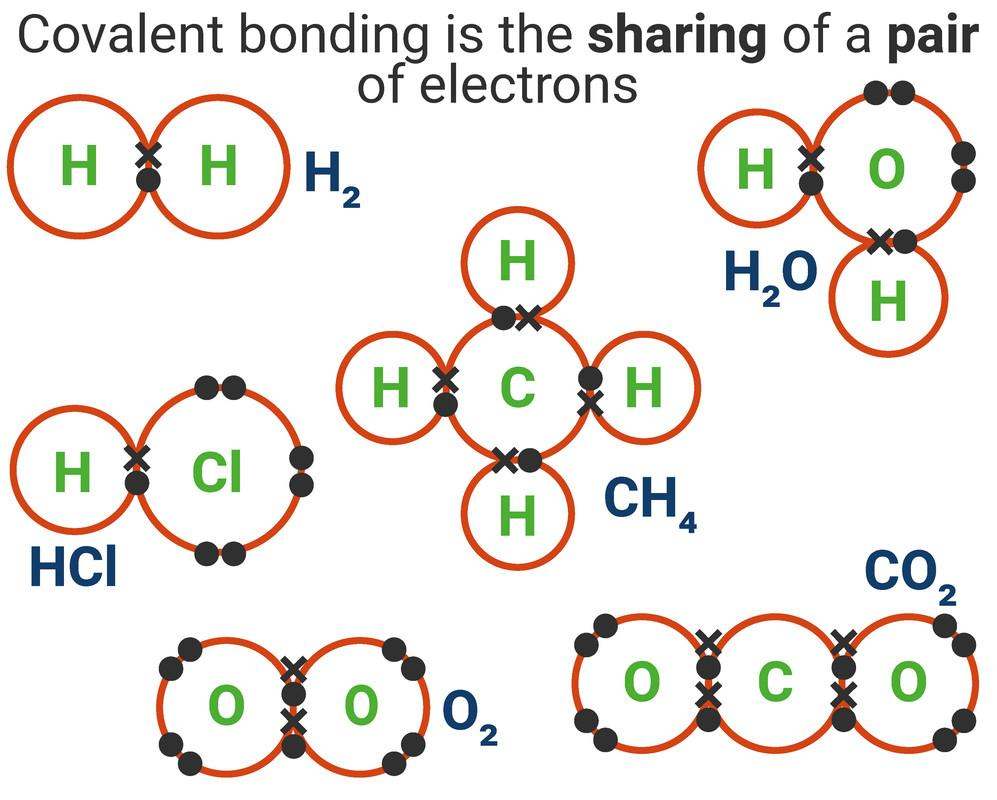
A covalent bond is formed when two atoms share one or more pairs of electrons to achieve stable electronic configurations.
The shared electrons attract the nuclei of both atoms and hold the atoms together.
Types of Covalent Bonds
| Type of bond | Number of shared electron pairs | Example |
|---|---|---|
| Single covalent bond | 1 pair | H₂, Cl₂, HCl |
| Double covalent bond | 2 pairs | O₂ |
| Triple covalent bond | 3 pairs | N₂ |
5.1 Formation of Hydrogen Molecule (H₂)
The atomic number of hydrogen is 1.
Its electronic configuration is 1.
Each hydrogen atom contains one electron in its K-shell and requires one more electron to complete its duplet.
When two hydrogen atoms come close, each shares one electron with the other.
Thus, a hydrogen molecule is formed.
Representation:
H—H
One shared pair of electrons forms a single covalent bond.
5.2 Formation of Chlorine Molecule (Cl₂)
The atomic number of chlorine is 17.
Its electronic configuration is 2, 8, 7.
Each chlorine atom has seven valence electrons and needs one more electron to complete its octet.
Two chlorine atoms share one electron each.
The resulting molecule is represented as:
Cl—Cl
This is a single covalent bond.
5.3 Formation of Oxygen Molecule (O₂)
The atomic number of oxygen is 8.
Its electronic configuration is 2, 6.
Each oxygen atom has six valence electrons and requires two more electrons to complete its octet.
Therefore, two oxygen atoms share two electrons each, forming two shared pairs.
Representation:
O=O
This is a double covalent bond.
5.4 Formation of Hydrogen Chloride (HCl)
Hydrogen has one electron and requires one more electron to complete its duplet.
Chlorine has seven valence electrons and requires one more electron to complete its octet.
Both atoms share one electron each.
Thus, hydrogen chloride is formed.
Representation:
H—Cl
Since electrons are shared, HCl is a covalent compound.
5.5 Formation of Water (H₂O)
Oxygen has six valence electrons and needs two more electrons to complete its octet.
Each hydrogen atom needs one electron to complete its duplet.
Therefore, two hydrogen atoms share one electron each with one oxygen atom.
The resulting molecule is represented as:
H₂O
One water molecule contains:
- Two hydrogen atoms.
- One oxygen atom.
- Two single covalent bonds.
Important Covalent Molecules
| Molecule | Chemical formula | Bond representation |
|---|---|---|
| Hydrogen | H₂ | H—H |
| Chlorine | Cl₂ | Cl—Cl |
| Oxygen | O₂ | O=O |
| Hydrogen chloride | HCl | H—Cl |
| Water | H₂O | H—O—H |
6. Naming Covalent Compounds
Covalent compounds are named using prefixes that indicate the number of atoms of each element present in the molecule.
Rules for Naming
- The first element retains its regular name.
- The second element generally ends with the suffix ‘-ide’.
- Prefixes are used to indicate the number of atoms.
- The prefix mono- is generally omitted for the first element but is used for the second element.
- When a prefix ending in ‘o’ or ‘a’ is followed by a word beginning with a vowel, the final vowel is generally dropped.
Important Prefixes
| Number of atoms | Prefix |
|---|---|
| 1 | Mono |
| 2 | Di |
| 3 | Tri |
| 4 | Tetra |
| 5 | Penta |
| 6 | Hexa |
Examples
| Chemical formula | Name |
|---|---|
| CO | Carbon monoxide |
| CO₂ | Carbon dioxide |
| CS₂ | Carbon disulfide |
| PCl₃ | Phosphorus trichloride |
| SF₆ | Sulfur hexafluoride |
| N₂O₄ | Dinitrogen tetroxide |
| N₂O₅ | Dinitrogen pentoxide |
Special cases:
- H₂S is called hydrogen sulfide, not dihydrogen sulfide.
- H₂O is commonly known as water.
- NH₃ is commonly known as ammonia.
7. Ionic Bond – Bonding by Transfer of Electrons
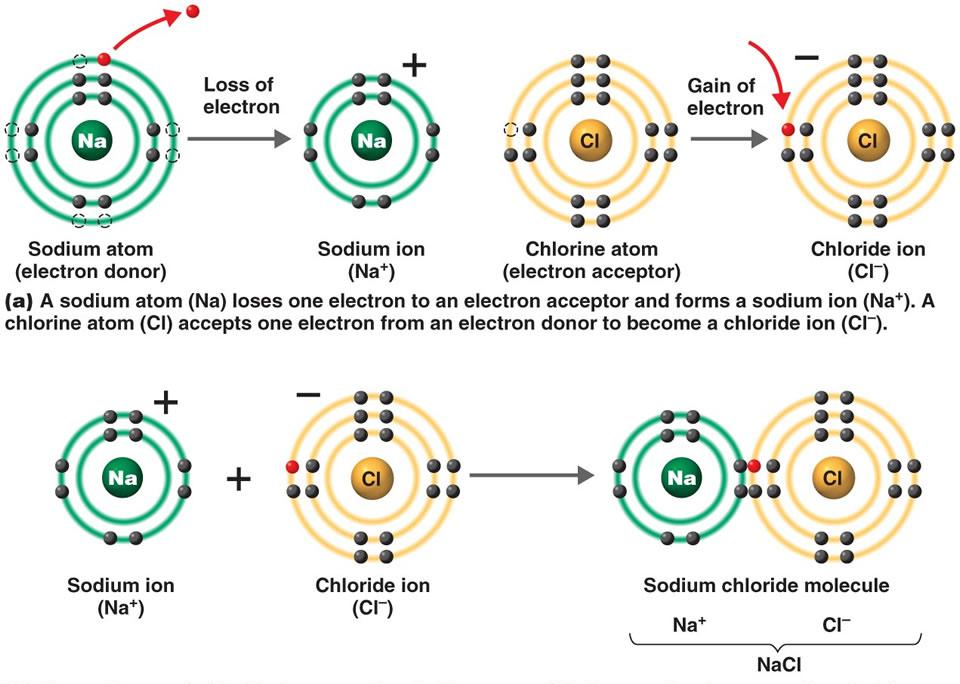
An ionic bond is formed when electrons are transferred from one atom to another.
Generally, metals lose electrons to form positively charged ions, while non-metals gain electrons to form negatively charged ions.
The oppositely charged ions attract each other through electrostatic forces.
This force of attraction is called an ionic bond.
What Are Ions?
An ion is an atom or group of atoms carrying an electrical charge.
There are two main types:
1. Cation
A positively charged ion formed when an atom loses one or more electrons.
Examples: Na⁺, Mg²⁺, Ca²⁺
2. Anion
A negatively charged ion formed when an atom gains one or more electrons.
Examples: Cl⁻, O²⁻, S²⁻
Formation of Sodium Chloride (NaCl)
Sodium chloride is common table salt.
Let us understand how it is formed.
Step 1: Sodium atom
- Atomic number = 11
- Electronic configuration = 2, 8, 1
- Valence electrons = 1
Sodium becomes stable by losing its one valence electron.
Na → Na⁺ + e⁻
The sodium atom now has 11 protons and 10 electrons. Therefore, it becomes positively charged.
It is called a sodium cation.
Step 2: Chlorine atom
- Atomic number = 17
- Electronic configuration = 2, 8, 7
- Valence electrons = 7
Chlorine requires one electron to complete its octet.
Cl + e⁻ → Cl⁻
After gaining an electron, chlorine becomes negatively charged.
It is called a chloride anion.
Step 3: Formation of ionic bond
The positively charged sodium ion and negatively charged chloride ion attract each other.
Na⁺ + Cl⁻ → NaCl
Thus, sodium chloride is formed by the transfer of one electron from sodium to chlorine.
Formation of Sulfide Ion
Sulfur has six electrons in its outermost shell.
It requires two additional electrons to complete its octet.
Therefore:
S + 2e⁻ → S²⁻
Sulfur forms a negatively charged sulfide ion.
8. Crystal Structure of Ionic Compounds
Ionic compounds generally do not exist as individual molecules.
Instead, their positive and negative ions are arranged in a regular, repeating three-dimensional pattern called a crystal structure.
For example, in sodium chloride:
- Each sodium ion is surrounded by six chloride ions.
- Each chloride ion is surrounded by six sodium ions.
This regular arrangement is represented using a crystal lattice.
The crystal structure helps explain why ionic compounds have strong attractions between their ions.
9. Naming Ionic Compounds
Ionic compounds are named by writing the name of the positive ion first, followed by the name of the negative ion.
Rules
- Write the cation name first.
- Write the anion name second.
- Simple anions generally end in ‘-ide’.
- Names of polyatomic ions generally retain their special names.
Examples
| Formula | Name |
|---|---|
| NaCl | Sodium chloride |
| CaO | Calcium oxide |
| MgS | Magnesium sulfide |
| NaOH | Sodium hydroxide |
| NaNO₃ | Sodium nitrate |
| CaCO₃ | Calcium carbonate |
| NH₄Cl | Ammonium chloride |
Common Monoatomic Ions
| Name | Symbol | Valency |
|---|---|---|
| Sodium | Na⁺ | 1 |
| Lithium | Li⁺ | 1 |
| Potassium | K⁺ | 1 |
| Silver | Ag⁺ | 1 |
| Calcium | Ca²⁺ | 2 |
| Barium | Ba²⁺ | 2 |
| Magnesium | Mg²⁺ | 2 |
| Zinc | Zn²⁺ | 2 |
| Aluminium | Al³⁺ | 3 |
| Iron (Ferrous) | Fe²⁺ | 2 |
| Iron (Ferric) | Fe³⁺ | 3 |
| Copper (Cuprous) | Cu⁺ | 1 |
| Copper (Cupric) | Cu²⁺ | 2 |
| Fluoride | F⁻ | 1 |
| Chloride | Cl⁻ | 1 |
| Bromide | Br⁻ | 1 |
| Iodide | I⁻ | 1 |
| Oxide | O²⁻ | 2 |
| Sulfide | S²⁻ | 2 |
Common Polyatomic Ions
Polyatomic ions are ions formed by the combination of two or more atoms.
| Name | Formula | Valency |
|---|---|---|
| Ammonium | NH₄⁺ | 1 |
| Hydroxide | OH⁻ | 1 |
| Nitrate | NO₃⁻ | 1 |
| Hydrogencarbonate | HCO₃⁻ | 1 |
| Carbonate | CO₃²⁻ | 2 |
| Sulfate | SO₄²⁻ | 2 |
10. Writing Chemical Formulae
A chemical formula represents the elements present in a compound and the number of atoms or the simplest ratio of ions present in it.
There are two commonly used approaches in this chapter:
- Writing formulae of covalent compounds using valencies.
- Writing formulae of ionic compounds using ion charges and the criss-cross method.
10.1 Writing Formulae of Covalent Compounds
Follow these steps:
- Write the symbols of the constituent elements.
- Write their valencies.
- Cross over the valencies and write them as subscripts.
- Simplify the subscripts if required.
- Do not write the subscript 1.
Example 1: Hydrogen Chloride
Hydrogen valency = 1
Chlorine valency = 1
After crossing over, the formula is:
HCl
Example 2: Hydrogen Sulfide
Hydrogen valency = 1
Sulfur valency = 2
After crossing over:
H₂S
Example 3: Carbon Tetrachloride
Carbon valency = 4
Chlorine valency = 1
After crossing over:
CCl₄
10.2 Writing Formulae of Ionic Compounds
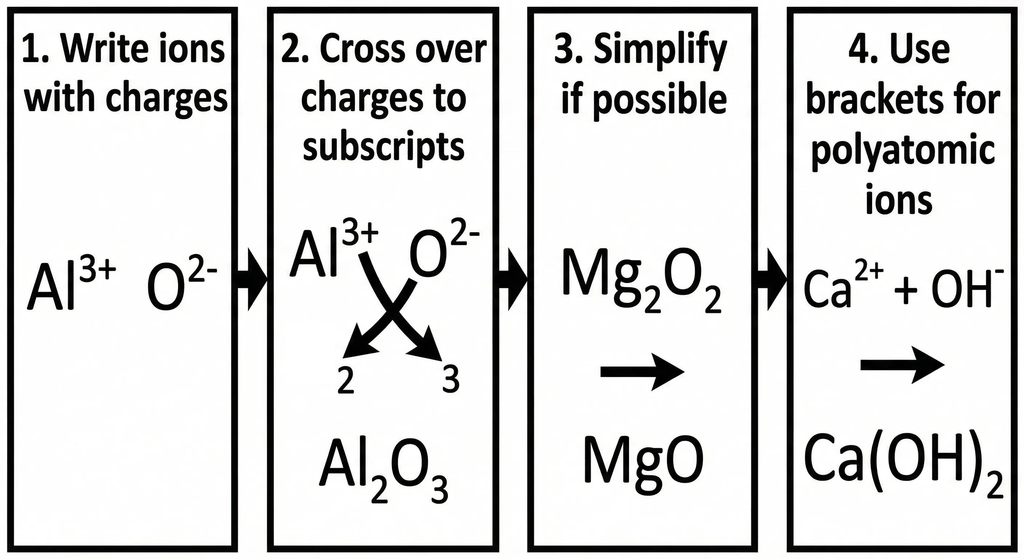
The criss-cross method makes writing ionic formulae easier.
Follow these steps:
- Write the symbol of the cation first.
- Write the symbol of the anion second.
- Write their charges.
- Cross over the numerical values of the charges as subscripts.
- Simplify the subscripts wherever possible.
- Do not write a subscript of 1.
- Use brackets when more than one polyatomic ion of the same type is present.
Example 1: Calcium Chloride
Calcium ion = Ca²⁺
Chloride ion = Cl⁻
Cross over the charges:
Ca₁Cl₂
The subscript 1 is not written.
Formula = CaCl₂
Example 2: Aluminium Oxide
Aluminium ion = Al³⁺
Oxide ion = O²⁻
After crossing over:
Formula = Al₂O₃
Example 3: Magnesium Oxide
Magnesium ion = Mg²⁺
Oxide ion = O²⁻
After crossing over:
Mg₂O₂
Divide both subscripts by 2.
Formula = MgO
Example 4: Calcium Carbonate
Calcium ion = Ca²⁺
Carbonate ion = CO₃²⁻
After crossing over, the subscripts are 2 and 2. Simplifying them gives:
Formula = CaCO₃
Example 5: Magnesium Hydroxide
Magnesium ion = Mg²⁺
Hydroxide ion = OH⁻
After crossing over:
Formula = Mg(OH)₂
The brackets are necessary because two hydroxide ions are present.
Example 6: Aluminium Sulfate
Aluminium ion = Al³⁺
Sulfate ion = SO₄²⁻
After crossing over:
Formula = Al₂(SO₄)₃
Three sulfate ions combine with two aluminium ions.
Important Formulae to Remember
| Compound | Chemical formula |
|---|---|
| Sodium chloride | NaCl |
| Calcium chloride | CaCl₂ |
| Magnesium oxide | MgO |
| Aluminium oxide | Al₂O₃ |
| Calcium carbonate | CaCO₃ |
| Magnesium hydroxide | Mg(OH)₂ |
| Aluminium hydroxide | Al(OH)₃ |
| Aluminium sulfate | Al₂(SO₄)₃ |
| Sodium hydroxide | NaOH |
| Ammonium chloride | NH₄Cl |
Common mistake: Do not forget brackets when a polyatomic ion appears more than once. For example, magnesium hydroxide is Mg(OH)₂, not MgOH₂.
11. Properties of Ionic and Covalent Compounds
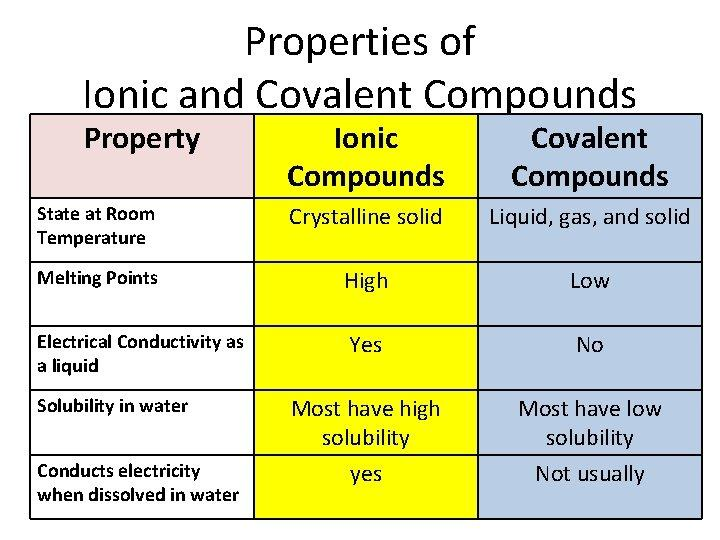
Ionic and covalent compounds have different physical properties because of the different ways in which their particles are held together.
The differences can be understood by studying their solubility, electrical conductivity and melting and boiling points.
11.1 Solubility
Ionic compounds such as sodium chloride and copper sulfate are generally soluble in water but insoluble in kerosene and petrol.
Most covalent compounds, such as camphor and naphthalene, are generally insoluble in water but dissolve in kerosene and petrol.
Some covalent compounds, such as sugar, are soluble in water.
11.2 Electrical Conductivity
Ionic compounds
- Do not conduct electricity in the solid state.
- Their ions are held in fixed positions and cannot move freely.
- Conduct electricity when dissolved in water because their ions become free to move.
- They can also conduct electricity in the molten state because their ions become mobile.
Covalent compounds
- Generally do not conduct electricity.
- They do not produce freely moving ions in solution.
- Even sugar, although soluble in water, does not conduct electricity because it does not produce ions in the solution.
11.3 Melting and Boiling Points
Ionic compounds generally have high melting and boiling points because of strong electrostatic attractions between oppositely charged ions.
Covalent compounds usually have comparatively low melting and boiling points.
Comparison Between Ionic and Covalent Compounds
| Property | Ionic compounds | Covalent compounds |
|---|---|---|
| Formation | Transfer of electrons | Sharing of electrons |
| Particles | Positive and negative ions | Molecules |
| Solubility in water | Generally soluble | Mostly insoluble, with exceptions |
| Solubility in kerosene/petrol | Generally insoluble | Many are soluble |
| Conductivity in solid state | Do not conduct | Generally do not conduct |
| Conductivity in aqueous solution | Generally conduct | Generally do not conduct |
| Melting and boiling points | Generally high | Usually low |
| Examples | NaCl, CuSO₄ | H₂O, CO₂, sugar, camphor |
12. Molecular Mass of Covalent Compounds
Molecular mass is the sum of the atomic masses of all the atoms present in a molecule.
It is expressed in atomic mass units (u).
Formula
Molecular mass = Sum of the atomic masses of all atoms in a molecule
To calculate molecular mass:
- Write the chemical formula.
- Note the atomic mass of each element.
- Multiply each atomic mass by the number of atoms present.
- Add all the values.
Example 1: Molecular Mass of Water (H₂O)
Given:
- Atomic mass of H = 1 u
- Atomic mass of O = 16 u
Molecular mass of H₂O:
= (2 × 1) + (1 × 16)
= 2 + 16
= 18 u
Example 2: Molecular Mass of Carbon Dioxide (CO₂)
Given:
- Atomic mass of C = 12 u
- Atomic mass of O = 16 u
Molecular mass of CO₂:
= (1 × 12) + (2 × 16)
= 12 + 32
= 44 u
Example 3: Molecular Mass of Nitric Acid (HNO₃)
Given:
- H = 1 u
- N = 14 u
- O = 16 u
Molecular mass of HNO₃:
= (1 × 1) + (1 × 14) + (3 × 16)
= 1 + 14 + 48
= 63 u
Example 4: Molecular Mass of Methane (CH₄)
Given:
- C = 12 u
- H = 1 u
Molecular mass of CH₄:
= (1 × 12) + (4 × 1)
= 12 + 4
= 16 u
13. Formula Unit Mass of Ionic Compounds
Ionic compounds form three-dimensional crystal structures rather than individual molecules.
Therefore, their mass is expressed in terms of formula unit mass instead of molecular mass.
A formula unit is the collection of ions in the simplest whole-number ratio in an ionic compound.
The mass of one formula unit is called its formula unit mass.
Formula
Formula unit mass = Sum of the atomic masses of all atoms present in the formula unit
Example 1: Sodium Oxide (Na₂O)
Given:
- Na = 23 u
- O = 16 u
Formula unit mass:
= (2 × 23) + (1 × 16)
= 46 + 16
= 62 u
Example 2: Calcium Nitrate [Ca(NO₃)₂]
Given:
- Ca = 40 u
- N = 14 u
- O = 16 u
Formula unit mass:
= (1 × 40) + 2 × [(1 × 14) + (3 × 16)]
= 40 + 2 × (14 + 48)
= 40 + 2 × 62
= 40 + 124
= 164 u
Example 3: Potassium Chloride (KCl)
Given:
- K = 39 u
- Cl = 35.5 u
Formula unit mass:
= 39 + 35.5
= 74.5 u
Example 4: Magnesium Hydroxide [Mg(OH)₂]
Given:
- Mg = 24 u
- O = 16 u
- H = 1 u
Formula unit mass:
= 24 + 2 × (16 + 1)
= 24 + 34
= 58 u
Difference Between Molecular Mass and Formula Unit Mass
| Molecular mass | Formula unit mass |
|---|---|
| Used for covalent compounds. | Used for ionic compounds. |
| Represents the mass of a molecule. | Represents the mass of the simplest whole-number ratio of ions. |
| Example: H₂O = 18 u. | Example: Na₂O = 62 u. |
14. Important Scientists and Their Contributions
| Scientist | Contribution |
|---|---|
| Antoine Lavoisier | Proposed the Law of Conservation of Mass in 1789. |
| Joseph Louis Proust | Proposed the Law of Constant Proportions. |
| John Dalton | Presented his Atomic Theory in 1808. |
Remember these scientists and their contributions for examinations.
15. Quick Revision – Important Points
- Matter is made up of tiny particles called atoms.
- The Law of Conservation of Mass was proposed by Antoine Lavoisier in 1789.
- According to the Law of Conservation of Mass, total mass of reactants equals total mass of products.
- The Law of Constant Proportions was proposed by Joseph Proust.
- Water always contains hydrogen and oxygen in the mass ratio of 1:8.
- John Dalton presented his atomic theory in 1808.
- Atoms combine to achieve stable electronic configurations.
- A chemical bond is the force that holds atoms together.
- Covalent bonds are formed by sharing electrons.
- Ionic bonds are formed by the electrostatic attraction between oppositely charged ions.
- A positively charged ion is called a cation.
- A negatively charged ion is called an anion.
- Ionic compounds generally have high melting and boiling points.
- Ionic compounds conduct electricity when molten or dissolved in water.
- Molecular mass is used for covalent compounds.
- Formula unit mass is used for ionic compounds.
- The chemical formula of an ionic compound represents the simplest whole-number ratio of its ions.
16. Important Formulae and Numerical Results
| Compound | Formula | Mass |
|---|---|---|
| Water | H₂O | 18 u |
| Carbon dioxide | CO₂ | 44 u |
| Nitric acid | HNO₃ | 63 u |
| Methane | CH₄ | 16 u |
| Sodium oxide | Na₂O | 62 u |
| Calcium nitrate | Ca(NO₃)₂ | 164 u |
| Potassium chloride | KCl | 74.5 u |
| Magnesium hydroxide | Mg(OH)₂ | 58 u |
17. Important Practice Questions
Try these questions after completing the chapter.
A. Very Short Answer Questions
- Who proposed the Law of Conservation of Mass?
- What is the mass ratio of hydrogen and oxygen in water?
- Who proposed the Law of Constant Proportions?
- What is a chemical bond?
- What is an ion?
- Define a covalent bond.
- What is an ionic bond?
- What is the valency of oxygen?
- What is the formula of sodium chloride?
- Why do ionic compounds not conduct electricity in the solid state?
B. Short Answer Questions
- State the Law of Conservation of Mass with an example.
- Explain the Law of Constant Proportions using water as an example.
- Write the six postulates of Dalton’s Atomic Theory.
- Explain the formation of a hydrogen molecule with a suitable diagram.
- Explain the formation of an oxygen molecule.
- Differentiate between cations and anions.
- Explain the formation of sodium chloride through electron transfer.
- Why do ionic compounds conduct electricity when dissolved in water?
- Why does sugar solution not conduct electricity?
- Differentiate between ionic and covalent compounds.
C. Write the Chemical Formulae
- Calcium chloride
- Aluminium oxide
- Magnesium hydroxide
- Aluminium sulfate
- Calcium carbonate
- Sodium hydrogencarbonate
- Ferric chloride
- Cuprous oxide
- Ammonium chloride
- Potassium sulfate
D. Numerical Questions
- 12 g of carbon combines with 32 g of oxygen. Calculate the mass of carbon dioxide formed.
- Water contains hydrogen and oxygen in a ratio of 1:8 by mass. Calculate the mass of oxygen present in 45 g of water.
- Calculate the molecular mass of ammonia (NH₃). Given N = 14 u and H = 1 u.
- Calculate the molecular mass of carbon dioxide (CO₂). Given C = 12 u and O = 16 u.
- Calculate the formula unit mass of calcium chloride (CaCl₂). Given Ca = 40 u and Cl = 35.5 u.
- Calculate the formula unit mass of aluminium oxide (Al₂O₃). Given Al = 27 u and O = 16 u.
E. Higher Order Thinking Questions
- Why does the mass appear to decrease when vinegar and baking soda react in an open flask?
- Why is the Law of Constant Proportions applicable to compounds but not to mixtures?
- Why is sodium chloride represented as NaCl and not Na₂Cl₂?
- Why does magnesium form Mg²⁺ while chlorine forms Cl⁻?
- A solid substance does not conduct electricity, but its aqueous solution conducts electricity. What type of compound is it likely to be? Explain.
Conclusion
The chapter Atomic Foundations of Matter explains how atoms form the substances around us. The laws of chemical combination help us understand why mass remains conserved and why compounds have fixed compositions.
Dalton’s Atomic Theory provides the foundation for understanding atoms, while covalent and ionic bonding explain how atoms combine to form molecules and compounds.
Learning the methods of writing chemical formulae and calculating molecular mass and formula unit mass will help students build a strong foundation for higher-level chemistry.
Keep revising, practise the numerical problems and understand the concepts instead of simply memorising them!
The Study Smart – Study Smarter, Score Higher.