The Study Smart | Class IX Mathematics | Chapter 1
Mathematics is built on numbers. From simple counting to complex calculations, numbers play an important role in our everyday lives. In Class 9 Mathematics, we learn about different types of numbers and how they are related to one another.
In this chapter, Number Systems, we will study natural numbers, whole numbers, integers, rational numbers, irrational numbers and real numbers. We will also learn about decimal expansions, number line representation, operations on real numbers, rationalisation and laws of exponents.
These notes are designed to help CBSE Class 9 students understand the concepts easily, practise numerical problems and prepare effectively for examinations.
Table of Contents
- Introduction to Number Systems
- Types of Numbers
- Rational Numbers
- Irrational Numbers
- Real Numbers
- Decimal Expansions of Rational Numbers
- Representation of Real Numbers on the Number Line
- Operations on Real Numbers
- Rationalisation of Denominators
- Laws of Exponents
- Important Formulas
- Solved Examples
- Important Questions for Practice
- Multiple Choice Questions (MCQs)
- Chapter Summary
- Frequently Asked Questions
1. Introduction to Number Systems
A number system is a way of classifying and representing numbers according to their properties.
We use numbers in our daily lives for counting, measuring, comparing quantities and performing calculations.
For example:
- Counting students in a classroom.
- Measuring the length of a table.
- Calculating the price of goods.
- Measuring temperature.
Different types of numbers form a number system.
2. Types of Numbers
Numbers are classified into different categories.
2.1 Natural Numbers (N)
Natural numbers are the counting numbers that start from 1 and continue infinitely.
Examples: 1, 2, 3, 4, 5, 6, …
The set of natural numbers is represented by N.
N = {1, 2, 3, 4, 5, …}
Important points:
- The smallest natural number is 1.
- Natural numbers do not include zero.
- Natural numbers do not include negative numbers or fractions.
2.2 Whole Numbers (W)
Whole numbers include all natural numbers along with zero.
W = {0, 1, 2, 3, 4, 5, …}
Important points:
- The smallest whole number is 0.
- Every natural number is a whole number.
- Whole numbers do not include negative numbers.
2.3 Integers (Z)
Integers include positive numbers, negative numbers and zero.
Z = {…, -3, -2, -1, 0, 1, 2, 3, …}
Examples: -10, -5, 0, 8, 15.
Important points:
- Zero is neither positive nor negative.
- Every whole number is an integer.
- Integers do not include fractions or decimals such as 1/2 and 2.5.
2.4 Rational Numbers (Q)
A number is called a rational number if it can be expressed in the form:
p/q, where:
- p and q are integers.
- q ≠ 0.
Examples:
- 1/2
- 3/4
- -5/7
- 8/1
- 0/3
Every integer is a rational number because it can be expressed with denominator 1.
For example:
5 = 5/1
-3 = -3/1
Important points:
- Every integer is a rational number.
- Every terminating decimal is rational.
- Every non-terminating recurring decimal is rational.
- The denominator of a rational number can never be zero.
2.5 Irrational Numbers
Numbers that cannot be expressed in the form p/q, where p and q are integers and q ≠ 0, are called irrational numbers.
Their decimal expansions are non-terminating and non-recurring.
Examples:
- √2 = 1.41421356…
- √3 = 1.73205080…
- √5 = 2.23606797…
- π = 3.14159265…
Important points:
- Irrational numbers cannot be expressed as simple fractions of integers.
- Their decimal expansions never terminate.
- Their decimal digits do not repeat in a fixed pattern.
Remember: The square root of a perfect square is rational.
Examples:
- √4 = 2
- √9 = 3
- √16 = 4
But:
- √2 is irrational.
- √3 is irrational.
- √7 is irrational.
2.6 Real Numbers (R)
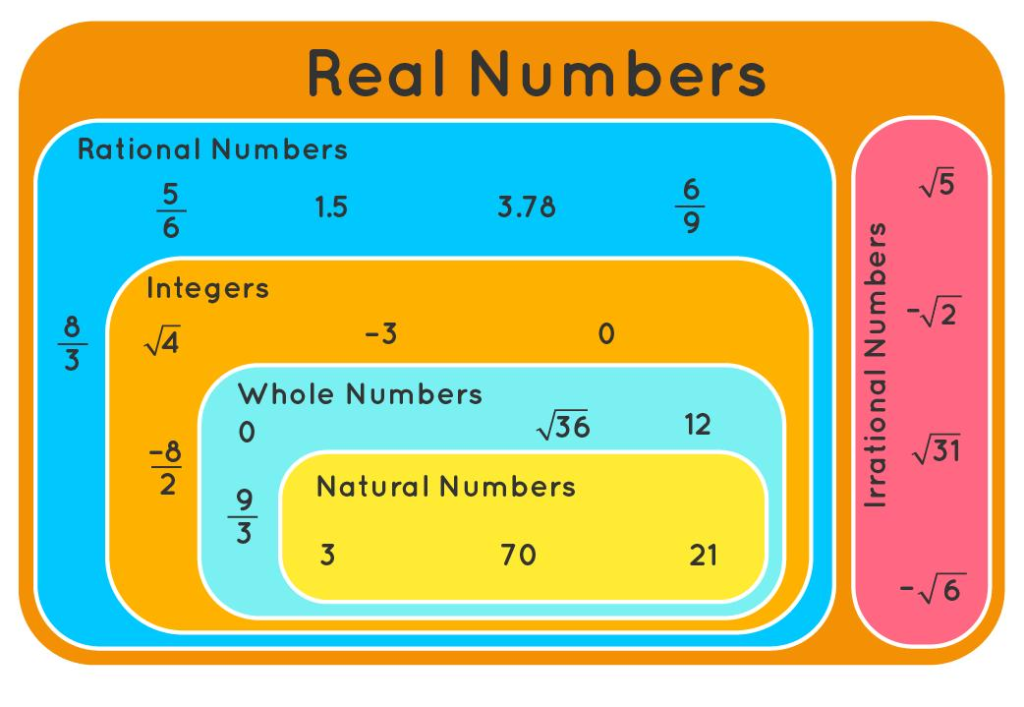
All rational and irrational numbers together form the set of real numbers.
Real numbers are represented by R.
Examples:
- 5
- -8
- 3/4
- 0.25
- √2
- π
Every real number can be represented by a unique point on the number line, and every point on the number line represents a unique real number.
Relationship Between Different Number Systems
The relationship between number sets is:
N ⊂ W ⊂ Z ⊂ Q ⊂ R
Where:
- N = Natural Numbers
- W = Whole Numbers
- Z = Integers
- Q = Rational Numbers
- R = Real Numbers
Irrational numbers are also part of the real number system but are not part of the rational number system.
3. Difference Between Rational and Irrational Numbers
| Rational Numbers | Irrational Numbers |
|---|---|
| Can be written as p/q. | Cannot be written as p/q. |
| Decimal expansion terminates or repeats. | Decimal expansion never terminates or repeats. |
| Examples: 1/2, 3/4, 5. | Examples: √2, √3, π. |
| Includes integers. | Does not include integers. |
4. Decimal Expansions of Rational Numbers
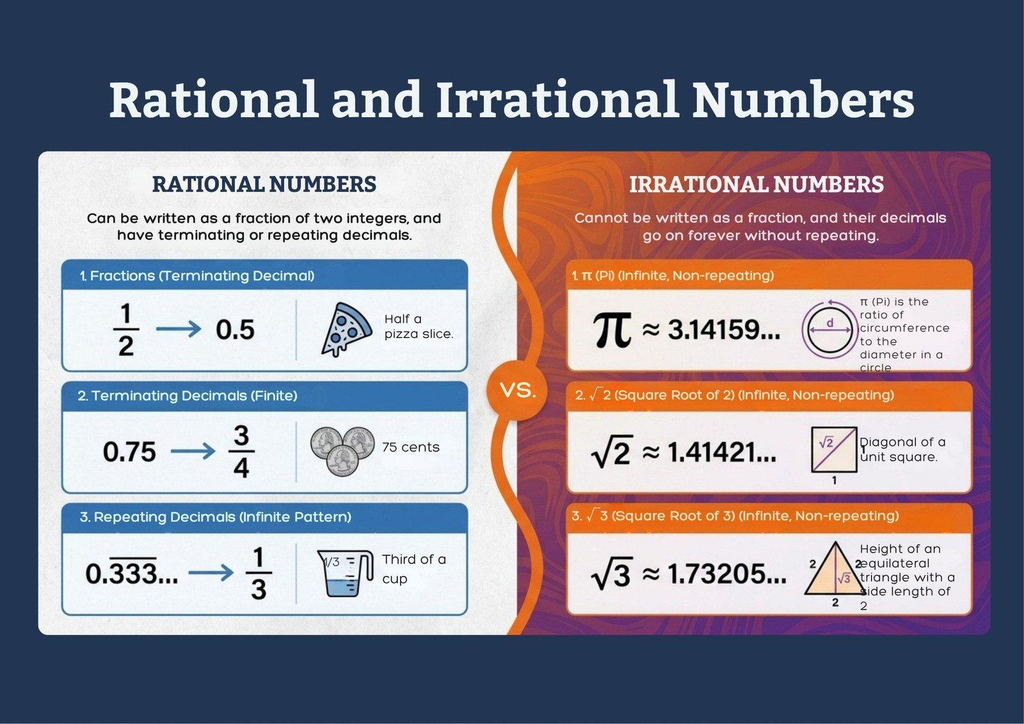
The decimal expansion of a rational number can be of two types.
4.1 Terminating Decimal Expansion
A decimal expansion that ends after a finite number of digits is called a terminating decimal.
Examples:
1/2 = 0.5
3/4 = 0.75
7/8 = 0.875
5/4 = 1.25
4.2 Non-Terminating Recurring Decimal Expansion
A decimal expansion that continues infinitely but repeats a particular digit or group of digits is called a non-terminating recurring decimal.
Examples:
1/3 = 0.3333…
1/11 = 0.090909…
2/7 = 0.285714285714…
The repeating digits are represented by a bar over them.
For example:
1/3 = 0.3̅
1/11 = 0.09̅
4.3 Non-Terminating Non-Recurring Decimal Expansion
A decimal expansion that continues infinitely without repeating any fixed pattern is called a non-terminating non-recurring decimal.
Examples:
√2 = 1.414213562…
√3 = 1.732050807…
π = 3.141592653…
These numbers are irrational numbers.
Important Result
A rational number p/q in its simplest form has a terminating decimal expansion if and only if its denominator has no prime factors other than 2 and 5.
Examples:
Example 1: 7/20
20 = 2² × 5
Therefore, 7/20 = 0.35 (terminating).
Example 2: 7/12
12 = 2² × 3
Since the denominator contains the prime factor 3, its decimal expansion is non-terminating recurring.
7/12 = 0.58333…
5. Representation of Real Numbers on the Number Line
Every real number can be represented on a number line.
A number line is a straight line on which numbers are marked at equal intervals.
- Positive numbers lie to the right of zero.
- Negative numbers lie to the left of zero.
- Zero is the reference point.
Representation of √2 on the Number Line
We can represent √2 geometrically using the Pythagoras theorem.
Steps:
- Draw a number line and mark O as 0 and A as 1.
- Draw a perpendicular line segment AB of length 1 unit at A.
- Join O to B.
- According to the Pythagoras theorem:OB² = OA² + AB²OB² = 1² + 1²OB² = 2OB = √2
- Using a compass, transfer the length OB onto the number line.
The resulting point represents √2.
Successive Magnification
Successive magnification is a method used to locate decimal numbers accurately on a number line.
Example: Represent 4.377 on a number line.
Steps:
- Locate 4.377 between 4 and 5.
- Divide the interval into ten equal parts.
- Locate the interval between 4.3 and 4.4.
- Divide this interval into ten equal parts.
- Locate 4.37 between 4.3 and 4.4.
- Continue dividing the interval to locate 4.377 accurately.
This process is called successive magnification.
6. Operations on Real Numbers
Real numbers follow important mathematical properties during addition, subtraction, multiplication and division.
6.1 Addition
The sum of two real numbers is always a real number.
Example:
5 + 3 = 8
6.2 Subtraction
The difference between two real numbers is always a real number.
Example:
8 – 3 = 5
6.3 Multiplication
The product of two real numbers is always a real number.
Example:
4 × 5 = 20
6.4 Division
The quotient of two real numbers is a real number provided the divisor is not zero.
Example:
10 ÷ 2 = 5
Important Properties of Real Numbers
Commutative Property
For addition:
a + b = b + a
For multiplication:
a × b = b × a
Associative Property
For addition:
(a + b) + c = a + (b + c)
For multiplication:
(a × b) × c = a × (b × c)
Distributive Property
a × (b + c) = ab + ac
Identity Property
Additive identity:
a + 0 = a
Multiplicative identity:
a × 1 = a
Important facts about rational and irrational numbers:
- Rational + Irrational = Irrational.
- Rational – Irrational = Irrational.
- A non-zero rational × Irrational = Irrational.
- Irrational + Irrational may be rational or irrational.
- Irrational × Irrational may be rational or irrational.
Examples:
√2 + √2 = 2√2 (irrational)
√2 × √2 = 2 (rational)
√2 + (-√2) = 0 (rational)
7. Rationalisation of Denominators
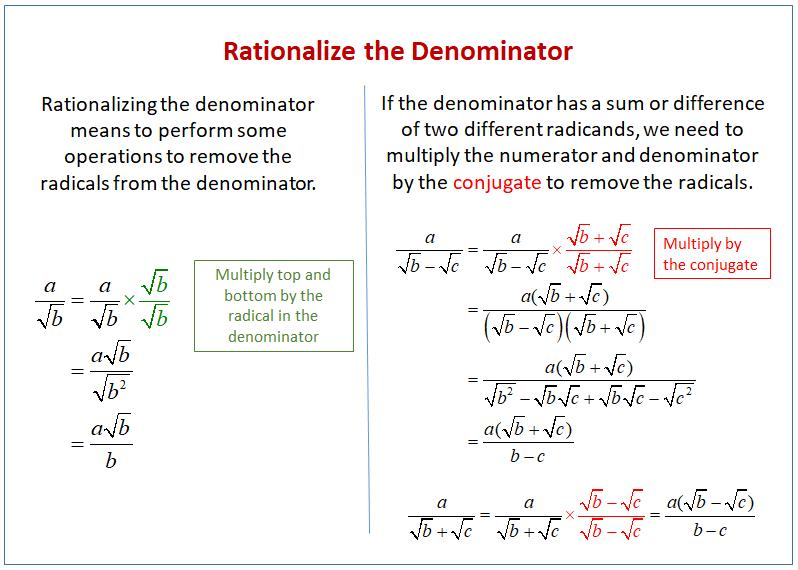
Rationalisation is the process of removing irrational numbers from the denominator of a fraction.
It is done by multiplying both the numerator and denominator by a suitable number.
Example 1: Rationalise 1/√2
Solution:
= (1/√2) × (√2/√2)
= √2/2
Therefore, the rationalised form is √2/2.
Example 2: Rationalise 1/√3
Solution:
= (1/√3) × (√3/√3)
= √3/3
Example 3: Rationalise 1/(√5 + √3)
Solution:
Multiply the numerator and denominator by the conjugate (√5 – √3).
= (1/(√5 + √3)) × ((√5 – √3)/(√5 – √3))
= (√5 – √3)/(5 – 3)
= (√5 – √3)/2
Therefore, the answer is:
(√5 – √3)/2
Conjugate of a Surd
The conjugate of an expression a + √b is a – √b.
Similarly, the conjugate of √a + √b is √a – √b.
Important identity:
(a + b)(a – b) = a² – b²
For surds:
(√a + √b)(√a – √b) = a – b
8. Laws of Exponents for Real Numbers
Exponents are used to represent repeated multiplication.
For example:
2³ = 2 × 2 × 2 = 8
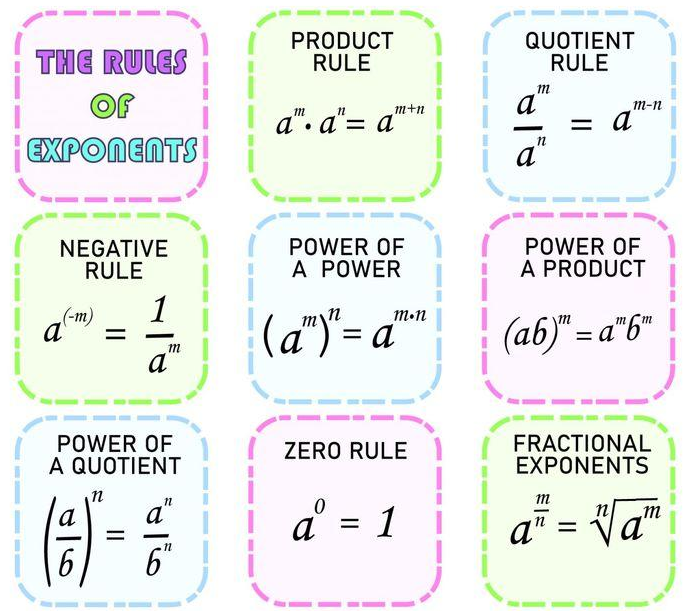
For positive real numbers a and b, the following laws of exponents are important.
1. Product Law
aᵐ × aⁿ = aᵐ⁺ⁿ
Example:
2³ × 2² = 2⁵ = 32
2. Quotient Law
aᵐ ÷ aⁿ = aᵐ⁻ⁿ (a ≠ 0)
Example:
5⁴ ÷ 5² = 5² = 25
3. Power of a Power
(aᵐ)ⁿ = aᵐⁿ
Example:
(2²)³ = 2⁶ = 64
4. Power of a Product
(ab)ᵐ = aᵐ × bᵐ
Example:
(2 × 3)² = 2² × 3² = 36
5. Power of a Quotient
(a/b)ᵐ = aᵐ/bᵐ (b ≠ 0)
6. Zero Exponent
a⁰ = 1 (a ≠ 0)
Example:
7⁰ = 1
7. Negative Exponent
a⁻ᵐ = 1/aᵐ (a ≠ 0)
Example:
2⁻³ = 1/2³ = 1/8
8. Fractional Exponents
For a positive real number a:
a^(1/n) = ⁿ√a
And:
a^(m/n) = ⁿ√(aᵐ) = (ⁿ√a)ᵐ
Example:
16^(1/2) = √16 = 4
27^(1/3) = ∛27 = 3
9. Important Formulas – Quick Revision
| Topic | Formula |
|---|---|
| Rational Number | p/q, q ≠ 0 |
| Square Root Product | √a × √b = √(ab) |
| Square Root Quotient | √a/√b = √(a/b), b > 0 |
| Product of Powers | aᵐ × aⁿ = aᵐ⁺ⁿ |
| Division of Powers | aᵐ/aⁿ = aᵐ⁻ⁿ |
| Power of Power | (aᵐ)ⁿ = aᵐⁿ |
| Zero Exponent | a⁰ = 1 |
| Negative Exponent | a⁻ᵐ = 1/aᵐ |
| Rational Exponent | a^(m/n) = ⁿ√(aᵐ) |
| Difference of Squares | a² – b² = (a+b)(a-b) |
10. Solved Examples
Question 1. Is 0 a rational number?
Solution:
A rational number can be written as p/q, where q ≠ 0.
0 = 0/1
Therefore, zero is a rational number.
Question 2. Express 0.75 in the form p/q.
Solution:
0.75 = 75/100
= 3/4
Answer: 3/4
Question 3. Find the decimal expansion of 7/8.
Solution:
7 ÷ 8 = 0.875
Answer: 0.875 (terminating decimal).
Question 4. Is √49 rational or irrational?
Solution:
√49 = 7
Since 7 is an integer, it is a rational number.
Question 5. Find two rational numbers between 1/3 and 1/2.
Solution:
Taking equivalent fractions:
1/3 = 8/24
1/2 = 12/24
Two rational numbers between them are:
9/24 and 10/24.
Therefore, the answers are 3/8 and 5/12.
Question 6. Simplify √50 + √18.
Solution:
√50 + √18
= √(25 × 2) + √(9 × 2)
= 5√2 + 3√2
= 8√2
Question 7. Simplify 2³ × 2⁴.
Solution:
Using the product law:
2³ × 2⁴ = 2³⁺⁴
= 2⁷
= 128
Question 8. Rationalise 1/(√7 – √5).
Solution:
Multiply by the conjugate:
= (1/(√7 – √5)) × ((√7 + √5)/(√7 + √5))
= (√7 + √5)/(7 – 5)
= (√7 + √5)/2
Answer: (√7 + √5)/2
11. Important Questions for Practice
Try solving the following questions yourself before checking the answers.
Very Short Answer Questions
- Define natural numbers.
- Is zero a whole number?
- Give two examples of irrational numbers.
- Write the smallest whole number.
- Is every integer a rational number?
- What is the decimal expansion of 1/4?
- Write the symbol used for real numbers.
Short Answer Questions
- Differentiate between rational and irrational numbers.
- Express 0.625 in the form p/q.
- Find three rational numbers between 2/5 and 3/5.
- Simplify √72 + √32.
- Rationalise 1/√5.
- Find the value of 3⁴ × 3².
- Express 64^(1/3) in its simplest form.
Long Answer Questions
- Explain the different types of numbers with examples.
- Explain the decimal expansion of rational numbers.
- Represent √2 on a number line using geometrical construction.
- Rationalise 1/(√3 + √2).
- Simplify (2³ × 2⁵)/2⁴.
- Explain the laws of exponents with examples.
12. Multiple Choice Questions (MCQs)
Q1. Which of the following is a natural number?
A. -2
B. 0
C. 5
D. 1/2
Answer: C. 5
Q2. Which of the following is an irrational number?
A. 1/2
B. 0.75
C. √2
D. 4
Answer: C. √2
Q3. The smallest whole number is:
A. 1
B. 0
C. -1
D. 2
Answer: B. 0
Q4. Which of the following is a rational number?
A. √3
B. π
C. √7
D. 5/8
Answer: D. 5/8
Q5. The decimal expansion of 1/3 is:
A. Terminating
B. Non-terminating recurring
C. Non-terminating non-recurring
D. None of these
Answer: B. Non-terminating recurring
Q6. √81 is equal to:
A. 8
B. 9
C. 10
D. 7
Answer: B. 9
Q7. The value of 2³ × 2² is:
A. 16
B. 24
C. 32
D. 64
Answer: C. 32
Q8. The value of 5⁰ is:
A. 0
B. 1
C. 5
D. 10
Answer: B. 1
Q9. Which of the following is not a rational number?
A. 3/5
B. -7
C. 0.25
D. √5
Answer: D. √5
Q10. The rationalised form of 1/√3 is:
A. √3
B. 1/3
C. √3/3
D. 3/√3
Answer: C. √3/3
13. Chapter Summary
Let’s revise the important concepts of Number Systems:
- Natural numbers begin from 1.
- Whole numbers include zero and natural numbers.
- Integers include positive numbers, negative numbers and zero.
- Rational numbers can be expressed in the form p/q.
- Irrational numbers cannot be expressed in the form p/q.
- Real numbers include both rational and irrational numbers.
- Rational decimals are terminating or non-terminating recurring.
- Irrational decimals are non-terminating and non-recurring.
- Every real number can be represented on a number line.
- Rationalisation removes irrational terms from the denominator.
- Laws of exponents help simplify mathematical expressions.
14. Frequently Asked Questions (FAQs)
Q1. What is Number Systems in Class 9 Maths?
Number Systems is the first chapter of Class 9 Mathematics. It explains different types of numbers, their properties, decimal expansions, number line representation and operations on real numbers.
Q2. What are rational numbers?
Rational numbers are numbers that can be expressed in the form p/q, where p and q are integers and q is not zero.
Q3. Is √2 a rational number?
No. √2 is an irrational number because it cannot be expressed as a ratio of two integers.
Q4. Is zero a rational number?
Yes. Zero can be expressed as 0/1, so it is a rational number.
Q5. What are real numbers?
Real numbers include all rational and irrational numbers. They can be represented on a number line.
Q6. What is rationalisation?
Rationalisation is the process of removing irrational terms from the denominator of a fraction.
Q7. What are the important topics in Number Systems?
Important topics include:
- Rational and irrational numbers.
- Decimal expansions.
- Representation on the number line.
- Operations on real numbers.
- Rationalisation.
- Laws of exponents.
Q8. How can I prepare Chapter 1 for my examination?
Understand the definitions, practise decimal expansions, learn the exponent laws, solve rationalisation problems and attempt the practice questions given in these notes.
Final Words
The chapter Number Systems is one of the most important foundations of Class 9 Mathematics. Understanding these concepts will make it easier to study algebra, geometry and higher-level mathematics.
Read the notes carefully, practise the solved examples and attempt all the exercise questions.
Keep Learning, Keep Practising and Keep Growing!
The Study Smart – Your Learning Partner.