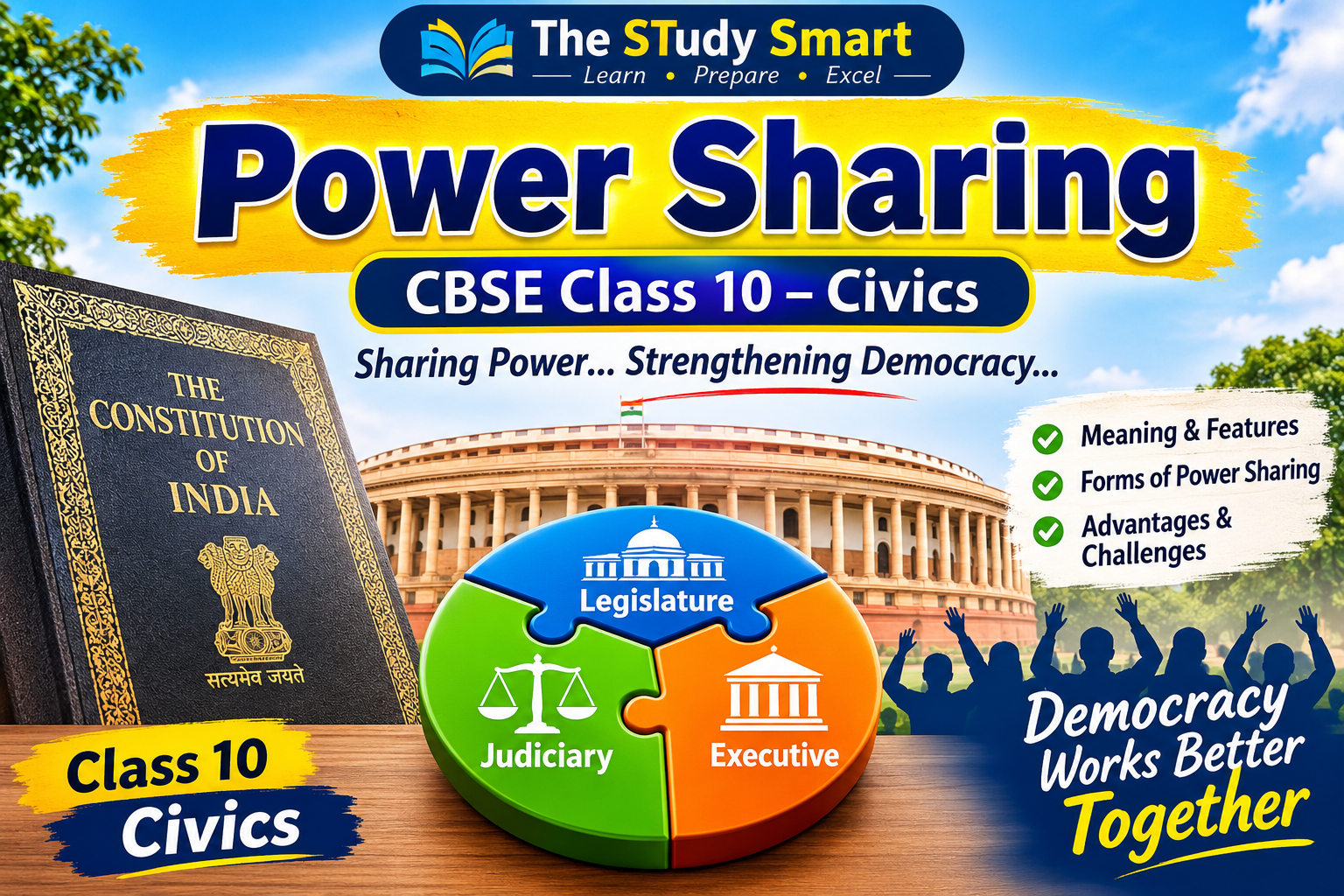
Power sharing is one of the most important concepts of democracy. In a democratic country, political power should not remain concentrated in the hands of one person, one institution or one community. Instead, it should be distributed among different organs of government, different levels of government and various social groups.
In CBSE Class 10 Social Science, Chapter 1 of Political Science (Civics), Power Sharing, explains why sharing power is necessary for democracy. The chapter uses the examples of Belgium and Sri Lanka to show how different approaches to power sharing can affect the unity and stability of a country.
These notes cover all the important topics in simple language, along with examples, comparison tables, key terms, frequently asked questions and practice questions for examination preparation.
Chapter at a Glance
| Particular | Details |
|---|---|
| Subject | Social Science – Political Science (Civics) |
| Class | 10 |
| Board | CBSE |
| Chapter Number | 1 |
| Chapter Name | Power Sharing |
| Textbook | Democratic Politics – II |
Table of Contents
- Meaning of Power Sharing
- Story of Belgium
- Story of Sri Lanka
- Majoritarianism in Sri Lanka
- Accommodation in Belgium
- Belgium and Sri Lanka – A Comparison
- Why is Power Sharing Desirable?
- Forms of Power Sharing
- Horizontal and Vertical Power Sharing
- Power Sharing in India
- Important Terms and Definitions
- Quick Revision Notes
- Frequently Asked Questions
- Practice Questions and Answers
1. What is Power Sharing?
Power sharing means the distribution of political power among different organs of government, different levels of government, social groups and political organisations.
In a democracy, power should not be concentrated in one person or one institution. Different groups and institutions should have a role in decision-making.
For example, in India, power is shared among:
- The Legislature
- The Executive
- The Judiciary
- The Central Government
- The State Governments
- Local self-government institutions
- Different social groups and political parties
Power sharing helps ensure that different sections of society participate in the functioning of the government.
Why is Power Sharing Important?
Imagine a country where all political power is controlled by one person or one community. Such a situation may lead to unfair decisions, discrimination and conflicts.
Power sharing helps prevent the misuse of power and gives different groups an opportunity to participate in governance.
Important Point: Power sharing is the very spirit of democracy because people have the right to participate in decisions that affect their lives.
2. Story of Belgium
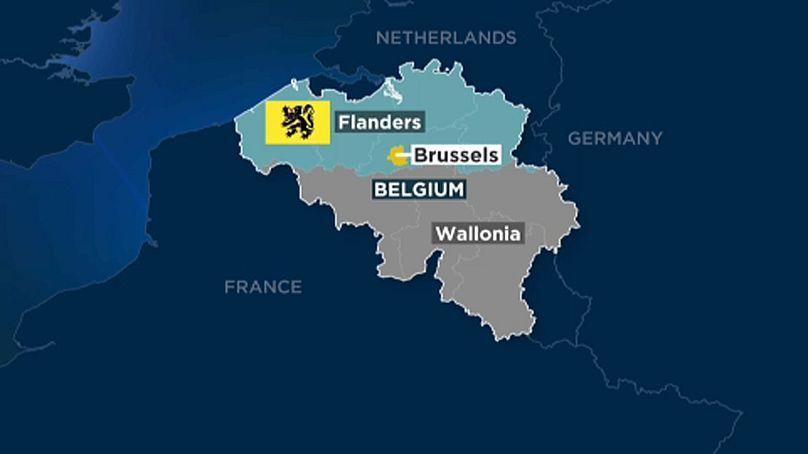
Belgium is a small country in Europe. It shares its borders with France, the Netherlands, Germany and Luxembourg.
Belgium has a diverse population consisting of people who speak different languages.
2.1 Ethnic Composition of Belgium
The population of Belgium is divided mainly into three linguistic groups:
- 59% Dutch-speaking people: They live mainly in the Flemish region.
- 40% French-speaking people: They live mainly in the Wallonia region.
- 1% German-speaking people: They form a small minority.
2.2 Population Composition of Brussels
Brussels is the capital city of Belgium.
Unlike the rest of the country, Brussels has a French-speaking majority.
- 80% of the people speak French.
- 20% of the people speak Dutch.
2.3 Social Differences in Belgium
Although the Dutch-speaking community was the majority in the country, the French-speaking minority was relatively rich and powerful.
The French-speaking community had benefited from economic development and education earlier than the Dutch-speaking community.
This created tensions between the two communities.
The situation was particularly difficult in Brussels, where the Dutch-speaking people were in a minority.
The leaders of Belgium understood that these differences could threaten the unity of the country. Therefore, they decided to adopt a system of power sharing.
Key Learning: Belgium chose accommodation and cooperation instead of allowing one linguistic community to dominate the others.
3. Story of Sri Lanka
Sri Lanka is an island country situated in the Indian Ocean, near the southern coast of India.
Like Belgium, Sri Lanka also has a diverse population consisting of different linguistic and religious communities.
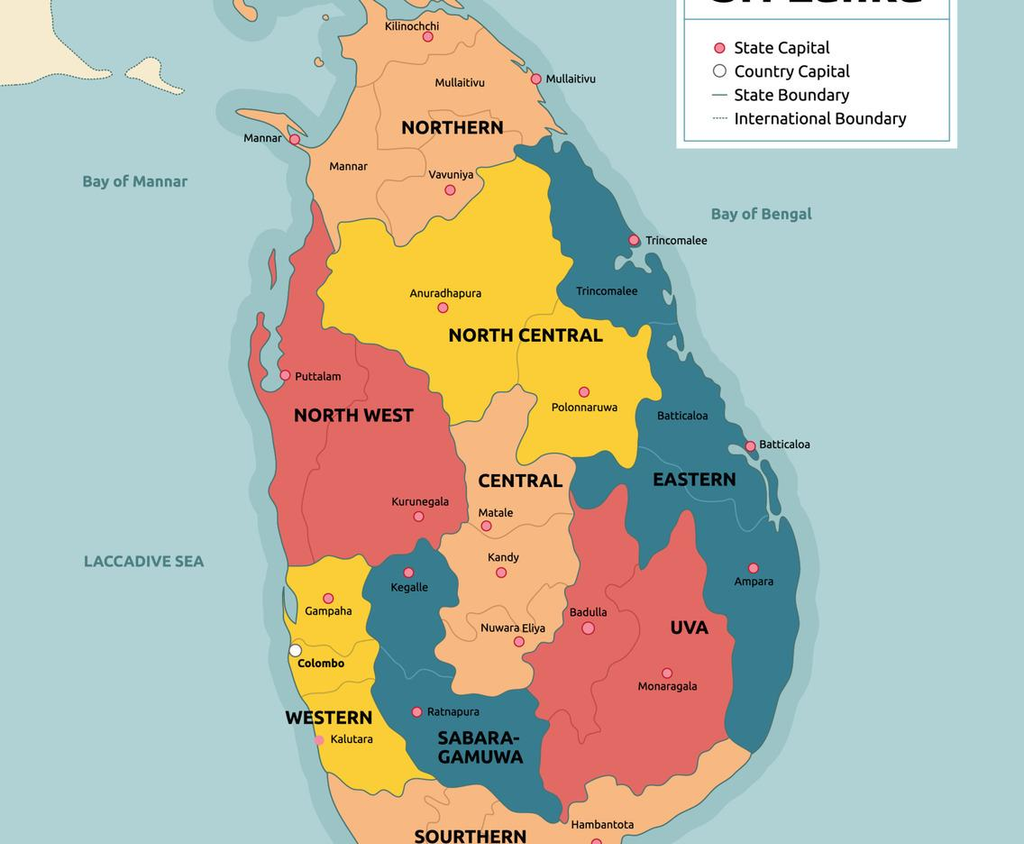
3.1 Ethnic Composition of Sri Lanka
The major social groups in Sri Lanka are:
- Sinhala-speaking people: Approximately 74% of the population.
- Tamil-speaking people: Approximately 18% of the population.
The Tamil-speaking population is further divided into two groups:
- Sri Lankan Tamils: About 13% of the population. They are concentrated mainly in the northern and eastern parts of the country.
- Indian Tamils: About 5% of the population. Their ancestors were brought to Sri Lanka from India by plantation workers during colonial rule.
3.2 Religious Composition
- Most Sinhala-speaking people are Buddhists.
- Most Tamils are Hindus or Muslims.
- There are also Christians among both Sinhala and Tamil communities.
Sri Lanka became an independent country in 1948.
After independence, the leaders of the Sinhala community tried to establish the dominance of the majority community through government policies.
This approach created dissatisfaction among the Tamil community.
4. Majoritarianism in Sri Lanka
Majoritarianism is a belief or practice in which the majority community rules a country according to its own wishes, ignoring the needs and interests of minority communities.
After independence in 1948, the democratically elected government of Sri Lanka adopted several measures to establish Sinhala supremacy.
4.1 Sinhala as the Only Official Language
In 1956, an Act was passed to recognise Sinhala as the only official language of Sri Lanka.
This policy ignored the Tamil language and created dissatisfaction among Tamil-speaking people.
4.2 Preference in Government Jobs and Education
The government followed preferential policies that favoured Sinhala applicants in university admissions and government employment.
As a result, Tamil-speaking people felt that they were being discriminated against.
4.3 Protection of Buddhism
The Constitution provided that the state should protect and foster Buddhism.
This gave special recognition to the religion of the majority community.
4.4 Demands of the Tamil Community
The Tamil community began to raise demands for equal treatment and political rights.
Their major demands included:
- Recognition of Tamil as an official language.
- Equal opportunities in government jobs and educational institutions.
- Provincial autonomy for Tamil-dominated regions.
However, these demands were not adequately accommodated.
4.5 Results of Majoritarianism
The distrust between the Sinhala and Tamil communities increased over time.
Many Tamil organisations and political groups began demanding an independent Tamil state called Tamil Eelam.
This conflict eventually developed into a civil war.
The civil war caused widespread destruction, loss of lives, displacement of people and damage to the country’s economy. It ended in 2009.
Key Learning: Sri Lanka’s experience shows that refusing to share power with minority communities can create conflict and threaten national unity.
5. Accommodation in Belgium
Unlike Sri Lanka, the leaders of Belgium recognised the importance of respecting the interests of different linguistic communities.
Between 1970 and 1993, the Belgian Constitution was amended four times to develop a power-sharing arrangement acceptable to different communities.
The Belgian model included the following arrangements:
5.1 Equal Number of Dutch and French-Speaking Ministers
The Constitution provided that the number of Dutch-speaking and French-speaking ministers in the Central Government would be equal.
This ensured that neither linguistic community could dominate the Central Government.
5.2 Special Laws Require Support from Both Communities
Some special laws could be passed only when they received the support of the majority of members from each linguistic group.
This arrangement ensured that important decisions were not imposed on one community.
5.3 State Governments Have Their Own Powers
Many powers of the Central Government were transferred to State Governments.
The State Governments were not subordinate to the Central Government in matters within their authority.
5.4 Equal Representation in Brussels
Brussels has a separate government in which both Dutch-speaking and French-speaking communities have equal representation.
This arrangement helped protect the interests of both communities.
5.5 Community Government
Apart from the Central and State Governments, Belgium has a third type of government called the Community Government.
The Community Government is elected by people belonging to one language community, regardless of where they live.
Belgium has community governments for:
- Dutch-speaking people
- French-speaking people
- German-speaking people
These governments have powers related to cultural, educational and language matters.
Results of the Belgian Model
The Belgian model helped different linguistic communities share power and participate in governance.
It reduced tensions between communities and helped maintain the unity of the country.
Key Learning: Belgium demonstrates that power sharing and accommodation of social differences can strengthen democracy and national unity.
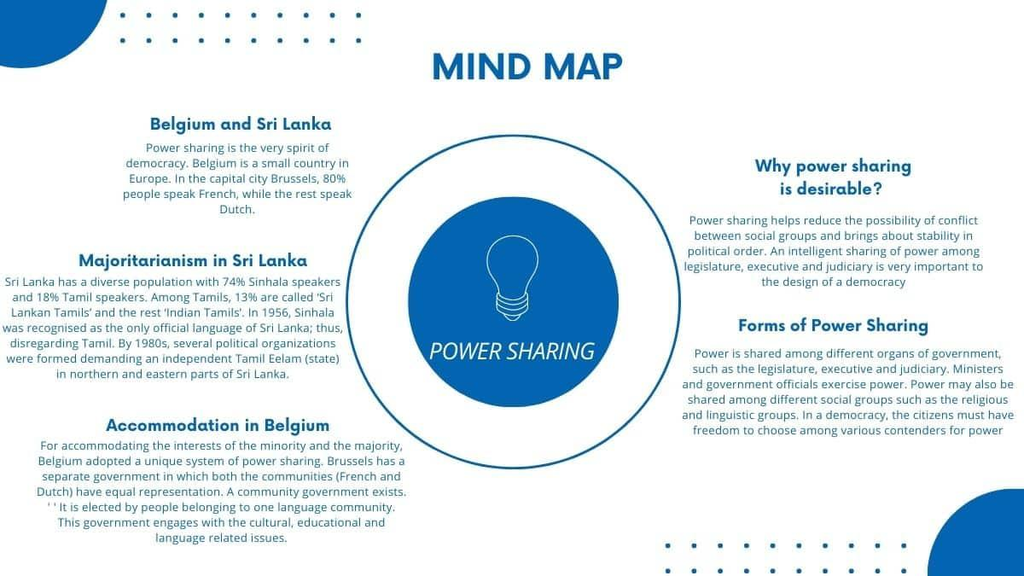
6. Belgium and Sri Lanka – A Comparison
Belgium and Sri Lanka are both democratic countries with diverse populations. However, they adopted different approaches to handling social and linguistic differences.
| Belgium | Sri Lanka |
|---|---|
| Adopted the policy of accommodation. | Followed majoritarian policies. |
| Shared power among different linguistic communities. | Established the dominance of the Sinhala majority. |
| Provided equal representation to Dutch and French-speaking ministers in the Central Government. | Gave preference to Sinhala-speaking people in government jobs and education. |
| Brussels has a separate government with equal representation for both major linguistic communities. | Tamil demands for equal rights and autonomy were not adequately accommodated. |
| Introduced Community Governments. | Did not adopt a similar community-government arrangement. |
| Constitutional changes helped reduce tensions and maintain unity. | Majoritarian policies increased distrust and contributed to civil war. |
What Do We Learn from Belgium and Sri Lanka?
The two examples teach us important lessons:
- Respecting the interests of different communities helps maintain national unity.
- Majority rule should not mean that the majority community can ignore minority rights.
- Power sharing reduces the possibility of social conflict.
- Democracy becomes stronger when different communities participate in decision-making.
- Refusing to share power can create dissatisfaction, distrust and conflict.
Remember: Belgium followed accommodation, whereas Sri Lanka followed majoritarianism.
7. Why is Power Sharing Desirable?
Power sharing is desirable in a democracy because it helps maintain political stability, reduces social conflicts and ensures the participation of citizens in governance.
There are two main reasons why power sharing is desirable:
- Prudential Reasons
- Moral Reasons
7.1 Prudential Reasons
Prudential reasons are based on careful calculations of gains and losses.
These reasons explain why power sharing is beneficial because of the positive results it produces.
Important prudential reasons include:
1. Reduces Conflict Between Social Groups
Power sharing reduces the possibility of conflict between different religious, linguistic and ethnic communities.
2. Ensures Political Stability
When different communities participate in governance, they are more likely to accept government decisions. This helps maintain political stability.
3. Promotes National Unity
Power sharing encourages cooperation among different communities and strengthens the unity of the country.
4. Prevents Social Tensions
When minority communities receive fair representation, they are less likely to feel neglected or discriminated against.
7.2 Moral Reasons
Moral reasons are based on democratic principles and values.
They explain why power sharing is important because it is the right thing to do in a democracy.
Important moral reasons include:
1. Power Sharing is the Spirit of Democracy
Democracy is based on the participation of people in decision-making. Therefore, political power should be shared among those who are affected by government decisions.
2. Right to Be Consulted
People have the right to be consulted about how they are governed.
3. Creates a Legitimate Government
When citizens participate in the political system, they develop a sense of belonging and responsibility towards the government.
This makes the government more legitimate and acceptable.
Difference Between Prudential and Moral Reasons
| Prudential Reasons | Moral Reasons |
|---|---|
| Based on careful calculation of gains and losses. | Based on democratic values and principles. |
| Focus on the positive results of power sharing. | Focus on the importance of power sharing itself. |
| Help reduce conflict between social groups. | Recognise the right of people to participate in governance. |
| Ensure political stability and national unity. | Treat power sharing as the spirit of democracy. |
Easy Way to Remember:
- Prudential = Power sharing is useful because it produces better results.
- Moral = Power sharing is necessary because it is the right thing to do in a democracy.
8. Forms of Power Sharing
In modern democracies, power sharing takes different forms.
There are four major forms of power sharing:
- Power sharing among different organs of government.
- Power sharing among governments at different levels.
- Power sharing among different social groups.
- Power sharing among political parties, pressure groups and movements.
8.1 Power Sharing Among Different Organs of Government
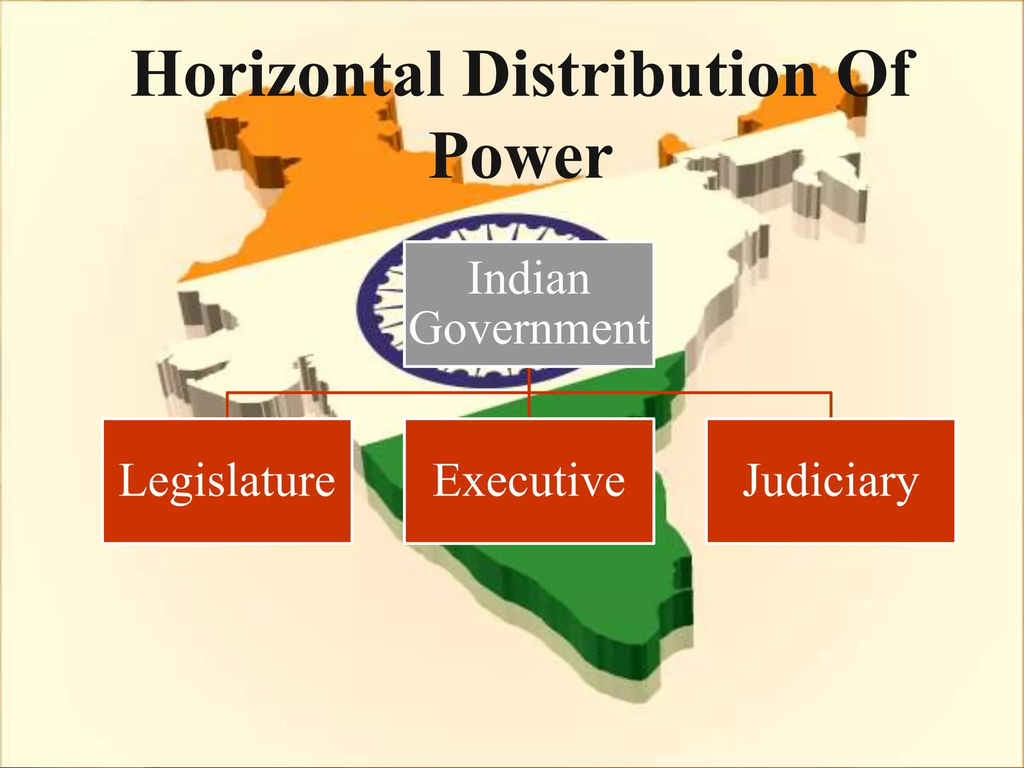
In this form, power is shared among the three major organs of government:
- Legislature
- Executive
- Judiciary
This arrangement is known as Horizontal Power Sharing.
Each organ has its own functions and powers.
Legislature: Makes laws.
Executive: Implements laws and runs the administration.
Judiciary: Interprets laws and delivers justice.
All three organs work at the same level of government but perform different functions.
This arrangement ensures that no single organ exercises unlimited power.
It is also known as the System of Checks and Balances.
Example: In India, the judiciary can examine whether government actions and laws are constitutional. Similarly, the legislature exercises control over the executive through parliamentary procedures.
8.2 Power Sharing Among Governments at Different Levels
In this form, power is shared among governments functioning at different levels.
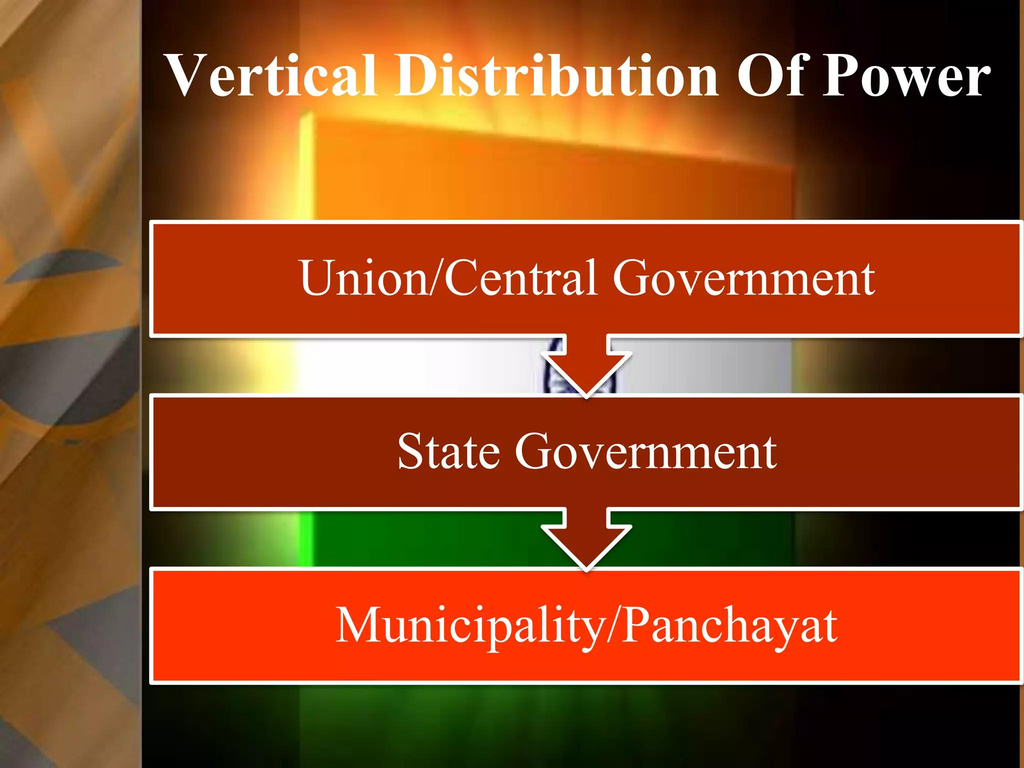
This is known as Vertical Power Sharing.
In India, power is distributed among:
- Central Government
- State Governments
- Local Governments
The Constitution clearly defines the powers and responsibilities of different levels of government.
Example: The Central Government looks after national-level matters, State Governments manage state-level matters and local governments deal with local issues.
This arrangement allows people at different levels to participate in governance.
8.3 Power Sharing Among Different Social Groups
In this form, power is shared among different social groups such as religious and linguistic communities.
This arrangement ensures that weaker and minority communities receive proper representation in government and public institutions.
Examples:
- Reservation of seats for Scheduled Castes and Scheduled Tribes in elected bodies.
- Special representation for minority and weaker sections through constitutional and legal arrangements.
- Community Government in Belgium.
Such arrangements help protect the interests of different social groups and promote equality.
8.4 Power Sharing Among Political Parties, Pressure Groups and Movements
In a democracy, political power is also shared among different political parties, pressure groups and social movements.
Different political parties compete in elections to gain political power.
Sometimes, when no single political party gets a clear majority, several parties come together to form a government.
Such a government is known as a Coalition Government.
Examples:
- Coalition governments formed by different political parties in India.
- Pressure groups representing farmers, workers, traders and industrialists.
- Social movements that influence government decisions and public policies.
Pressure groups and movements may not directly form the government, but they can influence government decisions and policies.
9. Horizontal and Vertical Power Sharing
Horizontal and vertical power sharing are two important arrangements in modern democracies.
Difference Between Horizontal and Vertical Power Sharing
| Horizontal Power Sharing | Vertical Power Sharing |
|---|---|
| Power is shared among different organs of government. | Power is shared among different levels of government. |
| It involves the Legislature, Executive and Judiciary. | It involves Central, State and Local Governments. |
| All organs function at the same level but have different powers. | Different levels of government have their own constitutional or legally defined powers. |
| It is based on the system of checks and balances. | It is based on the division of powers among levels of government. |
| Example: Legislature, Executive and Judiciary in India. | Example: Union, State and Local Governments in India. |
Important: Horizontal power sharing prevents any one organ of government from becoming too powerful. Vertical power sharing distributes authority among different levels of government.
10. Power Sharing in India
India is a democratic country that follows different forms of power sharing.
10.1 Among Different Organs of Government
Power is shared among the Legislature, Executive and Judiciary.
The Legislature makes laws, the Executive implements them and the Judiciary interprets them.
10.2 Among Different Levels of Government
India has three levels of government:
- Union Government
- State Governments
- Local Governments
The Constitution distributes powers and responsibilities among these levels.
10.3 Among Social Groups
The Constitution provides for the representation of certain weaker sections through reserved seats in elected bodies.
This helps ensure that different sections of society have a voice in governance.
10.4 Among Political Parties and Pressure Groups
Different political parties compete in elections. Coalition governments allow multiple parties to share political power.
Pressure groups, farmers’ organisations, trade unions and social movements also influence public policies.
Thus, India follows all four major forms of power sharing.
11. Important Terms and Definitions
| Term | Meaning |
|---|---|
| Power Sharing | Distribution of political power among different organs, levels and groups. |
| Ethnic | A social division based on shared culture, common descent or language. |
| Majoritarianism | A belief or practice in which the majority community rules without adequately considering minority interests. |
| Civil War | A violent conflict between opposing groups within the same country. |
| Prudential | Based on careful calculation of gains and losses. |
| Accommodation | An arrangement in which different communities adjust and share power to live together peacefully. |
| Community Government | A government elected by people belonging to one language community, irrespective of where they live. |
| Horizontal Power Sharing | Sharing of power among different organs of government. |
| Vertical Power Sharing | Sharing of power among different levels of government. |
| Coalition Government | A government formed by two or more political parties working together. |
| Checks and Balances | A system in which different organs of government check one another’s powers. |
| Legislature | The organ of government responsible for making laws. |
| Executive | The organ of government responsible for implementing laws and running administration. |
| Judiciary | The organ of government responsible for interpreting laws and delivering justice. |
12. Quick Revision – Important Points
- Power sharing means distributing political power among different organs, levels and groups.
- Belgium is a small European country with Dutch, French and German-speaking communities.
- In Belgium, 59% of the population speaks Dutch, 40% speaks French and 1% speaks German.
- In Brussels, 80% of the people speak French and 20% speak Dutch.
- Belgium amended its Constitution four times between 1970 and 1993 to develop a power-sharing arrangement.
- The Belgian model includes equal representation in the Central Government, State Governments and Community Governments.
- Sri Lanka became independent in 1948.
- Approximately 74% of Sri Lanka’s population speaks Sinhala and 18% speaks Tamil.
- In 1956, Sinhala was recognised as the only official language of Sri Lanka.
- The government followed preferential policies favouring Sinhala applicants in education and employment.
- Majoritarianism contributed to tensions and civil war in Sri Lanka.
- There are two main reasons for power sharing: prudential and moral.
- Prudential reasons focus on reducing conflict and ensuring political stability.
- Moral reasons consider power sharing the spirit of democracy.
- There are four major forms of power sharing: among organs, among levels, among social groups and among political parties and pressure groups.
- Horizontal power sharing involves the Legislature, Executive and Judiciary.
- Vertical power sharing involves the Central, State and Local Governments.
- The system of checks and balances prevents any one organ from exercising unlimited power.
13. Frequently Asked Questions (FAQs)
Q1. What is power sharing?
Power sharing means distributing political power among different organs of government, different levels of government, social groups and political organisations.
Q2. What is majoritarianism?
Majoritarianism is a belief or practice in which the majority community rules according to its own wishes, ignoring the needs and interests of minority communities.
Q3. What was the main cause of tension between the Dutch-speaking and French-speaking communities in Belgium?
The French-speaking minority was relatively rich and powerful, while the Dutch-speaking majority had received the benefits of economic development and education later. This created tensions between the two communities.
Q4. What was the Sinhala Only Act?
In 1956, the Sri Lankan government passed an Act recognising Sinhala as the only official language of the country, ignoring the Tamil language.
Q5. What is a Community Government?
A Community Government is a government elected by people belonging to one language community, irrespective of where they live. Belgium has community governments for Dutch, French and German-speaking people.
Q6. What are prudential reasons for power sharing?
Prudential reasons are based on the positive results of power sharing. It reduces conflict between social groups, ensures political stability and promotes national unity.
Q7. What are moral reasons for power sharing?
Moral reasons are based on democratic values. Power sharing is the spirit of democracy because people have the right to participate in decisions that affect their lives.
Q8. What is horizontal power sharing?
Horizontal power sharing is the distribution of power among different organs of government, such as the Legislature, Executive and Judiciary.
Q9. What is vertical power sharing?
Vertical power sharing is the distribution of power among different levels of government, such as the Central, State and Local Governments.
Q10. What is a Coalition Government?
A Coalition Government is a government formed by two or more political parties that come together to share political power, usually when no single party has a clear majority.
Q11. What is the system of checks and balances?
It is a system in which different organs of government check one another’s powers so that no single organ can exercise unlimited authority.
Q12. Name the four major forms of power sharing.
- Among different organs of government.
- Among governments at different levels.
- Among different social groups.
- Among political parties, pressure groups and movements.
14. Practice Questions – Power Sharing
Test your understanding of the chapter with the following questions.
A. Multiple Choice Questions (MCQs)
1. Which of the following is the capital city of Belgium?
(a) Paris
(b) Brussels
(c) Amsterdam
(d) Berlin
2. Which language was recognised as the only official language of Sri Lanka in 1956?
(a) Tamil
(b) English
(c) Sinhala
(d) French
3. What percentage of the population of Belgium speaks Dutch?
(a) 40%
(b) 59%
(c) 20%
(d) 80%
4. Which community was relatively rich and powerful in Belgium?
(a) Dutch-speaking community
(b) French-speaking community
(c) German-speaking community
(d) All communities equally
5. What is the main objective of power sharing?
(a) To concentrate power
(b) To increase conflict
(c) To distribute power among different groups and institutions
(d) To weaken democracy
6. Which of the following is an example of horizontal power sharing?
(a) Central and State Governments
(b) State and Local Governments
(c) Legislature, Executive and Judiciary
(d) Union and State Governments
7. Which of the following is a prudential reason for power sharing?
(a) It is the spirit of democracy.
(b) It reduces the possibility of conflict.
(c) People have the right to be consulted.
(d) It is a moral obligation.
8. Which country adopted majoritarian policies after independence?
(a) Belgium
(b) India
(c) Sri Lanka
(d) France
9. A government formed by two or more political parties is called:
(a) Community Government
(b) Coalition Government
(c) Unitary Government
(d) Local Government
10. How many times was the Belgian Constitution amended between 1970 and 1993?
(a) Two times
(b) Three times
(c) Four times
(d) Five times
B. Fill in the Blanks
- Belgium is a small country in __________.
- The capital city of Belgium is __________.
- The Sinhala Only Act was passed in the year __________.
- The Constitution of Belgium was amended __________ times between 1970 and 1993.
- Power sharing among the Legislature, Executive and Judiciary is called __________ power sharing.
- Power sharing among Central, State and Local Governments is called __________ power sharing.
- A government formed by two or more political parties is known as a __________ government.
- The civil war in Sri Lanka ended in the year __________.
C. State Whether True or False
- Belgium followed majoritarianism after independence.
- Sri Lanka became independent in 1948.
- The French-speaking community was relatively rich and powerful in Belgium.
- Sinhala was recognised as the only official language of Sri Lanka in 1956.
- Horizontal power sharing is based on checks and balances.
- Prudential reasons are based on moral values alone.
- Community Government is a feature of the Belgian power-sharing model.
- Power sharing helps reduce conflict between social groups.
D. Very Short Answer Questions (1–2 Marks)
- Define power sharing.
- What is majoritarianism?
- What is a civil war?
- Name the capital city of Belgium.
- What is a Community Government?
- What is a Coalition Government?
- Name the three organs of government.
- What is meant by prudential reasons?
- What is meant by moral reasons?
- What is the system of checks and balances?
E. Short Answer Questions (3 Marks)
- Explain any three demands of the Tamil community in Sri Lanka.
- Mention any three elements of the Belgian model of power sharing.
- Explain any three reasons why power sharing is desirable.
- Differentiate between prudential and moral reasons for power sharing.
- Explain horizontal power sharing with an example.
- Explain vertical power sharing with an example.
- What were the majoritarian measures adopted by the Sri Lankan government?
- How does power sharing help in maintaining national unity?
F. Long Answer Questions (5 Marks)
- Explain the ethnic composition of Belgium and describe how its leaders solved the problem of social differences through power sharing.
- Describe the majoritarian measures adopted by the Sri Lankan government and explain their consequences.
- Compare the approaches adopted by Belgium and Sri Lanka towards power sharing.
- Why is power sharing desirable in a democracy? Explain prudential and moral reasons.
- Explain the four major forms of power sharing in modern democracies with suitable examples.
- Explain the difference between horizontal and vertical power sharing with suitable examples.
15. Answer Key
MCQ Answers
| Question | Correct Answer |
|---|---|
| 1 | (b) Brussels |
| 2 | (c) Sinhala |
| 3 | (b) 59% |
| 4 | (b) French-speaking community |
| 5 | (c) To distribute power among different groups and institutions |
| 6 | (c) Legislature, Executive and Judiciary |
| 7 | (b) It reduces the possibility of conflict |
| 8 | (c) Sri Lanka |
| 9 | (b) Coalition Government |
| 10 | (c) Four times |
Fill in the Blanks
- Europe
- Brussels
- 1956
- Four
- Horizontal
- Vertical
- Coalition
- 2009
True or False
- False
- True
- True
- True
- True
- False
- True
- True
Conclusion
Power sharing is an essential feature of democracy. It ensures that political power is not concentrated in the hands of a single person, institution or community.
The examples of Belgium and Sri Lanka clearly demonstrate the importance of sharing power. Belgium adopted a system of accommodation and cooperation, while Sri Lanka’s majoritarian policies increased tensions between communities.
A successful democracy respects diversity, protects minority interests and encourages people to participate in governance. Therefore, power sharing strengthens democracy, promotes national unity and helps maintain political stability.
Keep learning with The Study Smart – Learn Smart, Score Better!