CBSE Class 10 Science | Chemistry | Chapter 4
Carbon is one of the most important elements found in nature. From the food we eat and the clothes we wear to fuels, medicines, plastics and living organisms, carbon compounds are present everywhere around us.
In this chapter, Carbon and Its Compounds, we will learn why carbon forms such a large number of compounds, how carbon atoms bond with one another, the classification of hydrocarbons, functional groups, chemical reactions of carbon compounds and the cleansing action of soaps and detergents.
These notes are prepared to help CBSE Class 10 students understand the chapter in simple language and revise important concepts for their examinations.
Table of Contents
- Introduction to Carbon Compounds
- Bonding in Carbon – Covalent Bond
- Allotropes of Carbon
- Versatile Nature of Carbon
- Hydrocarbons and Their Classification
- Functional Groups
- Homologous Series
- Nomenclature of Carbon Compounds
- Chemical Properties of Carbon Compounds
- Important Carbon Compounds – Ethanol and Ethanoic Acid
- Soaps and Detergents
- Important Chemical Equations
- Important Definitions
- Frequently Asked Questions
- Practice Questions
1. Introduction to Carbon Compounds
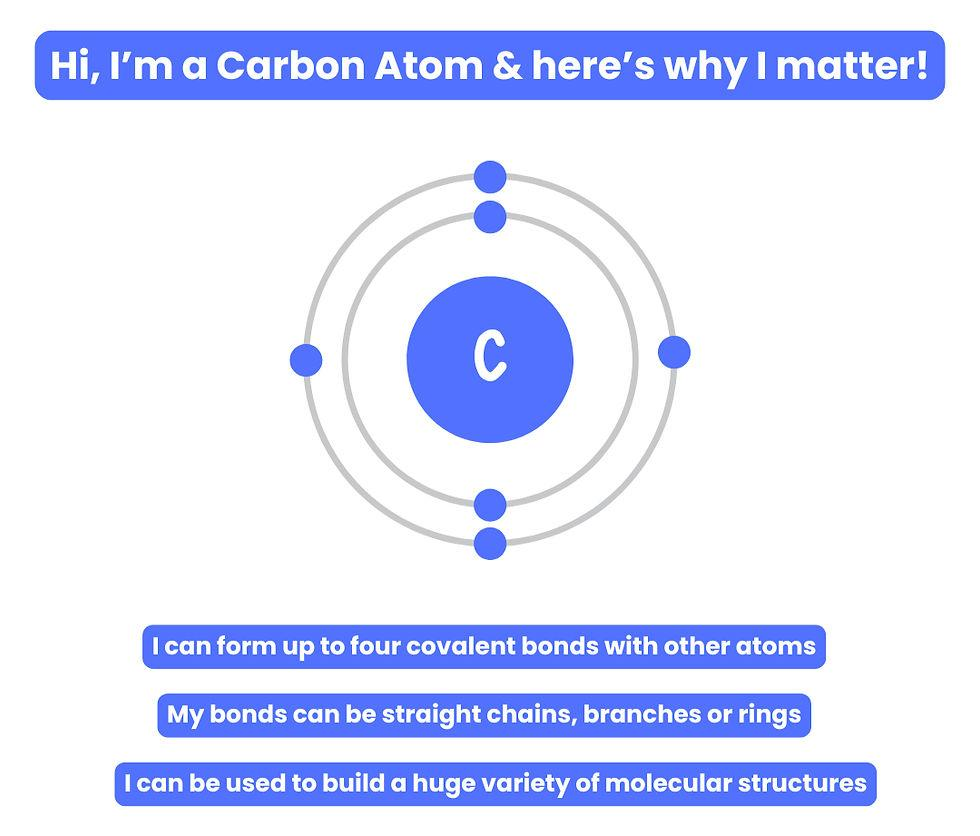
Carbon is a non-metallic element with atomic number 6. Its electronic configuration is 2, 4.
Carbon is found in a wide variety of compounds, both in living organisms and non-living materials.
Organic Chemistry: The branch of chemistry that deals with the study of carbon compounds, particularly hydrocarbons and their derivatives, is called organic chemistry.
Hydrocarbons: Compounds made up of carbon and hydrogen only are called hydrocarbons.
Examples:
- Methane – CH₄
- Ethane – C₂H₆
- Ethene – C₂H₄
- Ethyne – C₂H₂
2. Bonding in Carbon – Covalent Bond
The atomic number of carbon is 6, and its electronic configuration is 2, 4. Therefore, it has four electrons in its outermost shell.
To achieve a stable electronic configuration, carbon requires four more electrons.
However, carbon cannot easily gain or lose four electrons because:
- Gaining four electrons would produce a negatively charged ion with considerable electron-electron repulsion.
- Losing four electrons would require a very large amount of energy.
Therefore, carbon completes its outermost shell by sharing electrons with other atoms.
Covalent Bond
A chemical bond formed by the mutual sharing of electron pairs between two atoms is called a covalent bond.
Carbon forms covalent bonds with hydrogen, oxygen, nitrogen, sulphur, chlorine and other elements.
Types of Covalent Bonds
1. Single Covalent Bond
When two atoms share one pair of electrons, a single covalent bond is formed.
Example: H–H, CH₄ and C₂H₆.
2. Double Covalent Bond
When two atoms share two pairs of electrons, a double covalent bond is formed.
Example: O=O and C₂H₄.
3. Triple Covalent Bond
When two atoms share three pairs of electrons, a triple covalent bond is formed.
Example: N≡N and C₂H₂.
Important: Carbon has a valency of four. Hence, it is called tetravalent.
3. Allotropes of Carbon
The existence of an element in different physical forms is called allotropy. These different forms are known as allotropes.
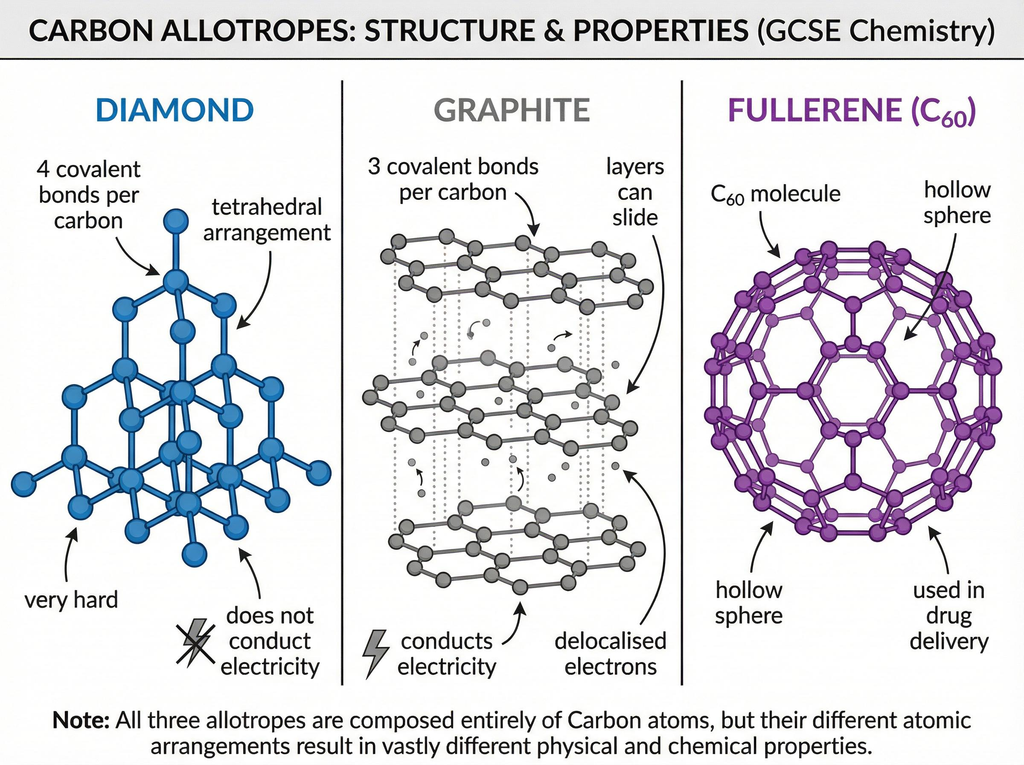
Carbon has three important allotropes:
A. Diamond
- Each carbon atom is bonded to four other carbon atoms.
- It has a rigid three-dimensional structure.
- Diamond is extremely hard.
- It does not conduct electricity because it has no free electrons.
- It is used in jewellery, cutting tools and drilling equipment.
B. Graphite
- Each carbon atom is bonded to three other carbon atoms.
- The atoms form hexagonal arrangements in layers.
- Graphite is soft, smooth and slippery.
- It conducts electricity due to the presence of free electrons.
- It is used in pencil leads and as a lubricant.
C. Buckminsterfullerene
- It is an allotrope of carbon containing 60 carbon atoms.
- Its molecular formula is C₆₀.
- The carbon atoms are arranged in a spherical structure.
- It is named after the architect Buckminster Fuller.
Difference Between Diamond and Graphite
| Diamond | Graphite |
|---|---|
| Each carbon is bonded to four carbon atoms. | Each carbon is bonded to three carbon atoms. |
| Three-dimensional structure. | Layered structure. |
| Extremely hard. | Soft and slippery. |
| Does not conduct electricity. | Conducts electricity. |
| Used in cutting tools and jewellery. | Used in pencil leads and lubricants. |
4. Versatile Nature of Carbon
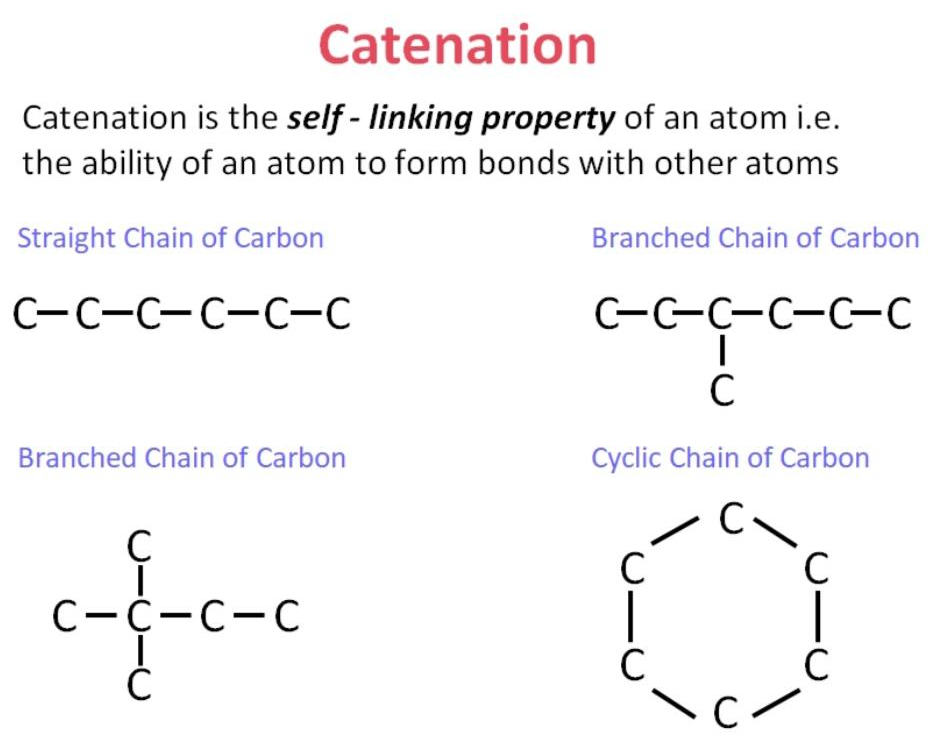
Carbon forms millions of compounds because of two important properties:
A. Catenation
The property of carbon atoms to bond with one another to form long chains, branched chains and rings is called catenation.
Carbon can form:
- Straight-chain compounds.
- Branched-chain compounds.
- Closed-chain or ring compounds.
Catenation is possible because carbon atoms form strong carbon-carbon covalent bonds.
B. Tetravalency
The valency of carbon is four. Therefore, one carbon atom can form four covalent bonds with other carbon atoms or atoms of other elements.
Carbon forms compounds with hydrogen, oxygen, nitrogen, sulphur, chlorine and many other elements.
Remember: Catenation and tetravalency are the two major reasons behind the large number of carbon compounds.
5. Hydrocarbons and Their Classification
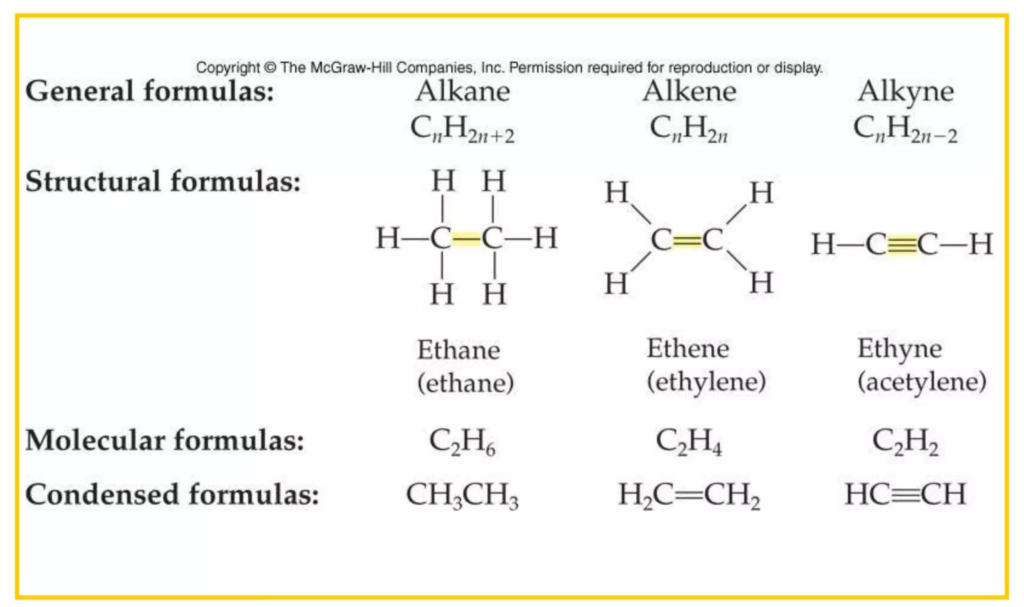
Hydrocarbons are compounds containing only carbon and hydrogen.
They are classified into two main types:
- Saturated hydrocarbons
- Unsaturated hydrocarbons
A. Saturated Hydrocarbons – Alkanes
Hydrocarbons in which carbon atoms are connected by only single covalent bonds are called saturated hydrocarbons.
They are known as alkanes.
General formula:
CₙH₂ₙ₊₂
Examples:
| Name | Molecular Formula |
|---|---|
| Methane | CH₄ |
| Ethane | C₂H₆ |
| Propane | C₃H₈ |
| Butane | C₄H₁₀ |
| Pentane | C₅H₁₂ |
B. Unsaturated Hydrocarbons
Hydrocarbons containing at least one carbon-carbon double bond or triple bond are called unsaturated hydrocarbons.
They are of two types.
1. Alkenes
Hydrocarbons containing at least one carbon-carbon double bond are called alkenes.
General formula: CₙH₂ₙ
Example:
- Ethene – C₂H₄
- Propene – C₃H₆
2. Alkynes
Hydrocarbons containing at least one carbon-carbon triple bond are called alkynes.
General formula: CₙH₂ₙ₋₂
Example:
- Ethyne – C₂H₂
- Propyne – C₃H₄
Difference Between Saturated and Unsaturated Hydrocarbons
| Saturated Hydrocarbons | Unsaturated Hydrocarbons |
|---|---|
| Contain only single carbon-carbon bonds. | Contain double or triple carbon-carbon bonds. |
| Also called alkanes. | Include alkenes and alkynes. |
| General formula: CₙH₂ₙ₊₂ | Alkenes: CₙH₂ₙ; Alkynes: CₙH₂ₙ₋₂ |
| Generally burn with a clean flame when sufficient oxygen is available. | Generally burn with a yellow, sooty flame in air. |
Cyclic Hydrocarbons
Hydrocarbons in which carbon atoms are arranged in the form of a ring are called cyclic hydrocarbons.
Examples:
- Cyclohexane – C₆H₁₂ (saturated cyclic hydrocarbon).
- Benzene – C₆H₆ (unsaturated cyclic hydrocarbon).
6. Functional Groups
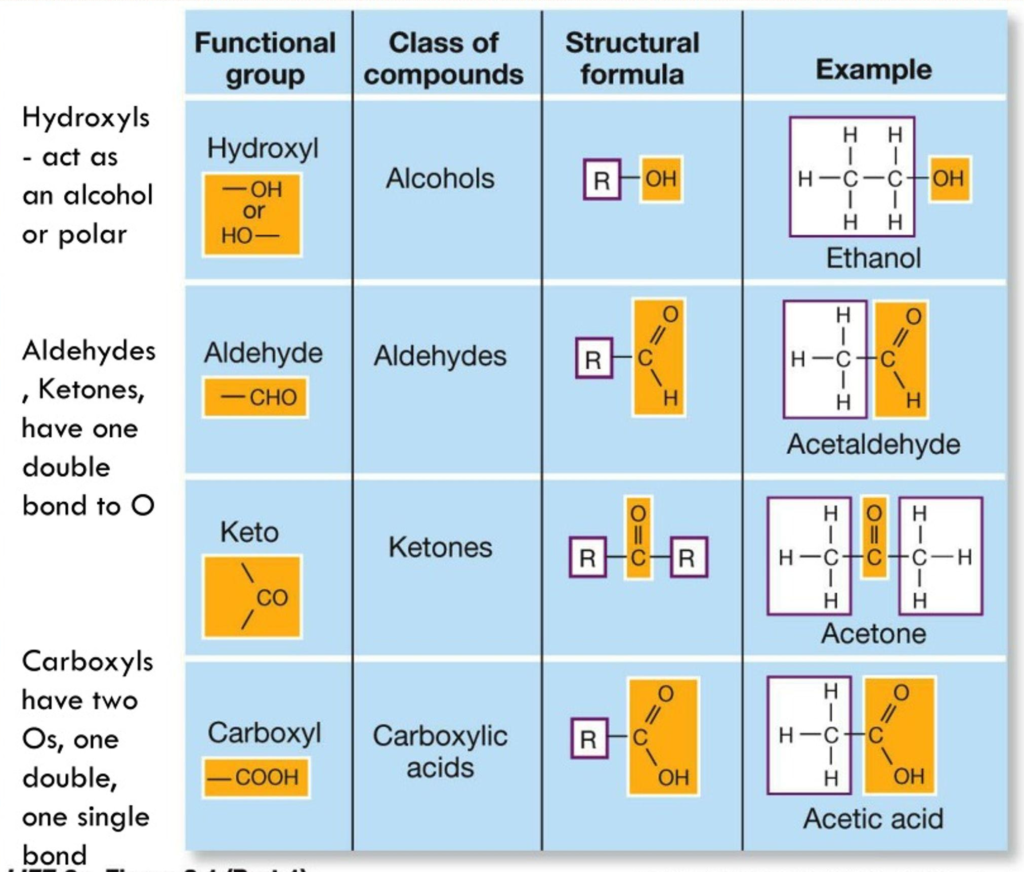
A functional group is an atom or group of atoms present in an organic compound that determines its characteristic chemical properties.
Organic compounds can be formed by replacing one or more hydrogen atoms of a hydrocarbon with other atoms or groups of atoms.
Important Functional Groups
| Functional Group | Formula | Class of Compound | Suffix/Prefix |
|---|---|---|---|
| Halo | –Cl, –Br, –F, –I | Haloalkanes | Chloro, Bromo etc. |
| Hydroxyl | –OH | Alcohols | –ol |
| Aldehyde | –CHO | Aldehydes | –al |
| Ketone | >C=O | Ketones | –one |
| Carboxyl | –COOH | Carboxylic acids | –oic acid |
| Ether | –O– | Ethers | Alkoxy |
Examples:
- CH₃Cl – Chloromethane
- C₂H₅OH – Ethanol
- CH₃CHO – Ethanal
- CH₃COOH – Ethanoic acid
- CH₃OCH₃ – Methoxymethane
7. Homologous Series
A homologous series is a group of organic compounds having the same functional group and similar chemical properties, in which successive members differ by a –CH₂– unit.
Characteristics of a Homologous Series
- All members have the same functional group.
- They have the same general formula.
- Successive members differ by one –CH₂– group.
- The molecular mass of successive members differs by 14 u.
- They show similar chemical properties.
- Their physical properties show a gradual change with increasing molecular mass.
Example: Homologous Series of Alkanes
| Compound | Formula |
|---|---|
| Methane | CH₄ |
| Ethane | C₂H₆ |
| Propane | C₃H₈ |
| Butane | C₄H₁₀ |
| Pentane | C₅H₁₂ |
Notice that every successive member differs by CH₂.
8. Nomenclature of Carbon Compounds
Nomenclature is the systematic process of naming chemical compounds.
The International Union of Pure and Applied Chemistry (IUPAC) provides a uniform system for naming organic compounds.
Word Roots Based on the Number of Carbon Atoms
| Number of Carbon Atoms | Word Root |
|---|---|
| 1 | Meth |
| 2 | Eth |
| 3 | Prop |
| 4 | But |
| 5 | Pent |
| 6 | Hex |
Suffixes Used in Naming Carbon Compounds
| Bond/Functional Group | Suffix |
|---|---|
| Single bond | –ane |
| Double bond | –ene |
| Triple bond | –yne |
| Alcohol (–OH) | –ol |
| Aldehyde (–CHO) | –al |
| Ketone (>C=O) | –one |
| Carboxylic acid (–COOH) | –oic acid |
Examples of IUPAC Names
| Formula | IUPAC Name |
|---|---|
| CH₄ | Methane |
| C₂H₆ | Ethane |
| C₂H₄ | Ethene |
| C₂H₂ | Ethyne |
| C₂H₅OH | Ethanol |
| CH₃COOH | Ethanoic acid |
| CH₃CHO | Ethanal |
Naming tip: First identify the number of carbon atoms, then the type of carbon-carbon bond and finally the functional group.
9. Chemical Properties of Carbon Compounds
Carbon compounds undergo several chemical reactions. The important reactions are:
A. Combustion
The process of burning a carbon compound in air or oxygen to produce carbon dioxide, water, heat and light is called combustion (in complete combustion).
Combustion reactions are exothermic reactions because they release heat.
Example – Combustion of methane:
CH₄ + 2O₂ → CO₂ + 2H₂O + Heat + Light
Combustion of ethane:
2C₂H₆ + 7O₂ → 4CO₂ + 6H₂O + Heat + Light
Important points:
- Saturated hydrocarbons generally burn with a clean blue flame when sufficient oxygen is available.
- Unsaturated hydrocarbons generally burn with a yellow, sooty flame in air.
- Incomplete combustion can produce carbon monoxide and soot.
B. Oxidation
The addition of oxygen or removal of hydrogen from a substance is called oxidation.
Alcohols can be oxidised to carboxylic acids.
For example, ethanol is oxidised to ethanoic acid using alkaline potassium permanganate (KMnO₄) or acidified potassium dichromate (K₂Cr₂O₇).
CH₃CH₂OH + 2[O] → CH₃COOH + H₂O
Oxidising agents:
- Alkaline KMnO₄
- Acidified K₂Cr₂O₇
C. Addition Reaction
The reaction in which atoms are added to an unsaturated compound is called an addition reaction.
Hydrogenation is the addition of hydrogen to an unsaturated hydrocarbon in the presence of a catalyst such as nickel, palladium or platinum.
Example:
CH₂=CH₂ + H₂ → CH₃–CH₃
(Catalyst: Nickel; heat)
Industrial application: Hydrogenation is used to convert vegetable oils into vegetable ghee (vanaspati ghee).
D. Substitution Reaction
The reaction in which one or more hydrogen atoms of a hydrocarbon are replaced by atoms of other elements is called a substitution reaction.
Substitution reactions are characteristic of saturated hydrocarbons.
Example:
CH₄ + Cl₂ → CH₃Cl + HCl
Condition: Sunlight.
In this reaction, one hydrogen atom of methane is replaced by a chlorine atom.
10. Important Carbon Compounds – Ethanol and Ethanoic Acid
A. Ethanol (C₂H₅OH)
Ethanol is commonly known as ethyl alcohol.
Physical Properties:
- It is a colourless liquid.
- It is soluble in water.
- It is neutral to litmus.
- It is inflammable.
Chemical Properties:
1. Reaction with Sodium
Ethanol reacts with sodium to form sodium ethoxide and hydrogen gas.
2C₂H₅OH + 2Na → 2C₂H₅ONa + H₂↑
2. Dehydration of Ethanol
When ethanol is heated with excess concentrated sulphuric acid at 170°C, it loses water and forms ethene.
C₂H₅OH → CH₂=CH₂ + H₂O
Condition: Concentrated H₂SO₄, 170°C.
B. Ethanoic Acid (CH₃COOH)
Ethanoic acid is commonly known as acetic acid.
A 5–8% solution of ethanoic acid in water is called vinegar.
Pure ethanoic acid freezes at approximately 16.6°C. It is therefore also known as glacial acetic acid.
Physical Properties:
- It is a colourless liquid.
- It has a pungent smell.
- It is soluble in water.
- It turns blue litmus red.
Chemical Properties:
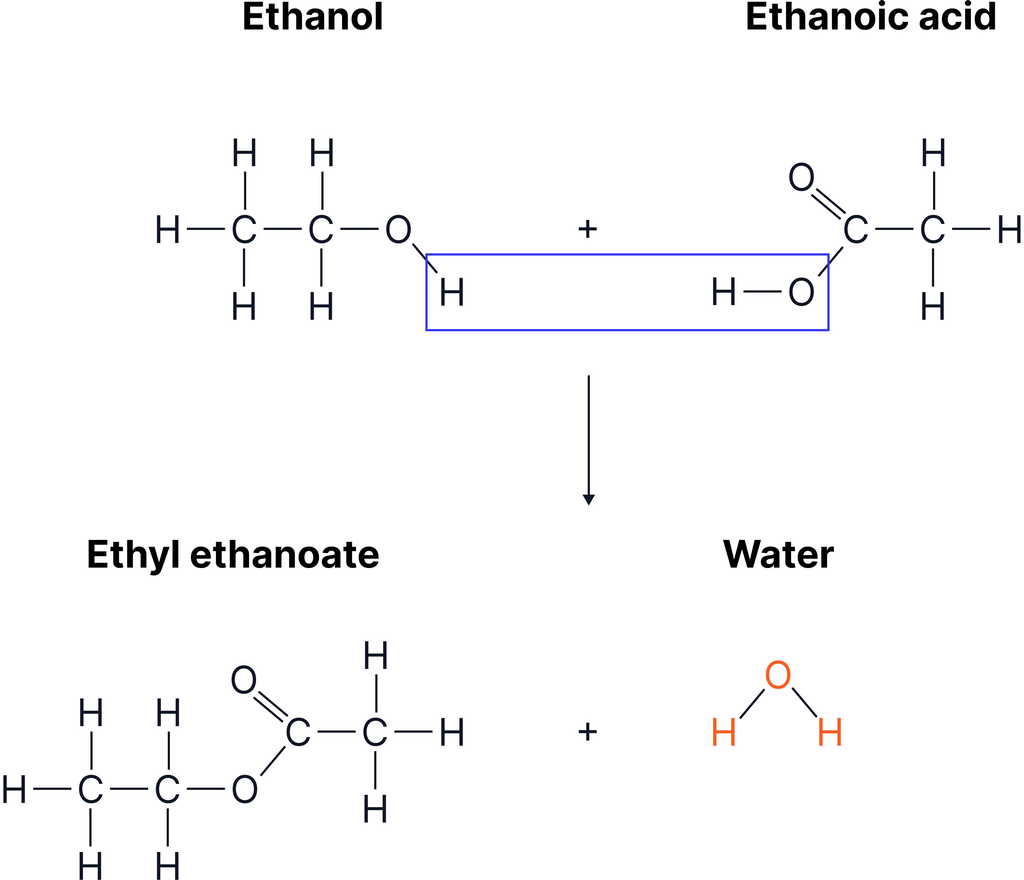
1. Esterification Reaction
When ethanoic acid reacts with ethanol in the presence of concentrated sulphuric acid, an ester is formed.
CH₃COOH + C₂H₅OH → CH₃COOC₂H₅ + H₂O
The ester formed is ethyl ethanoate. Esters generally have a pleasant, fruity smell and are used in perfumes and flavouring agents.
2. Reaction with a Base
Ethanoic acid reacts with sodium hydroxide to form sodium ethanoate and water.
CH₃COOH + NaOH → CH₃COONa + H₂O
3. Reaction with Sodium Carbonate
Ethanoic acid reacts with sodium carbonate to produce sodium ethanoate, water and carbon dioxide.
2CH₃COOH + Na₂CO₃ → 2CH₃COONa + H₂O + CO₂
4. Reaction with Sodium Hydrogen Carbonate
CH₃COOH + NaHCO₃ → CH₃COONa + H₂O + CO₂
Difference Between Ethanol and Ethanoic Acid
| Ethanol | Ethanoic Acid |
|---|---|
| Formula: C₂H₅OH | Formula: CH₃COOH |
| Functional group: –OH | Functional group: –COOH |
| Neutral to litmus | Turns blue litmus red |
| Commonly called ethyl alcohol | Commonly called acetic acid |
| Reacts with sodium to release hydrogen | Reacts with carbonates to release CO₂ |
11. Soaps and Detergents
What is Soap?
Soaps are sodium or potassium salts of long-chain carboxylic acids.
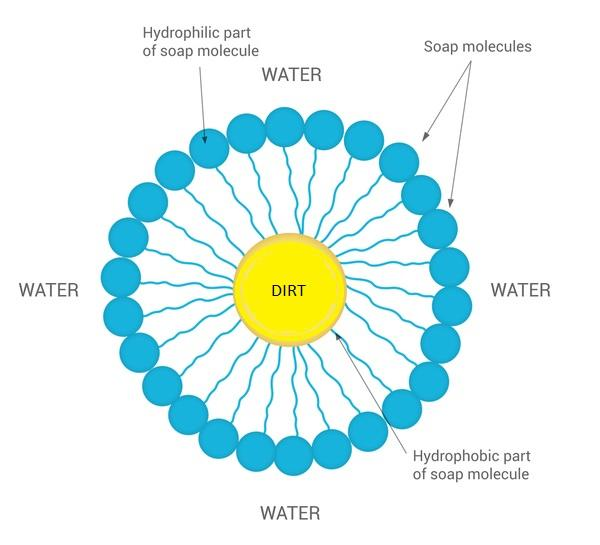
A soap molecule has two distinct parts:
- Hydrophobic end: The long hydrocarbon chain that is insoluble in water but soluble in oil and grease.
- Hydrophilic end: The ionic carboxylate end that is attracted to water.
Cleansing Action of Soap
Soap removes dirt and grease through the formation of structures called micelles.
The cleansing process takes place as follows:
- The hydrophobic end of the soap molecule attaches itself to oily dirt.
- The hydrophilic end remains attracted towards water.
- Many soap molecules surround the dirt particle.
- A spherical structure called a micelle is formed.
- The dirt gets suspended in water and can be washed away.
Micelle: A spherical aggregate of soap molecules formed in water, with the hydrocarbon ends directed towards the oily dirt and the ionic ends towards water.
What are Detergents?
Detergents are cleansing agents that can work effectively in both hard and soft water.
Difference Between Soaps and Detergents
| Soaps | Detergents |
|---|---|
| Sodium or potassium salts of long-chain carboxylic acids. | Commonly sodium salts of long-chain alkyl sulphates or alkylbenzene sulphonates. |
| Form scum in hard water. | Generally do not form insoluble scum in hard water. |
| Less effective in hard water. | Effective in hard water. |
| Some soaps are biodegradable. | Biodegradability depends on the detergent’s chemical structure. |
Why are detergents preferred in hard water?
Hard water contains calcium and magnesium ions. These ions react with soap to form insoluble substances called scum. This reduces the cleansing efficiency of soap.
Detergents generally do not form such insoluble precipitates and therefore work effectively in hard water.
12. Important Chemical Equations – Quick Revision
Learn these important reactions carefully for examinations.
| Reaction | Chemical Equation |
|---|---|
| Combustion of methane | CH₄ + 2O₂ → CO₂ + 2H₂O |
| Oxidation of ethanol | CH₃CH₂OH + 2[O] → CH₃COOH + H₂O |
| Hydrogenation of ethene | CH₂=CH₂ + H₂ → CH₃–CH₃ |
| Substitution of methane | CH₄ + Cl₂ → CH₃Cl + HCl |
| Ethanol with sodium | 2C₂H₅OH + 2Na → 2C₂H₅ONa + H₂ |
| Dehydration of ethanol | C₂H₅OH → CH₂=CH₂ + H₂O |
| Esterification | CH₃COOH + C₂H₅OH → CH₃COOC₂H₅ + H₂O |
| Ethanoic acid with NaOH | CH₃COOH + NaOH → CH₃COONa + H₂O |
| Ethanoic acid with NaHCO₃ | CH₃COOH + NaHCO₃ → CH₃COONa + H₂O + CO₂ |
Note: Reaction conditions and catalysts should also be written wherever required.
13. Important Definitions for CBSE Exams
1. Covalent Bond: A chemical bond formed by the mutual sharing of electron pairs between atoms.
2. Catenation: The property of carbon atoms to form bonds with one another, producing long chains, branched chains and rings.
3. Tetravalency: The property of carbon by which it forms four covalent bonds.
4. Hydrocarbons: Compounds containing only carbon and hydrogen.
5. Saturated Hydrocarbons: Hydrocarbons containing only single bonds between carbon atoms.
6. Unsaturated Hydrocarbons: Hydrocarbons containing one or more double or triple bonds between carbon atoms.
7. Functional Group: An atom or group of atoms that determines the characteristic chemical properties of an organic compound.
8. Homologous Series: A family of organic compounds having the same functional group and similar chemical properties, with successive members differing by –CH₂–.
9. Oxidation: A chemical process involving the addition of oxygen or removal of hydrogen.
10. Hydrogenation: The addition of hydrogen to an unsaturated compound in the presence of a catalyst.
11. Esterification: The reaction between an alcohol and a carboxylic acid to form an ester and water.
12. Saponification: The alkaline hydrolysis of an ester to form an alcohol and the salt of a carboxylic acid.
13. Micelle: A spherical aggregate of soap molecules formed in water.
14. Frequently Asked Questions (FAQs)
Q1. Why does carbon form covalent bonds?
Carbon has four valence electrons. It cannot easily gain or lose four electrons, so it shares electrons with other atoms to achieve a stable electronic configuration.
Q2. What are the two important properties responsible for the versatility of carbon?
Catenation and tetravalency.
Q3. Why is diamond hard but graphite soft?
In diamond, each carbon atom is bonded to four other carbon atoms in a rigid three-dimensional structure. In graphite, carbon atoms form layers that can slide over one another.
Q4. Why does graphite conduct electricity but diamond does not?
Graphite contains free electrons that can move and conduct electricity. Diamond does not have free electrons.
Q5. What is the difference between alkanes and alkenes?
Alkanes contain only single carbon-carbon bonds, whereas alkenes contain at least one carbon-carbon double bond.
Q6. What happens when ethanol reacts with sodium?
Ethanol reacts with sodium to produce sodium ethoxide and hydrogen gas.
Q7. What is vinegar?
Vinegar is a dilute aqueous solution of ethanoic acid, generally containing about 5–8% ethanoic acid.
Q8. Why are soaps ineffective in hard water?
Soaps react with calcium and magnesium ions in hard water to form insoluble scum, reducing their cleansing efficiency.
Q9. What is the function of concentrated sulphuric acid in the dehydration of ethanol?
It acts as a dehydrating agent and removes water from ethanol to form ethene.
Q10. What is the importance of hydrogenation?
Hydrogenation is used in industries to convert unsaturated vegetable oils into more saturated fats, such as vanaspati ghee.
15. Practice Questions for Class 10 Students
A. Multiple Choice Questions (MCQs)
1. The valency of carbon is:
(a) 1
(b) 2
(c) 3
(d) 4
2. Which of the following is an allotrope of carbon?
(a) Sulphur
(b) Graphite
(c) Oxygen
(d) Nitrogen
3. The general formula of alkanes is:
(a) CₙH₂ₙ
(b) CₙH₂ₙ₊₂
(c) CₙH₂ₙ₋₂
(d) CₙHₙ
4. Which functional group is present in alcohols?
(a) –COOH
(b) –CHO
(c) –OH
(d) –CO–
5. The molecular formula of buckminsterfullerene is:
(a) C₆₀
(b) C₆H₆
(c) C₂H₆
(d) C₆H₁₂
6. Which gas is released when ethanoic acid reacts with sodium hydrogen carbonate?
(a) Hydrogen
(b) Oxygen
(c) Carbon dioxide
(d) Nitrogen
7. Which of the following is used as an oxidising agent?
(a) NaCl
(b) KMnO₄
(c) NaOH
(d) HCl
8. The process of converting vegetable oil into vanaspati ghee is called:
(a) Oxidation
(b) Substitution
(c) Hydrogenation
(d) Esterification
B. Short Answer Questions
- Define covalent bonding. Why does carbon form covalent bonds?
- Explain the difference between diamond and graphite.
- What is catenation? Give examples of different carbon chains.
- Differentiate between saturated and unsaturated hydrocarbons.
- What is a functional group? Give four examples.
- Define a homologous series. Write any four characteristics.
- What happens when ethanol reacts with sodium?
- Explain the cleansing action of soap with the help of micelles.
C. Long Answer Questions
- Explain the versatile nature of carbon with reference to catenation and tetravalency.
- Describe the four important chemical properties of carbon compounds with suitable equations.
- Explain the physical and chemical properties of ethanol and ethanoic acid.
- Describe the cleansing action of soap with a labelled diagram of a micelle.
- Differentiate between soaps and detergents.
Conclusion
Carbon and Its Compounds is an important chapter in Class 10 Science because it introduces students to the basic concepts of organic chemistry.
Understanding covalent bonding, catenation, tetravalency, hydrocarbons, functional groups, homologous series and chemical reactions will help students build a strong foundation for higher classes.
Study Tip: Do not simply memorise the chemical equations. Understand the reactants, products and conditions of each reaction. Practise drawing structural formulae and micelle diagrams regularly.
Keep learning and keep revising with The Study Smart – Learn Better, Score Better!