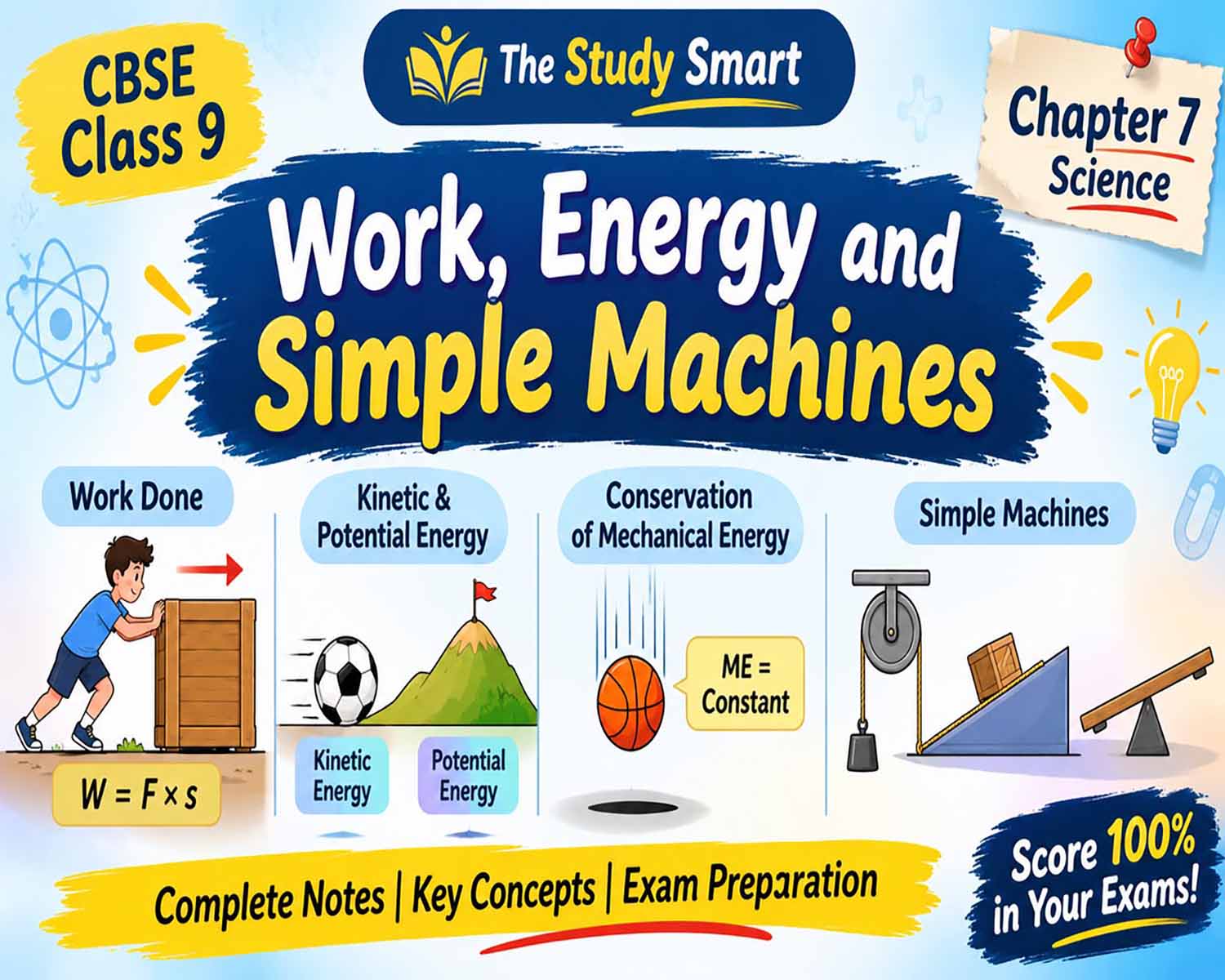
CBSE Class 9 Science Chapter 7 – Work, Energy and Simple Machines Notes
Welcome to The Study Smart!
In this chapter, we will learn about work, energy, power and simple machines. These concepts help us understand many activities in everyday life, such as lifting objects, pushing vehicles, climbing stairs, operating pulleys and using ramps.
These notes include easy explanations, important definitions, formulas, solved numerical problems, examples, diagrams to practise and examination-oriented questions.
Chapter Overview
- Work done by a constant force
- Positive, negative and zero work
- Work-energy theorem
- Different forms of energy
- Kinetic energy
- Potential energy
- Gravitational potential energy
- Conservation of mechanical energy
- Power and its units
- Simple machines
- Pulleys, inclined planes and levers
- Important formulas and numerical problems
1. Work Done by a Force
In everyday language, work may mean studying, writing, walking or doing physical activities. However, in science, work has a specific meaning.
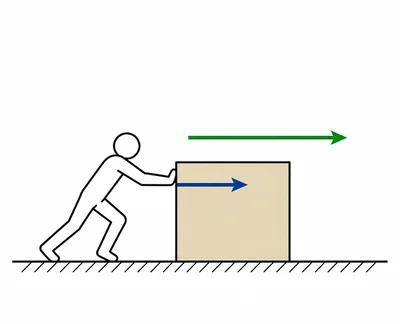
Definition: Work is said to be done when a force acting on an object produces displacement in the direction of the force.
Formula for Work
Where:
- W = Work done
- F = Force applied
- s = Displacement in the direction of force
SI unit: Joule (J)
One joule of work is done when a force of one newton displaces an object by one metre in the direction of the force.
Factors Affecting Work
- Magnitude of the force applied.
- Displacement produced in the direction of the force.
Greater force or greater displacement produces more work, provided the other factor remains unchanged.
When Is Work Zero?
Work done is zero in the following situations:
- When no force acts on the object.
- When the object does not move.
- When the force is perpendicular to the displacement.
Examples:
- A person pushing a rigid wall that does not move.
- A person holding a heavy bag without moving it.
- A person carrying a bag horizontally: the upward supporting force is perpendicular to horizontal displacement.
2. Positive, Negative and Zero Work
Depending on the direction of force and displacement, work can be positive, negative or zero.
| Type | Condition | Example |
|---|---|---|
| Positive Work | Force and displacement are in the same direction. | Pushing a trolley forward. |
| Negative Work | Force and displacement are in opposite directions. | Friction acting on a moving object. |
| Zero Work | No displacement or force perpendicular to displacement. | Pushing a wall without moving it. |
Positive Work
When force and displacement act in the same direction, work is positive. For example, when a person pushes a cart forward, the applied force helps its motion.
Negative Work
When force acts opposite to displacement, work is negative. For example, friction opposes the motion of a sliding object.
Zero Work
When displacement is zero, work done is zero even if force is applied.
3. Work-Energy Theorem
Energy is the capacity of an object or system to do work.
Work-Energy Theorem: The net work done on an object is equal to the change in its kinetic energy.
When positive net work is done, the kinetic energy of an object increases. When negative net work is done, its kinetic energy decreases.
Example: A moving football hits another object and transfers some of its energy, causing that object to move.
4. Different Forms of Energy
Energy exists in different forms. It can be transferred or converted from one form into another.
| Form of Energy | Meaning | Example |
|---|---|---|
| Mechanical | Energy due to motion or position. | Moving car |
| Thermal | Energy associated with temperature. | Hot water |
| Light | Energy that enables us to see. | Sunlight |
| Sound | Energy associated with vibrations. | Ringing bell |
| Electrical | Energy associated with electric charges. | Electric current |
| Chemical | Energy stored in chemical substances. | Food and fuels |
| Nuclear | Energy stored in atomic nuclei. | Nuclear reactions |
Examples of Energy Conversion
- Electric bulb: Electrical energy → Light energy and heat energy.
- Electric heater: Electrical energy → Thermal energy.
- Human body: Chemical energy → Mechanical energy and heat.
- Electric fan: Electrical energy → Mechanical energy and sound.
- Ringing bell: Mechanical energy → Sound energy.
5. Mechanical Energy
Mechanical energy is the energy possessed by an object due to its motion or position.
Mechanical energy has two main forms:
- Kinetic Energy
- Potential Energy
6. Kinetic Energy (KE)
Definition: The energy possessed by an object due to its motion is called kinetic energy.
Every moving object possesses kinetic energy. A moving bicycle, running person, flying bird and moving vehicle all have kinetic energy.
Formula of Kinetic Energy
Where:
- m = Mass of the object in kilogram (kg)
- v = Velocity of the object in metre per second (m/s)
SI unit of kinetic energy = Joule (J).
Important Properties of Kinetic Energy
- Kinetic energy depends on the mass of the object.
- Kinetic energy depends on the square of its velocity.
- If mass doubles and velocity remains constant, kinetic energy doubles.
- If velocity doubles and mass remains constant, kinetic energy becomes four times.
- A stationary object has zero kinetic energy.
Derivation of Kinetic Energy Formula
Consider an object of mass m initially at rest. A force F acts on it and produces displacement s, giving it final velocity v.
From Newton’s second law:
F = ma
Using the equation of motion:
v² − u² = 2as
Since initial velocity u = 0:
v² = 2as
s = v² / 2a
Work done = Force × Displacement
W = F × s
W = ma × v² / 2a
This work appears as the kinetic energy gained by the object.
7. Potential Energy (PE)
Definition: Energy stored in an object due to its deformation or due to the relative position of objects in a system is called potential energy.
Examples:
- A stretched rubber band.
- A compressed spring.
- A bent bow.
- A stone kept at a height.
- Two magnets placed in particular relative positions.
Gravitational Potential Energy
When an object is lifted against gravity, work is done on it. This work is stored as gravitational potential energy.
Where:
- m = Mass of the object (kg)
- g = Acceleration due to gravity (m/s²)
- h = Height above the chosen reference level (m)
Near Earth’s surface, g is approximately 9.8 m/s². For simple school-level calculations, it may be taken as 10 m/s² when instructed.
Factors Affecting Potential Energy
- Mass of the object.
- Acceleration due to gravity.
- Height of the object.
Greater mass or greater height means greater gravitational potential energy when g remains constant.
8. Law of Conservation of Mechanical Energy
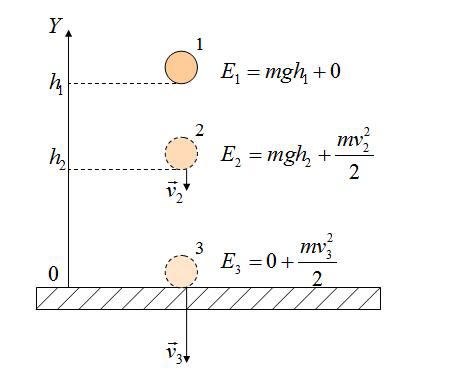
Statement: When only conservative forces act on a system, its total mechanical energy remains constant.
In other words:
Example: Freely Falling Object
Consider a ball dropped from a certain height.
| Position | Potential Energy | Kinetic Energy |
|---|---|---|
| At the top | Maximum | Zero (if released from rest) |
| During the fall | Decreases | Increases |
| Just before reaching ground | Minimum (zero at ground reference) | Maximum |
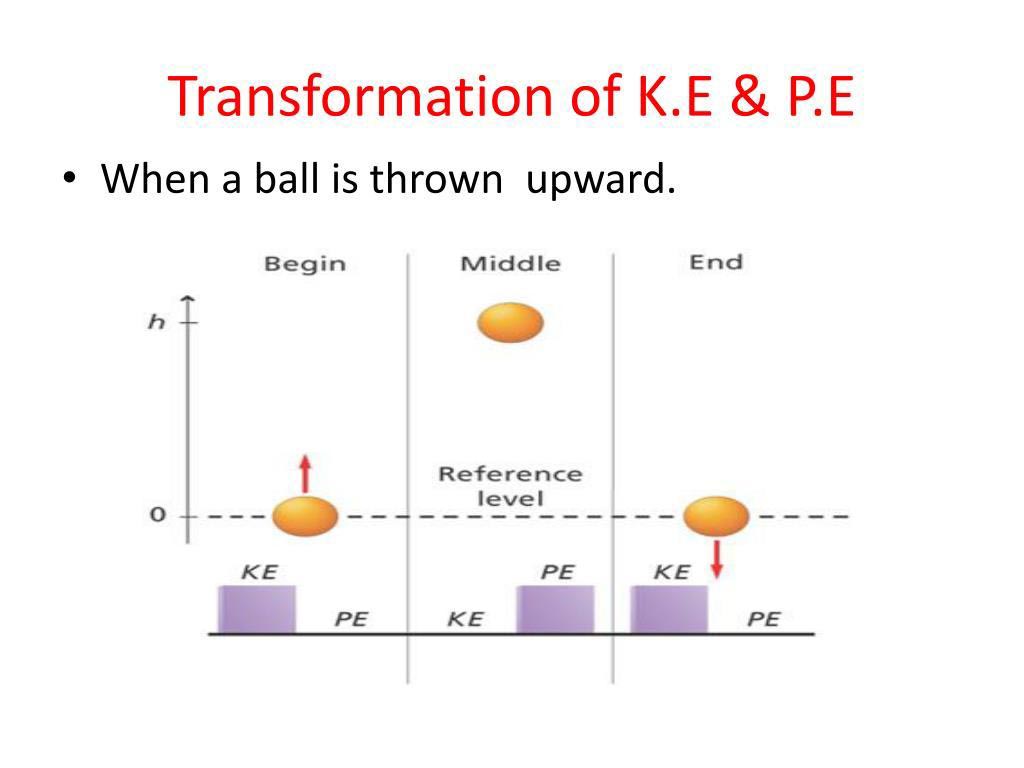
During the fall, potential energy is converted into kinetic energy. If air resistance is ignored, the total mechanical energy remains constant.
Example: Simple Pendulum
A swinging pendulum continuously converts potential energy into kinetic energy and kinetic energy into potential energy.
- At the extreme positions: Potential energy is maximum and kinetic energy is zero.
- At the mean position: Kinetic energy is maximum and potential energy is minimum.
9. Power
Definition: Power is the rate at which work is done or energy is transferred.
Where:
- P = Power
- W = Work done (J)
- t = Time taken (s)
SI unit: Watt (W).
Another unit of power is horsepower.
Examples of Power
Two students climb the same staircase. If both perform the same amount of work but one student takes less time, that student develops greater power.
10. Simple Machines
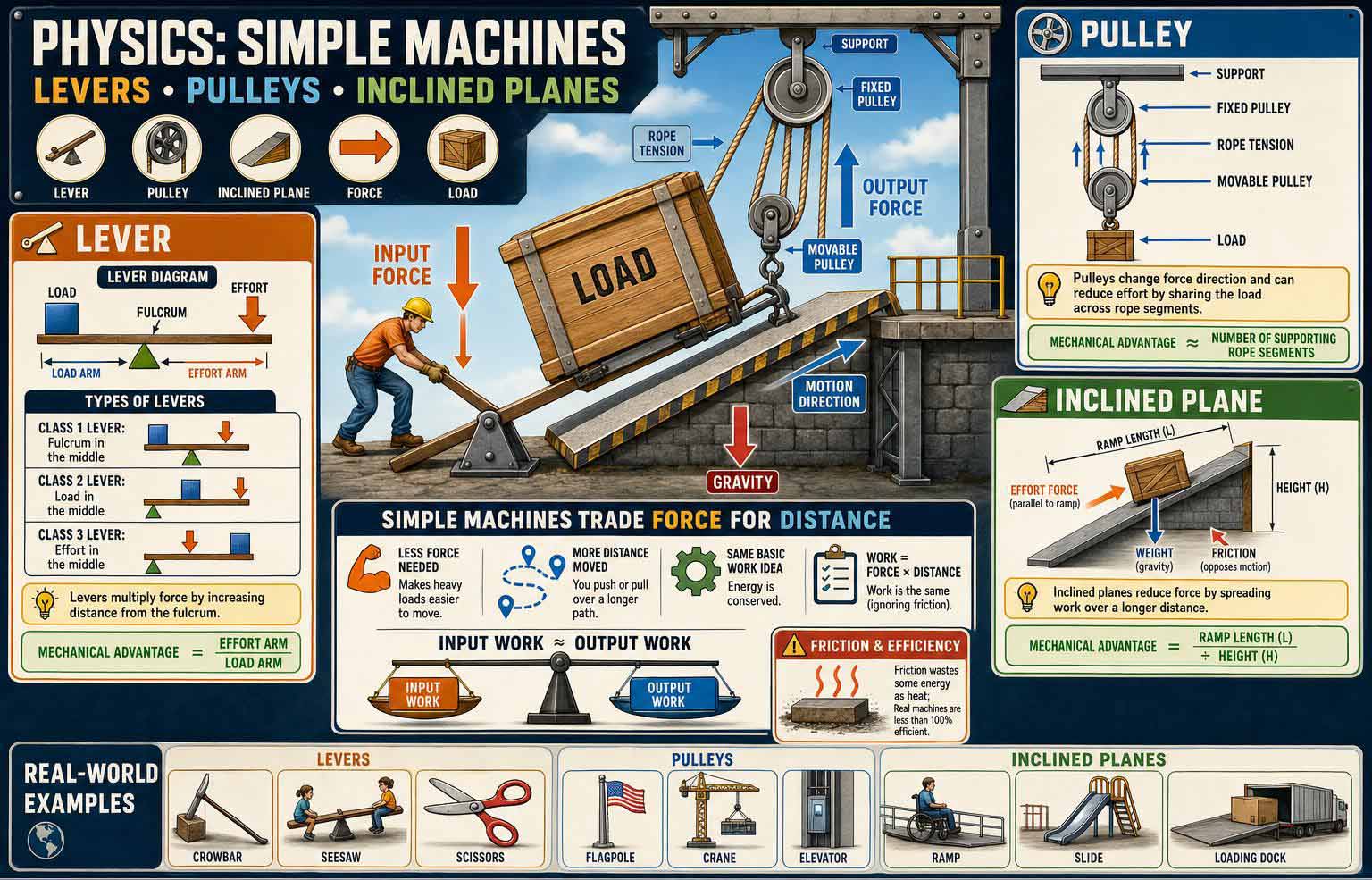
Definition: Simple machines are devices that make work easier by changing the magnitude or direction of the applied force.
They help us perform tasks with less effort or in a more convenient direction. An ideal machine does not reduce the total work required; a smaller force is generally applied through a greater distance.
Important Terms
- Effort: The force applied to operate a machine.
- Load: The force that the machine has to overcome.
- Fulcrum: The fixed point around which a lever rotates.
- Mechanical Advantage: The ratio of load to effort.
11. Pulley
A pulley is a grooved wheel around which a rope or cable passes. It helps lift heavy loads.
Types of Pulley
1. Fixed Pulley: A fixed pulley is attached to a support. It changes the direction of the applied effort but does not reduce the effort in an ideal single-pulley arrangement.
For an ideal fixed pulley:
2. Movable Pulley: A movable pulley moves along with the load. It can reduce the effort needed to lift a load.
Applications: Cranes, elevators and lifting arrangements.
12. Inclined Plane
An inclined plane is a sloping surface used to move heavy objects to a higher or lower level with less effort.
Examples:
- Ramps.
- Sloping roads in hilly areas.
- Loading ramps used for trucks.
A longer and less steep inclined plane requires less force, but the object travels a greater distance.
Mechanical Advantage of an Inclined Plane
Where L is the length of the plane and h is its vertical height.
This formula is for an ideal inclined plane, ignoring friction.
13. Lever
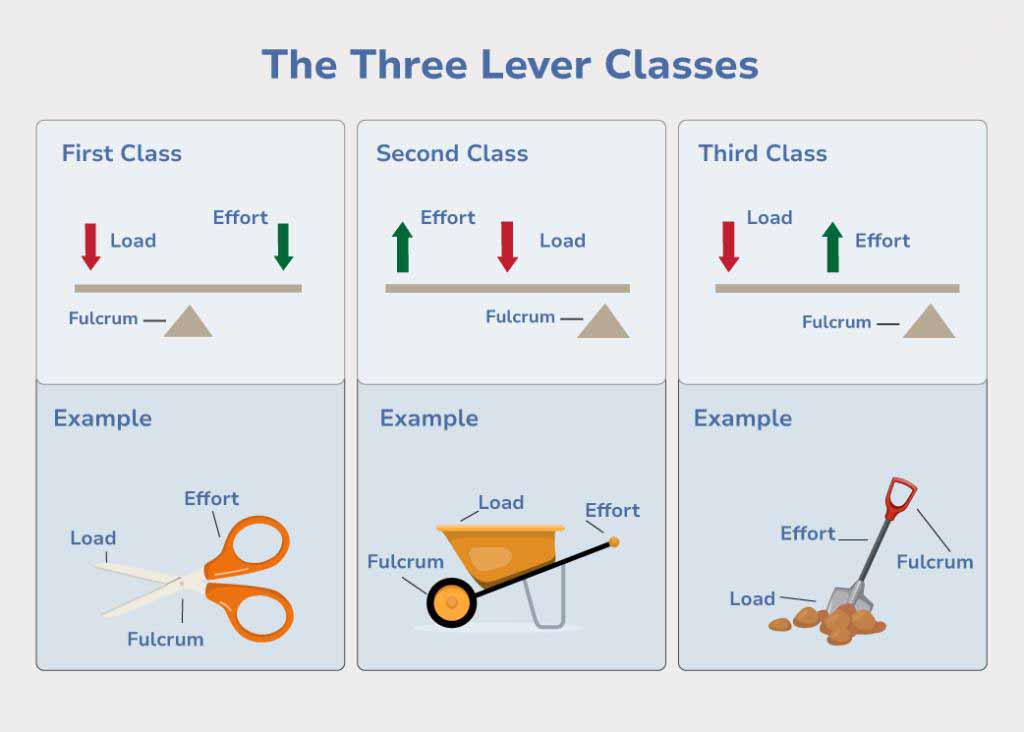
A lever is a rigid bar that rotates around a fixed point called the fulcrum.
Parts of a Lever
- Fulcrum – The fixed point of rotation.
- Load – The force or weight to be moved.
- Effort – The force applied to move the load.
- Effort Arm – Distance between fulcrum and effort.
- Load Arm – Distance between fulcrum and load.
Principle of Lever
Mechanical advantage of a lever:
Classes of Levers
| Class | Position | Examples |
|---|---|---|
| First Class | Fulcrum is between effort and load. | Scissors, seesaw, pliers, crowbar. |
| Second Class | Load is between fulcrum and effort. | Wheelbarrow, nutcracker, bottle opener. |
| Third Class | Effort is between fulcrum and load. | Tweezers, broom, fishing rod. |
First Class – Fulcrum in the middle.
Second Class – Load in the middle.
Third Class – Effort in the middle.
14. Important Formula Sheet
| Concept | Formula |
|---|---|
| Work Done | W = F × s |
| Work-Energy Theorem | Wnet = ΔKE |
| Kinetic Energy | KE = ½mv² |
| Gravitational Potential Energy | PE = mgh |
| Mechanical Energy | E = KE + PE |
| Power | P = W/t |
| Mechanical Advantage | MA = Load/Effort |
| Inclined Plane | MA = L/h |
| Principle of Lever | Effort × Effort Arm = Load × Load Arm |
| Lever MA | MA = Effort Arm/Load Arm |
15. Solved Numerical Problems
Numerical 1: Work Done
Given:
F = 20 N
s = 5 m
Formula:
W = F × s
Calculation:
W = 20 × 5
Answer = 100 J
Numerical 2: Kinetic Energy
m = 4 kg
v = 5 m/s
KE = ½mv²
KE = ½ × 4 × 5²
KE = 2 × 25
Answer = 50 J
Numerical 3: Potential Energy
m = 2 kg
h = 10 m
g = 10 m/s²
PE = mgh
PE = 2 × 10 × 10
Answer = 200 J
Numerical 4: Power
W = 600 J
t = 3 s
P = W/t
P = 600/3
Answer = 200 W
Numerical 5: Mechanical Advantage
MA = Load/Effort
MA = 500/100
Answer = 5
Numerical 6: Inclined Plane
MA = L/h
MA = 5/2
Answer = 2.5
Numerical 7: Work Against Gravity
W = mgh
W = 5 × 10 × 2
Answer = 100 J
16. Important Short Answer Questions
Work is done when a force acting on an object produces displacement in the direction of the force.
The SI unit of work is Joule (J).
Energy is the capacity to do work.
The energy possessed by an object due to its motion is called kinetic energy.
Potential energy is stored energy due to the deformation of an object or the relative position of objects in a system.
Power is the rate at which work is done or energy is transferred.
A simple machine is a device that makes a task easier by changing the magnitude or direction of an applied force.
Mechanical advantage is the ratio of load to effort.
The fixed point around which a lever rotates is called the fulcrum.
It changes the direction of the applied effort, allowing us to pull downward to lift a load upward. An ideal single fixed pulley does not reduce the magnitude of effort.
17. Important Long Answer Questions
- Explain the difference between positive, negative and zero work with suitable examples.
- State and explain the work-energy theorem.
- Derive the expression for kinetic energy of a moving body.
- Explain gravitational potential energy and derive the formula PE = mgh.
- Explain the law of conservation of mechanical energy with the example of a freely falling body.
- Define power. Explain its SI unit and calculate power using a numerical example.
- What are simple machines? Explain their purpose with examples.
- Explain fixed and movable pulleys.
- What is an inclined plane? Explain its mechanical advantage.
- Explain the three classes of levers with examples.
18. Common Mistakes to Avoid in Exams
- Do not write Newton (N) as the unit of work. The correct unit is Joule (J).
- Do not confuse kinetic energy with potential energy.
- Remember that velocity is squared in the kinetic energy formula.
- Convert centimetres into metres before using SI formulas.
- Convert minutes into seconds when calculating power in watts.
- Do not forget the negative sign when work is done opposite to displacement.
- Do not claim that an ideal machine reduces total work.
- Remember that mechanical energy is conserved only when non-conservative effects such as friction are absent or neglected.
19. Exam Preparation Strategy
Important Topics for Revision
- Definition and formula of work.
- Positive, negative and zero work.
- Work-energy theorem.
- Kinetic energy formula and derivation.
- Gravitational potential energy.
- Conservation of mechanical energy.
- Power and its SI unit.
- Mechanical advantage.
- Types of levers and their examples.
- Numerical problems based on all major formulas.
How to Prepare This Chapter
- Read every definition and understand its meaning.
- Practise writing all formulas without looking at the notes.
- Solve at least two numerical problems from each formula.
- Draw neat and labelled diagrams of a pulley, inclined plane and lever.
- Practise explaining conservation of energy using a freely falling ball.
- Revise the differences between positive, negative and zero work.
- Practise NCERT textbook questions and your teacher’s assigned exercises.
20. Multiple Choice Questions (MCQ) Practice
Test your understanding of Work, Energy and Simple Machines. Select an answer mentally and click the Show Answer button to check it.
A. Newton
B. Joule
C. Watt
D. Metre
Work is measured in joules (J).
A. Force is applied
B. Displacement is zero
C. Speed increases
D. Mass increases
A. mv
B. mgh
C. ½mv²
D. F × s
A. Joule
B. Newton
C. Watt
D. Pascal
A. Potential energy
B. Kinetic energy
C. Chemical energy
D. Heat energy
A. ½mv²
B. F × s
C. mgh
D. W/t
A. Positive work
B. Negative work
C. Zero work always
D. Infinite work
A. Load
B. Effort
C. Fulcrum
D. Pulley
A. Wheelbarrow
B. Seesaw
C. Tweezers
D. Nutcracker
A. Mass of the load
B. Direction of effort
C. Weight of the load
D. Height of the building
A. Double
B. Half
C. Four times
D. Eight times
A. 1 J/s
B. 1 N/m
C. 1 kg/m
D. 1 J × s
A. Fulcrum
B. Effort
C. Load
D. Effort arm
A. Effort/Load
B. Load/Effort
C. Force × Distance
D. Work/Time
A. Ramp
B. Seesaw
C. Pliers
D. Fixed pulley
21. Final Revision Checklist
- Understand the scientific meaning of work.
- Memorise W = F × s.
- Learn the three types of work.
- Understand the work-energy theorem.
- Memorise KE = ½mv² and PE = mgh.
- Understand conservation of mechanical energy.
- Learn P = W/t and the watt unit.
- Understand mechanical advantage.
- Learn pulley, inclined plane and lever.
- Practise numerical problems and labelled diagrams.
Conclusion
Work, Energy and Simple Machines is an important chapter in Class 9 Science. Understanding its concepts will help you connect physics with everyday activities.
Focus on the formulas, solve numerical problems regularly and practise diagrams of simple machines. Consistent revision will help you prepare confidently for your school examinations.
Keep Learning, Keep Growing!
— Team The Study Smart