









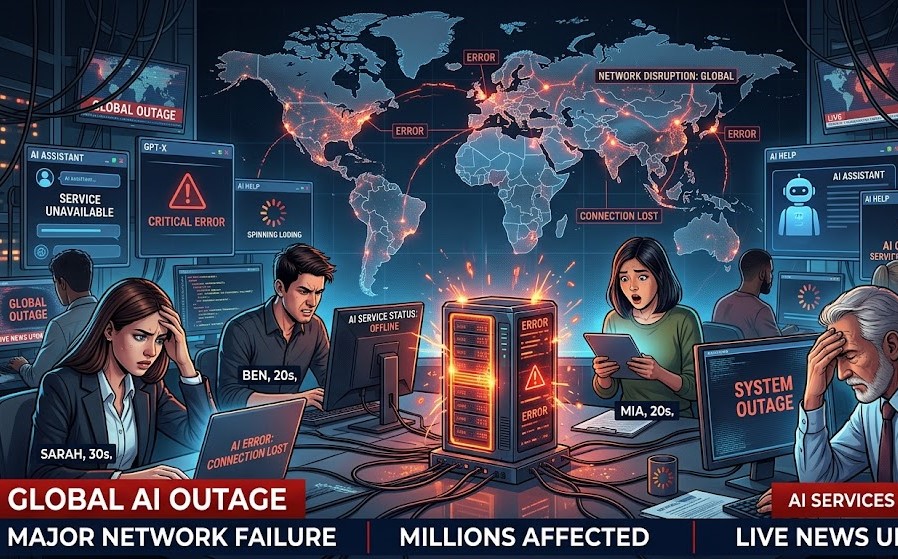
Something big happened to ChatGPT. It just stopped working all of an and this problem was everywhere. Thousands of people around the world could not use ChatGPT. This made a lot of people worried about how reliable ChatGPT and other artificial intelligence systems are.
The problem with ChatGPT affected a lot of people, businesses and developers who use ChatGPT for different things. They use ChatGPT to create content and to help customers automatically.
The company that made ChatGPT, OpenAI said they knew about the problem a few minutes after people started talking about it on social media and websites that track when things are not working. OpenAI said “our teams of engineers are trying to figure out what is wrong, with ChatGPT and they are working to make it work normally again fast as they can”.
A Big Problem That Affected The World
The system had an issue and it happened suddenly. It caught a lot of people off guard. Many said they could not get into their accounts. Some had to wait a while to get a response. Others got error messages when they tried to use the chatbot. Sometimes people could get in. The answers they got were not complete.. They did not work at all.
What was really surprising was that the problem was everywhere. People from North America, Europe, Asia and some parts of Australia said they had problems. This shows it was not one area or computer center with the issue. This shows how big the ChatGPT system is. It is hard to keep it working well for people at the same time.
The system issue was a hassle for people who work on their own. Students and working people who use AI tools a lot had problems. Many people stopped working. This shows how much people rely on AI tools like ChatGPT in their work. The ChatGPT problem was a deal. It was especially a problem, for people who use ChatGPT every day. They rely on ChatGPT.
Growing Dependence on AI Systems
Something happened and it is related to the fact that we are using artificial intelligence systems more and more for personal and business things. The use of ChatGPT has become really popular since it came out. Now it is one of the most used AI systems in the world.
People are using it for lots of things like writing emails and articles helping with programming and even answering customer questions. Businesses are using it to get things done faster. Students are using it to learn new things.
This is an example of a bigger issue: the more we rely on AI systems the more we need to make sure we are ready, for any problems that might happen. People do not see these technologies as something anymore they see AI systems as something they really need to run their businesses.
OpenAIs Response and Investigation
OpenAI said something about what happened. They told us that they know about the problem. They are working on it. The people who work at OpenAI are looking at the computer logs. Checking how the system is doing to figure out what went wrong.
There are a lot of things that could have caused this problem. It could be something with the servers or the internet connection. It could also be a problem with services that OpenAI uses for ChatGPT. ChatGPT is a thing so it might take some time to find out what really happened.
OpenAI wants us to know that they are trying to be honest and reliable. This means that OpenAI will tell us what is going on when they can. OpenAI will give us updates about the problem when they have information, about what happened with ChatGPT and how they are fixing it.
Infrastructures Role in Large-Scale Operations
Running a service like ChatGPT needs a lot of computer power. It requires servers, fast internet connections and good load balancing to handle thousands of questions at the same time. Even a small problem in the system can cause issues.
This incident shows how hard it is for companies to manage on this scale. As more and more people use the service it gets harder to keep the systems stable. It’s a task to make sure the infrastructure is scaled to meet user needs and that its reliable.
Also AI-based services usually work in a distributed environment. This means that if theres a problem, with one part it can cause issues with the system. This makes it harder to find and fix the problem with ChatGPT. The AI and ChatGPT systems need to be looked at to solve the issue.
Reactions of Users and Activity on Social Media Sites
When other technology failed people went to media sites to talk about what was happening to them. They used media sites to share what they were going through. There were hashtags about the outage and people shared screenshots of the error message. Users complained about how the outage was affecting their work.
Some users tried to make the situation a little better by making pictures of themselves without using any special tools. Other users who used ChatGPT for work were worried about missing deadlines.
The problem with the technology also made people think about the risks of relying much on these tools. People like using AI tools because they’re easy and efficient.. People also know that they should have other plans in case the AI tools do not work. Users know that social media sites and AI tools, like ChatGPT are helpful. They also know that they should be careful not to rely on them too much.
Effects on Businesses and Developers
The disruption did not just affect customers. It also had an impact on businesses and developers who used ChatGPT technology in their platforms. Many companies use this technology for automated services like chatbots and response systems.
When something like this happens businesses get disrupted. This can cause problems for them. They might lose money. Get a bad reputation because of delays.
This was also a hassle, for developers. Those who used ChatGPT for their apps had a hard time testing and launching them. The outage made it difficult for them to work on their applications.
Lessons from the Incident Regarding Reliability and Redundancy
The recent shutdown of ChatGPT is a lesson in how important reliability and redundancy are in artificial intelligence-based systems. With the increasing reliance on these systems in people’s everyday lives, they expect them to be available almost all the time.
Firms like OpenAI have to upgrade their systems continually to guarantee their availability. Also, users must think about how they can make themselves less dependent on such systems by utilizing other AI tools or having backup manual processes.
These strategies are somewhat redundant but necessary when the availability of essential systems becomes an issue.
Beyond the Incident: AI in an Interconnected Ecosystem
This situation reminds us of the big problems that come with the modern digital world. The modern digital world is very connected. More and more organizations are using cloud-based services and centralized platforms. So when something goes wrong it becomes a big deal.
AI systems are very important in areas, such as medicine, banking, education and entertainment. AI systems are used in fields. The stability and reliability of AI systems are very important. They are not just important for technology. Also for society. AI systems are crucial for our lives.
This could lead to discussions, about setting rules and making sure AI systems are reliable. We need to talk about making AI systems stronger and more stable. The topic of AI systems is very important so we need to think about how to make them better.
What Happens Next?
OpenAI is still looking into what happened. Users can only wait for information, on how this happened and what the company will do to prevent it from happening again. We need to know what OpenAI is doing to fix things with more companies working on AI.
Services are starting to work again but some users might still have problems sometimes.
Conclusion
The ChatGPT disruption shows how strong and fragile AI can be. ChatGPT has changed things in our lives like work, education and how we talk to each other.. Chatgpt also has some risks because of how complicated it is.
OpenAI has a chance to make ChatGPT better and make users trust it again. At the time people who use ChatGPT need to be ready, for surprises when using AI.
As AI keeps getting better making it reliable will always be important. ChatGPT and AI will always need to be reliable.