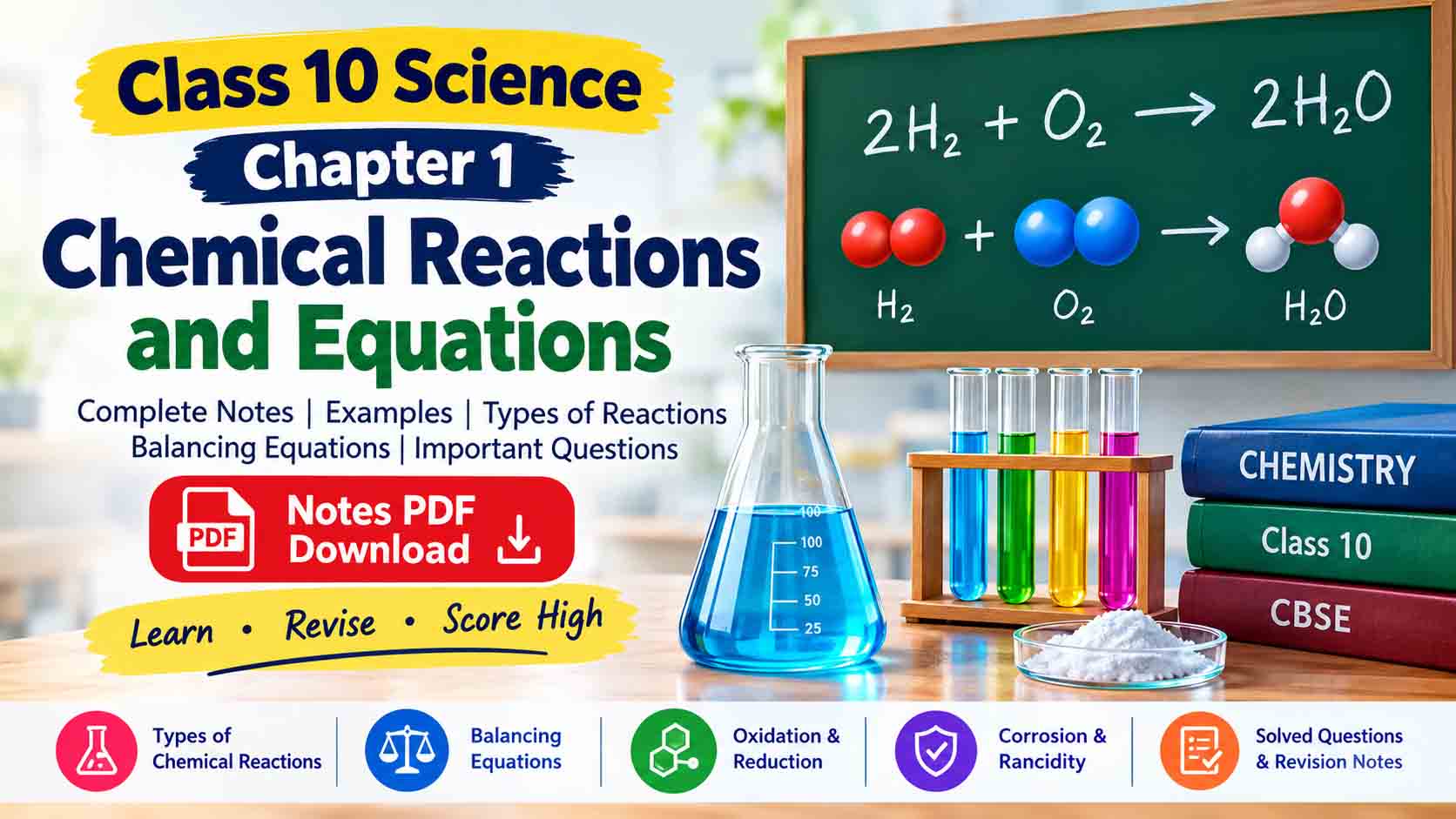
Are you preparing for the CBSE Class 10 Science Board Examination? If yes, understanding Chemical Reactions and Equations is an important step towards building a strong foundation in Chemistry.
In this chapter, students learn how chemical reactions take place, how to represent them using chemical equations, and how to balance these equations according to the Law of Conservation of Mass.
In this post, you will find easy-to-understand Class 10 Science Chapter 1 Notes – Chemical Reactions and Equations, including important definitions, chemical equations, examples, types of chemical reactions, solved questions and quick revision points.
These notes are useful for CBSE Class 10 students preparing for school examinations and board examinations.
Download Class 10 Science Chapter 1 Notes PDF
Students can download the complete notes in PDF format for offline study and quick revision.
Chapter: Chemical Reactions and Equations
Class: 10
Subject: Science
Chapter Number: 1
Board: CBSE
[Download Chemical Reactions and Equations Notes PDF]
1. What is a Chemical Reaction?
A chemical reaction is a process in which one or more substances undergo a chemical change to form new substances with different properties.
The substances that take part in a chemical reaction are called reactants, while the new substances formed are called products.
During a chemical reaction, chemical bonds between atoms break and new bonds are formed.
Examples of Chemical Reactions
- Rusting of iron.
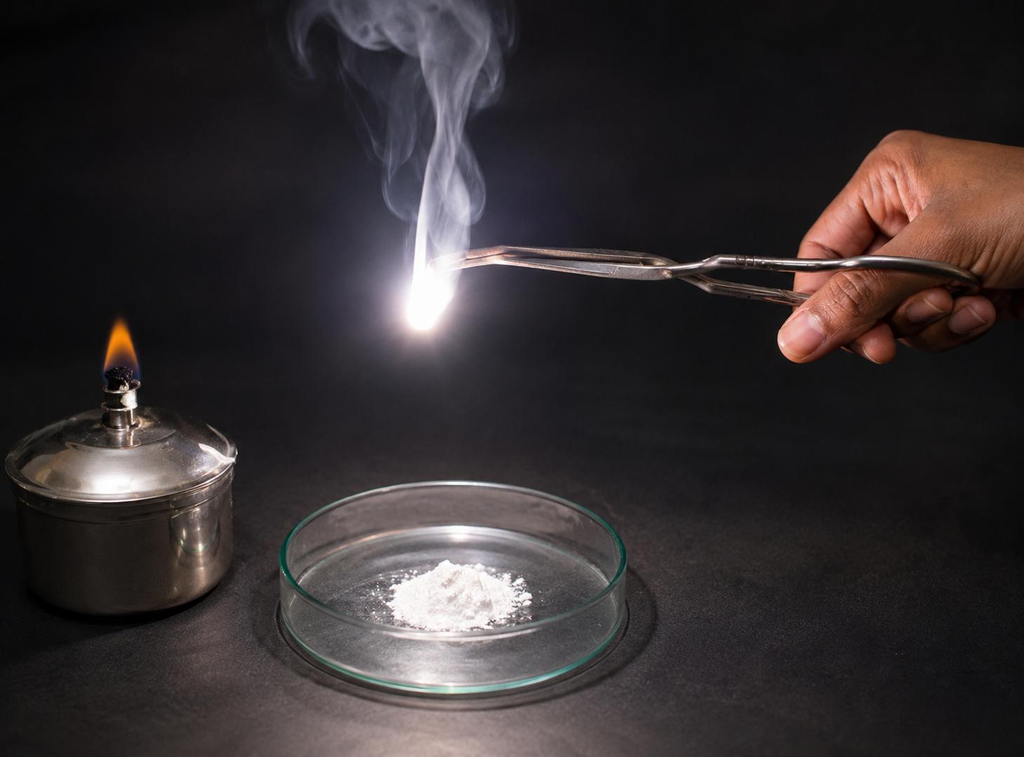
- Burning of magnesium ribbon in air.
- Formation of water from hydrogen and oxygen.
- Burning of coal.
For example, burning of magnesium in air:
2Mg + O₂ → 2MgO
Magnesium reacts with oxygen to form magnesium oxide.
2. Characteristics of Chemical Reactions
A chemical reaction can be identified through certain observable changes. These changes indicate that new substances may have been formed.
The important characteristics are:
1. Change in Colour
A change in colour of the reactants may indicate a chemical reaction.
Example: Copper turns black when heated in air due to the formation of copper oxide.
2. Evolution of Gas
The formation of gas bubbles during a reaction indicates the evolution of gas.
Example: Zinc reacts with dilute hydrochloric acid to produce hydrogen gas.
Zn + 2HCl → ZnCl₂ + H₂
3. Formation of Precipitate
A precipitate is an insoluble solid formed when two solutions react.
Example: Sodium chloride reacts with silver nitrate to form a white precipitate of silver chloride.
AgNO₃ + NaCl → AgCl↓ + NaNO₃
4. Change in Temperature
Some chemical reactions release heat, while others absorb heat. This results in a change in temperature.
Example: Calcium oxide reacts with water and releases heat.
3. Physical Changes and Chemical Changes
Physical Changes
A physical change is a change in which the physical properties of a substance change, but its chemical composition remains the same.
Examples:
- Melting of ice.
- Evaporation of water.
- Blowing up a balloon.
Chemical Changes
A chemical change is a change in which one or more substances are converted into new substances having different chemical compositions.
Examples:
- Rusting of iron.
- Rotting of fruits.
- Explosion of fireworks.
4. Writing Chemical Equations
A chemical equation is the symbolic representation of a chemical reaction using chemical symbols and formulae.
In a chemical equation:
- Reactants are written on the left-hand side (LHS).
- Products are written on the right-hand side (RHS).
- An arrow (→) separates reactants and products.
Example: Formation of Magnesium Oxide
Word Equation:
Magnesium + Oxygen → Magnesium oxide
Chemical Equation:
Mg + O₂ → MgO
Example: Formation of Water
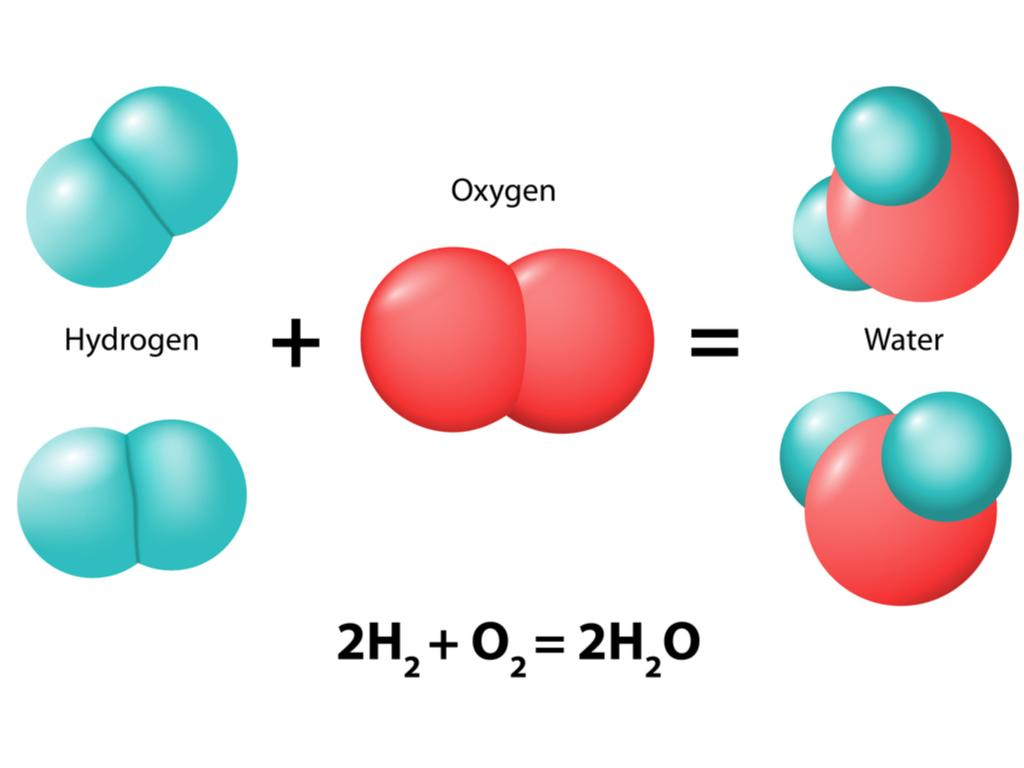
Hydrogen reacts with oxygen to form water.
2H₂ + O₂ → 2H₂O
5. Balancing Chemical Equations
Balancing chemical equations is one of the most important topics in this chapter.
A balanced chemical equation contains an equal number of atoms of each element on both sides of the equation.
Balancing is based on the Law of Conservation of Mass, which states that matter can neither be created nor destroyed during a chemical reaction.
Steps for Balancing Chemical Equations
- Write the correct chemical formulae of all reactants and products.
- Count the number of atoms of each element on both sides.
- Adjust the coefficients to make the number of atoms equal.
- Check all elements again.
- Ensure that the coefficients are in the simplest whole-number ratio.
Example: Balancing the Formation of Water
Unbalanced Equation:
H₂ + O₂ → H₂O
Balanced Equation:
2H₂ + O₂ → 2H₂O
Atom count:
| Element | LHS | RHS |
|---|---|---|
| Hydrogen | 4 | 4 |
| Oxygen | 2 | 2 |
Therefore, the equation is balanced.
Important Tip: Never change the subscripts in a chemical formula while balancing an equation. Only coefficients should be changed.
6. Making Chemical Equations More Informative
We can make chemical equations more informative by using symbols to represent the physical states of substances.
| Symbol | Meaning |
|---|---|
| (s) | Solid |
| (l) | Liquid |
| (g) | Gas |
| (aq) | Aqueous solution |
| ↑ | Evolution of gas |
| ↓ | Formation of precipitate |
For example:
BaCl₂(aq) + Na₂SO₄(aq) → BaSO₄(s)↓ + 2NaCl(aq)
Here, barium sulphate is formed as a solid precipitate.
7. Types of Chemical Reactions
Chemical reactions are classified into different types depending on how reactants are converted into products.
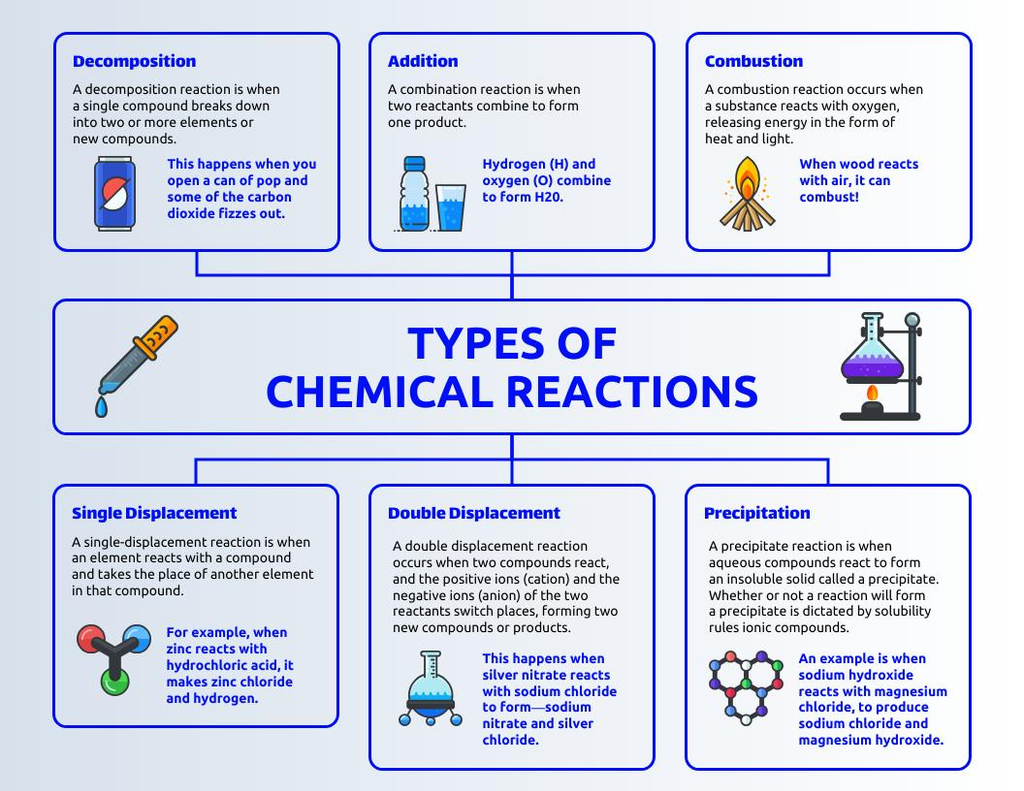
The five important types of chemical reactions are:
1. Combination Reaction
A reaction in which two or more substances combine to form a single new substance is called a combination reaction.
General Form:
A + B → AB
Example:
2H₂ + O₂ → 2H₂O
Hydrogen and oxygen combine to form water.
2. Decomposition Reaction
A reaction in which a single compound breaks down into two or more simpler substances is called a decomposition reaction.
General Form:
AB → A + B
Example:
2H₂O₂ → 2H₂O + O₂
Hydrogen peroxide decomposes into water and oxygen.
Another example:
H₂CO₃ → H₂O + CO₂
3. Displacement Reaction
A reaction in which a more reactive element displaces a less reactive element from its compound is called a displacement reaction.
Example:
Zn + CuSO₄ → ZnSO₄ + Cu
Zinc displaces copper from copper sulphate because zinc is more reactive than copper.
4. Double Displacement Reaction
A reaction in which two compounds exchange their ions or groups of atoms to form two new compounds is called a double displacement reaction.
These reactions are also known as double decomposition or metathesis reactions.
Example:
AgNO₃ + NaCl → NaNO₃ + AgCl↓
A white precipitate of silver chloride is formed.
5. Oxidation and Reduction Reactions (Redox Reactions)
A reaction in which oxidation and reduction take place simultaneously is called a redox reaction.
Oxidation: Addition of oxygen or removal of hydrogen from a substance.
Reduction: Addition of hydrogen or removal of oxygen from a substance.
Example:
ZnO + C → Zn + CO
In this reaction:
- Zinc oxide is reduced to zinc because it loses oxygen.
- Carbon is oxidised to carbon monoxide because it gains oxygen.
8. Reactivity Series of Metals
The reactivity series is an arrangement of metals in decreasing order of their reactivity.
The following metals are arranged from most reactive to least reactive:
| Metal | Symbol |
|---|---|
| Potassium | K |
| Sodium | Na |
| Calcium | Ca |
| Magnesium | Mg |
| Aluminium | Al |
| Zinc | Zn |
| Iron | Fe |
| Nickel | Ni |
| Tin | Sn |
| Lead | Pb |
| Hydrogen | H |
| Copper | Cu |
| Mercury | Hg |
| Silver | Ag |
| Gold | Au |
Important Point: A more reactive metal can displace a less reactive metal from its compound.
For example:
Zn + CuSO₄ → ZnSO₄ + Cu
9. Corrosion
Corrosion is the gradual destruction or deterioration of metals due to their reaction with substances present in the environment, such as moisture and acids.
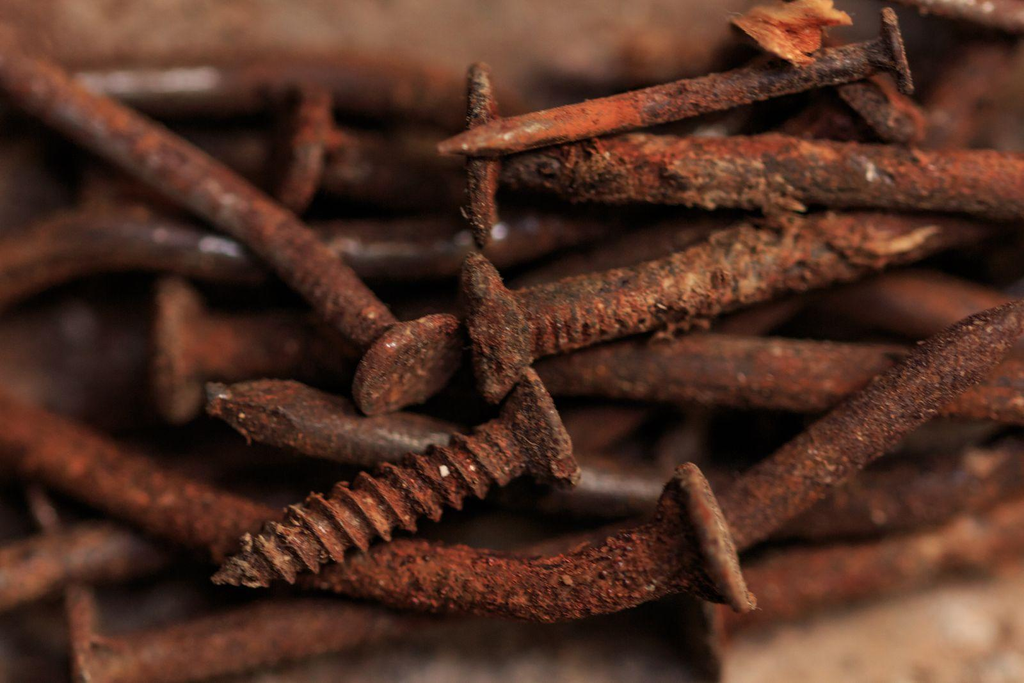
Common Examples of Corrosion
1. Rusting of Iron
Iron reacts with oxygen and moisture to form rust.
Rust is hydrated iron(III) oxide.
Formula: Fe₂O₃·2H₂O
2. Blackening of Silver
Silver articles become black after some time when exposed to air.
3. Green Coating on Copper
Copper reacts with moist carbon dioxide in the air and develops a green coating of basic copper carbonate.
10. Rancidity
Rancidity is the oxidation of fats and oils present in food, resulting in an unpleasant taste and smell.
Oxygen present in the air oxidises fats and oils in food and forms substances that produce a bad odour.
Prevention of Rancidity
Rancidity can be prevented by the following methods:
- Adding Antioxidants: Antioxidants are added to food to slow down oxidation.
- Using Airtight Containers: Food should be stored in airtight containers to reduce contact with air.
- Refrigeration: Keeping food in a refrigerator helps in preventing rancidity.
- Nitrogen Flushing: Chips packets are flushed with nitrogen gas to slow down oxidation.
11. Important Solved Questions
Q1. Why does the colour of copper sulphate solution change when an iron nail is dipped in it?
Answer: Iron displaces copper from copper sulphate solution because iron is more reactive than copper. Iron sulphate is formed, and brownish-red copper gets deposited on the nail.
Q2. Why should a magnesium ribbon be cleaned before burning in air?
Answer: Magnesium ribbon is cleaned to remove the oxide layer formed on its surface. This allows magnesium to burn more easily in air.
Q3. Identify the substances oxidised and reduced in the following reaction:
4Na(s) + O₂(g) → 2Na₂O(s)
Answer:
- Oxidised: Sodium (Na), because it gains oxygen.
- Reduced: Oxygen (O₂), because it gains electrons.
Q4. Identify the substances oxidised and reduced:
CuO(s) + H₂(g) → Cu(s) + H₂O(l)
Answer:
- Oxidised: Hydrogen (H₂), because it gains oxygen.
- Reduced: Copper oxide (CuO), because it loses oxygen.
Q5. Write the balanced chemical equation for the reaction between barium chloride and sodium sulphate.
Answer:
BaCl₂(aq) + Na₂SO₄(aq) → BaSO₄(s) + 2NaCl(aq)
Q6. Write the balanced chemical equation for the reaction between sodium hydroxide and hydrochloric acid.
Answer:
NaOH(aq) + HCl(aq) → NaCl(aq) + H₂O(l)
12. Important Points for Quick Revision
Before appearing for your examination, revise these important points:
- Reactants are the substances that take part in a chemical reaction.
- Products are the new substances formed during a chemical reaction.
- A balanced equation has an equal number of atoms of each element on both sides.
- Balancing equations follows the Law of Conservation of Mass.
- Combination reactions produce a single product.
- Decomposition reactions involve the breakdown of a compound.
- Displacement reactions involve the replacement of a less reactive element by a more reactive element.
- Double displacement reactions involve the exchange of ions.
- Oxidation involves the addition of oxygen or removal of hydrogen.
- Reduction involves the addition of hydrogen or removal of oxygen.
- Corrosion is the gradual deterioration of metals.
- Rancidity occurs due to oxidation of fats and oils.
13. Frequently Asked Questions (FAQs)
Q1. What is a chemical reaction?
A chemical reaction is a process in which one or more substances are transformed into new substances with different properties.
Q2. What is a balanced chemical equation?
A balanced chemical equation contains an equal number of atoms of every element on both the reactant and product sides.
Q3. Why is balancing a chemical equation important?
Balancing is important because it follows the Law of Conservation of Mass.
Q4. What are the five types of chemical reactions?
The five types are combination, decomposition, displacement, double displacement and oxidation-reduction reactions.
Q5. What is a decomposition reaction?
A decomposition reaction is a reaction in which one compound breaks down into two or more simpler substances.
Q6. What is corrosion?
Corrosion is the gradual deterioration of metals due to reactions with substances present in their environment.
Q7. What is rancidity?
Rancidity is the oxidation of fats and oils in food, resulting in an unpleasant taste and smell.
Q8. How can rancidity be prevented?
Rancidity can be prevented by adding antioxidants, using airtight containers, refrigeration and nitrogen flushing.
Conclusion
Chemical Reactions and Equations is an important chapter in CBSE Class 10 Science. Understanding the different types of chemical reactions, balancing equations, oxidation, reduction, corrosion and rancidity will help students develop a strong foundation in Chemistry.
Students are advised to practise balancing chemical equations regularly and revise the important definitions and examples given in this chapter.
Download the PDF notes, revise the important concepts and practise the chemical equations to prepare effectively for your CBSE Class 10 Science examination.