






Method of Communication
What Is Communication
Communication is a term derived from the Latin term “commūnicāre,” which means “to share.” It is a process whereby information can be exchanged between two or more individuals.
Definition: Communication is defined as the process by which information, knowledge, emotions, or thoughts are conveyed by speaking, writing, or physical gestures.
What are the different parts of communication
Communication has three important parts –
- Transmitting: When someone sends a message or information to others.
- Listening: The receiver listens to or understands the message.
- Feedback: The receiver gives a message to the sender in the form of feedback to complete the communication cycle.
What are the different elements of communication
The various elements of a communication cycle are:-
- Sender: The person beginning the communication.
- Message: The information that the sender wants to share, like ideas, information, questions, etc.
- Encoding : Transforming the message so that it can travel to receiver.
- Channel: Channel means how the message is sent to others, like using spoken word, gestures, emails, phone calls, etc.
- Decoding : Converting the message to an understandable form.
- Receiver: The person who receives the message.
- Feedback: The receiver’s acknowledgement and response to the message.
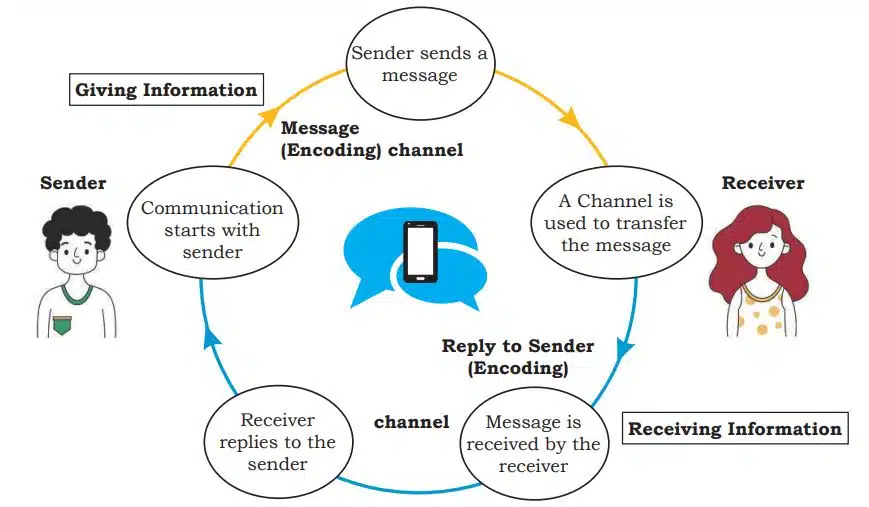
Image by CBSE Employability Skill Class X Textbook
| Method of Communication | Description |
|---|---|
| Face-to-face | Face-to-face communication is the easiest and quickest method for sharing information. It helps the message to be understood clearly and quickly. |
| E-mail can be sent to one or multiple users quickly. | |
| Notices/Posters | It is helpful when the same message has to be convey to a large group of people. |
| Business Meetings | Business meetings use different methods of communication, like sharing information using text, charts or graphs or decision-making. |
| Other Methods | Some other communication methods are used, like social networks, messages, phone calls, newsletters, blogs, etc. |
Verbal Communication
Definition of Verbal Communication
Verbal communication can be defined as the process of exchanging information through the use of words either verbally or in writing. Talking is considered to be one of the best means of communicating.
Different types of Verbal Communication
There are several types of verbal communication –
| Type of Verbal Communication | Description |
|---|---|
| Interpersonal Communication | It is a one-on-one conversation between two individuals. It can be formal (a business discussion) or informal (talking with friends). |
| Written Communication | This form of communication involves writing words. It can be letters, circulars, reports, manuals, SMS, social media chats, etc. |
| Small Group Communication | This type of communication takes place when there are more than two people involved. Example – 1. Press conferences 2. Board meetings 3. Team meetings |
| Public Communication | When one person speaks to a large group of people or audience. Example – 1. Election campaigns 2. Public speeches by dignitaries |
Advantages of Verbal Communication
- Ease: Simple and straightforward way of communication.
- Adaptability: Allows for adjustments based on the listener’s response.
- Immediacy: Enables quick exchange of information.
- Clarity: Facilitates clear understanding through spoken words.
Disadvantages of Verbal Communication
- Dependency on Words: Relies on the accuracy of spoken words, leading to potential misunderstandings.
- Lack of Permanent Record: Information is not always documented, making it challenging to reference.
- Limited Non-Verbal Cues: Absence of visual and body language cues can lead to misinterpretations.
- Potential for Confusion: Without precise wording, meanings may be unclear or confusing.
Mastering Verbal Communication:
- Clarity: Use clear and simple words; avoid using confusing words.
- Active Listening: Pay attention to what others are saying.
- Effective Tone: Speak in a friendly and respectful way.
- Conciseness: Say only what is needed.
Non-verbal Communication
What is non-Verbal Communication
Non-verbal communication is a process of conveying messages without using spoken or written words. Non-verbal communication uses facial expressions, body language and gestures for conveying the message.
In everyday communication:
- 55% communication is done using body movements, face, arms, etc.
- 38% communication is done using voice, tone, pauses, etc.
- Only 7% communication is done using words.
Example of the Non-Verbal Communication
| Non-Verbal Communication | Examples |
|---|---|
| Gestures | 1. Raising a hand to greet or say goodbye. 2. Pointing a finger at someone. |
| Expressions | 1. Smiling when happy. 2. Making a sad face when sad. |
| Body Language | 1. Postures by which attitudes and feelings are communicated. Standing straight, showing interest. |
What are the Different types of non-verbal communication
| Type | How to use effectively? |
|---|---|
| Facial Expressions | a. Smile when you meet someone. b. Keep your face relaxed. c. Match your expressions with your words. d. Nod while listening. |
| Posture | a. Keep your shoulders straight and body relaxed. b. Sit straight while resting your hands and feet in relaxed position. c. While standing, keep your hands by your sides. |
| Gestures or Body Language | a. Keep your hands open. b. Avoid pointing your finger at people. c. Tilt your head a bit to show that you are attentive |
| Touch | a. Shake hands firmly while meeting someone. b. Avoid other touch gestures during formal communication. |
| Space | a. Maintain proper space depending on the relationship, which could be formal. |
| Eye Contact | a. Look directly at the person who is speaking. b. Avoid staring; keep a relaxed look. c. Maintain eye contact with intermittent breaks. |
| Paralanguage | a. Use a suitable tone and volume b. Maintain a moderate speed while talking |
What is Visual Communication
Visual communication conveys the messages through images, pictures, videos and symbols. It is an effective way of communication.
Communication Cycle and Importance of Feedback
When a sender shares information, the receiver responds with feedback, which can be positive or negative. Feedback is an important part of the communication cycle.
Effective feedback is always-
- Specific
- Helpful
- Kind
Different types of Feedback in Communication Cycle
Type of Feedback Examples
| Types of Feedback | Examples |
|---|---|
| Positive Feedback | a. I noticed you finished the work perfectly. Great job! b. I really appreciate you taking that call. Can you please also share the details? |
| Negative Feedback | a. You keep forgetting to smile at the hotel guests when you talk to them. b. You take really long to reply to e-mails! Are you always so busy? |
| No Feedback | a. It is also feedback in itself which indicates disagreement of ideas. |
What do you mean by good feedback
Good feedback is one that –
- Specific
- Timely
- Polite
- Offering continuing support
What is the importance of Feedback
- It validates effective listening
- Motivation
- Learning Boost
- Performance Improvement
Barriers to Effective Communication
What is 7Cs of Effective Communication
Essential Principles for Effective Communication:
- Clear: Make your message easy to understand.
- Concise: Use a simple and short message; avoid unnecessary details.
- Concrete: Use specific words and real facts.
- Correct: Check your spelling and grammar to avoid confusion.
- Coherent: Ensure your words logically connect and relate to the main topic.
- Complete: Include all necessary information for a complete message.
- Courteous: Be polite, respectful, and truthful in your communication.
What are the different barriers to Effective Communication
- Physical Barriers: When distance, noise or surroundings create challenges, it is known as a physical barrier. For example, a weak phone signal can create physical barriers.
- Linguistic Barriers: A language barrier occurs when people use different languages. It is the most common communication barrier.
- Interpersonal Barriers: Sometimes, people misunderstand each other’s messages because of tone, emotions or personal biases.
- Organisational Barriers: When the organisational hierarchy, rules and regulations, procedures, policies and norms are not followed by the employee.
- Cultural Barriers: Cultural barriers are when people of different cultures are unable to understand each other’s customs, resulting in inconveniences and difficulties.
What are the ways to overcome Barriers of Effective Communication
- Use simple language
- Do not form assumptions on culture, religion or geography
- Try to communicate in person as much as possible
- Use visuals
- Take help of a translator to overcome differences in language
Be respectful of other’s opinions
Writing Skills — Parts of Speech
Writing skills are part of verbal communication and include e-mails, letters, notes, articles, SMS/chat, blogs, etc. all these forms of written communication, we use sentences to express ourselves.
What is Sentence
Sentence is a group of words that communicates a complete thought. A sentence always begins with a capital letter, and it always ends with a question mark, full stop or exclamation mark. For example, Pooja goes to school.
What is Phrase
The group of words, which does not make complete sense, is known as a phrase. For example, Pooja goes.
What are the different capitalization rules in communication cycle
We know that all sentences begin with capital letters. However, there are certain other points in a Sentence where we should use capital letters. ‘TINS’ is a set of simple rules that help you capitalise words correctly.