










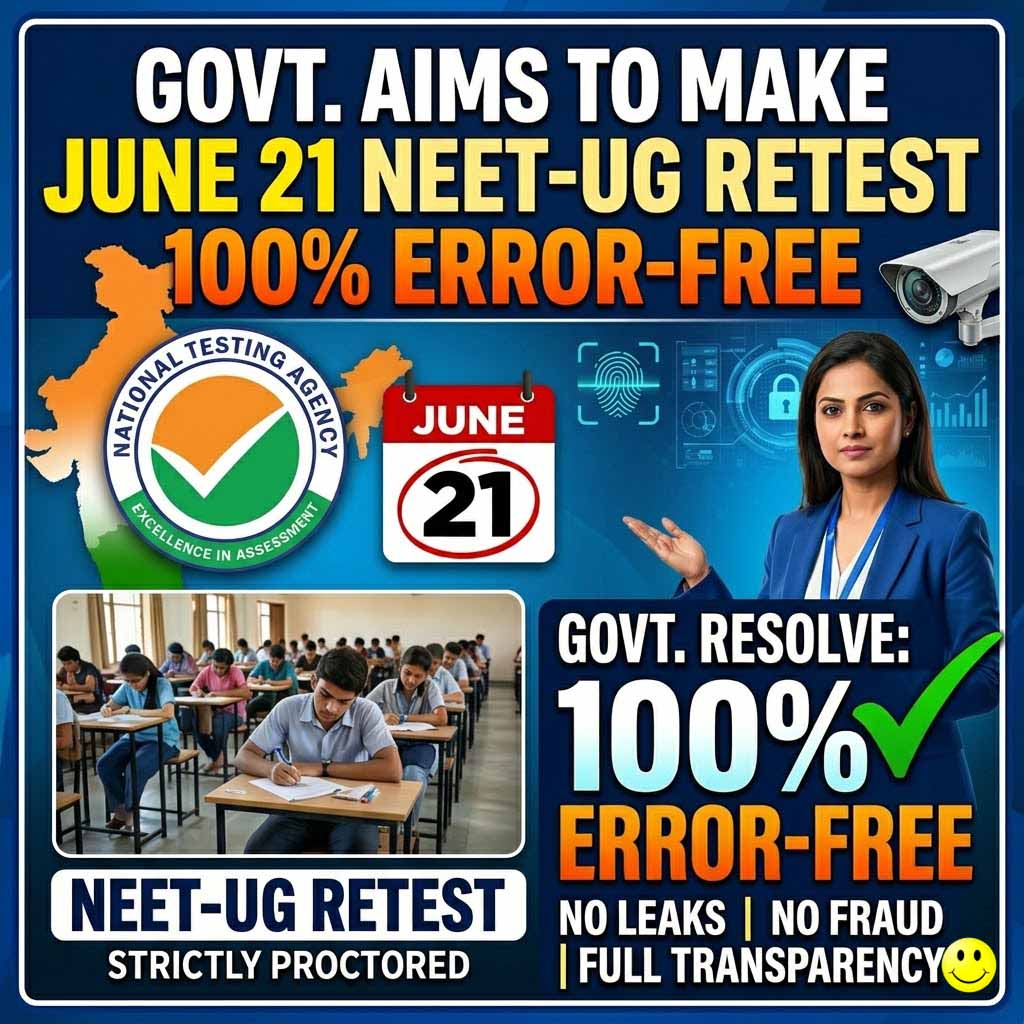
National Eligibility Cum Entrance Test (NEET) for undergraduate programs is one of the key examinations in India. This exam attracts hundreds of thousands of candidates who hope to be selected in leading medical colleges across the nation. Due to its high profile nature, even minor errors can play a significant role in the future of many students. In this respect, the government’s decision to make the upcoming June 21 NEET-UG retest “error-free” deserves particular attention.
As was mentioned earlier, the previous examinations were plagued by numerous problems associated with irregularities, paper leaks, and other issues that made millions of candidates and their parents worry about the validity of the results. Therefore, the government together with National Testing Agency is now faced with the challenge of proving that all further examinations will be conducted properly. June 21 examination will thus be viewed by many people as the test of examination administration in India.
The Need for Retesting
The need for conducting a retest for the National Eligibility Test – Undergraduate was necessitated by various complaints that students from different examination centers lodged. Many of the students complained of disturbance to their performance in the test, which occurred because of late distribution of question papers, loss of time in the test, and invigilator problems.
It seems like some students had problems with late supply of their papers, while others complained about improper seating or power outages. These disturbances created fear among the students, who have prepared themselves for a very difficult entrance test over several years.
Since this examination decides whether students join any of the prestigious medical colleges or not, there should be no compromises whatsoever when it comes to fair testing of the applicants. Any disturbance in the test might affect the ranks of the students, hence compromising their future careers.
After careful investigations into the complaints, the concerned authorities decided to grant the affected students another chance to write a test on June 21.
Commitment of Government towards Transparency
Understanding the gravity of the situation, the government has made it clear that the process of re-examination will be carried out with utmost scrutiny and caution. It is evident from their statement that maximum possible efforts will be made to carry out a fair and flawless examination process.
There are some steps planned to increase transparency in the process. These include stricter security arrangements regarding the handling of question papers, greater coordination with exam centers, deployment of more observers, and increased digital surveillance. The concerned authorities may also conduct simulation tests prior to the examination day for the invigilators.
From the standpoint of the government, it is clear that they are trying to assure all concerned parties that the previous experience has been considered. There is a need for restoring faith in the process of national-level competitive examinations.
Enhancing Security Measures
Among the issues that have cropped up in connection with competitive examinations in recent times include the risk of leaks and access to confidential documents. In this respect, it is very likely that multi-faceted security measures would be put in place for the retest scheduled on June 21.
Question papers are most likely going to be transported via highly sophisticated methods that will involve the use of GPS technology and sealed containers. The process of entering and leaving the examination centres might also become more stringent.
It is equally important to note that the services of local administration and law enforcing agencies would also become relevant here. The coordination between the authorities, police, and examination officials might help in preventing any sort of misconduct at examination centers.
In addition to all this, digital monitoring might also prove to be essential in order to keep track of things at regular intervals.
Better Examination Centre Administration
There have been instances in which poor administration at the examination centers has caused undue confusion among the candidates. To prevent any recurrence in future, it is expected from the relevant quarters that a lot of emphasis will be put on the proper administration of the centers.
A thorough check on the infrastructural setup in an examination center might become necessary prior to granting permission for holding the test there. Issues such as electricity supply, transportation facilities, availability of drinking water, etc., could be considered.
Training could be provided to invigilators and superintendents of the center to cope with any emergency that might arise during the conduct of the examination.
Accountability will yet be another major consideration that the government will keep in mind. Persons who might be held responsible for negligence could be sternly dealt with.
Emotional and Psychological Effect on Students
Though there is an urgent need for administrative reforms, it should not be overlooked that there is considerable emotional and psychological pressure that students are undergoing. NEET-UG preparations require years of rigorous practice, dedication, and sacrifices. In cases of any anomalies, students face frustration, worry, and nervousness.
For some candidates, the news of retesting has been a welcome one. However, for others, it might increase their anxiety and nervousness. Re-preparing for an extremely competitive exam is emotionally taxing.
According to experts, one way through which authorities can reduce the anxiety of students is by communicating effectively. Regular communication, provision of information regarding the procedure, and redressal of grievances can boost up the confidence of candidates.
Another party which plays an important part is parents. They must support and motivate their children throughout this process.
National Testing Agency’s Role
The National Testing Agency has remained at the core of all deliberations about the future of examinations. Being the organization that conducts various entrance exams in the country, the NTA has the dual task of increasing efficiency while ensuring integrity.
The June 21 re-test offers the NTA an ideal platform to prove itself capable of managing exams. The success in organizing this test will enable the NTA to regain its credibility.
The National Testing Agency will have to improve its management practices by improving its planning process, adopting advanced technology, and enhancing cooperation with state governments. There have been recommendations on the adoption of AI-based monitoring, digital encryption, and rigorous auditing processes.
In addition, there will be a need for transparency in dealing with complaints and issuing information related to the examination. Promptness in resolving issues and clearing any doubts will minimize rumors.
Significance of Conducting a Fair Competitive Examination
The case of NEET-UG has reiterated the significance of conducting a fair competitive examination. In a country like India, where millions of candidates sit for examinations, the results are of crucial significance as far as the future of these individuals is concerned.
Any form of misconduct not only impacts the concerned candidates adversely but also creates distrust in the institution. A fair examination process helps in creating equal opportunities irrespective of any candidate’s background or economic status.
The efforts being made by the authorities to conduct an error-free examination are indicative of their determination towards safeguarding merit among students. It has also opened up debates on some significant reforms that need to be introduced regarding the conduct of examinations.
Public Expectations from the Retest
The June 21 NEET-UG retest comes with great expectations. The public will watch with interest how the examination process unfolds.
A mistake-free retest will signal a positive sign that the authorities have the capability to fix mistakes and take appropriate measures. At the same time, it will give the impression that the efforts put in by the students will be rewarded fairly.
Otherwise, any kind of irregularities might worsen the situation by generating even more criticisms and concerns regarding the conduct of the examinations in the country. That is the reason behind the immense pressure on the part of the authorities to make sure that everything proceeds smoothly.
It is only through improved performance and proper conduct of business that the public will gain confidence in the examination system.
Looking Forward
This re-test of NEET-UG is not just another procedural activity. The government’s resolve to ensure that the exam held on June 21 becomes “100% error-free” shows that it recognizes the gravity of the situation and the importance of maintaining the sanctity of examinations at the national level.
Maintaining the sanctity of examinations is not just necessary to prevent cheating. It involves ensuring that the dreams of those students who put in years of hard work to pursue a career in medicine are not jeopardized.
This upcoming re-test, hence, is going to play an important role in defining examination reforms in India. If done well, this would be a case study for restoring integrity in the system.