Human Eye and the Colourful World
Human Eye
The human eye is an important and valuable sense organ which uses light and enables us to see the colourful world around us.
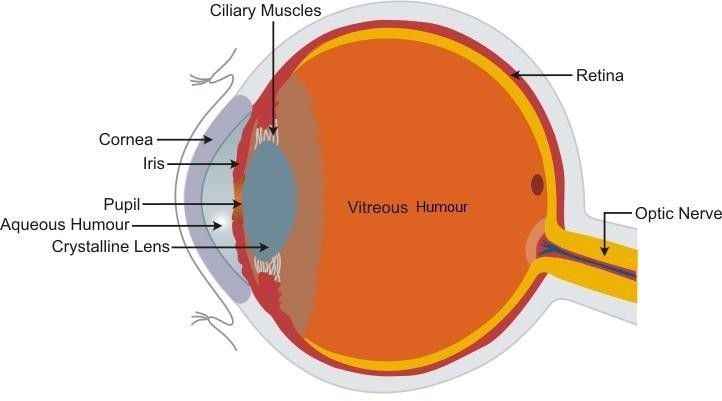
- The various parts of the human eye and their respective functions include
| Part | Function |
| Cornea | Protective layer of the eye Refraction of light rays entering the eye |
| Eye lens | Adjust the focal length and form an inverted image of the object on the retina |
| Pupil | Regulates the amount of light entering the eye |
| Iris | Controls the size of the pupil |
| Retina | Acts as a screen for forming the image |
| Ciliary muscles | Adjust the thickness of the lens |
| Optic nerves | Send signals to the brain |
- The image of any object seen persists on the retina for 1/16th of a second, even after the removal of the object. This continuance of sensation on the eye for some time is called persistence of vision.
- The numerous light-sensitive cells contained in the retina of the eye are of two types:
- Rod-shaped cells which respond to the brightness or intensity of light.
- Cone-shaped cells which respond to the colour of light.
.Power of Accommodation of the Human Eye
- Power of accommodation of the eye is the ability of the eye to observe distinctly the objects, situated at widely different distances from the eye, on account of change in the focal length of the eye lens by the action of the ciliary muscles holding the lens.
- The farthest point up to which the eye can see objects clearly is called the far point (F) of the eye. It is ideally infinity for a normal eye.
- The point of closest distance at which an object can be seen clearly by the eye is called the near point (N) of the eye. For a normal eye, the near point is 25 cm, which is called the least distance of distinct vision (d) of a normal eye.
- The distance between the far point (F) and near point (N) is called the range of vision of the eye.
Defects of Vision
(a) Myopia or Short-Sightedness
A person with myopia can see nearby objects clearly but cannot see distant objects distinctly, as if the far point of the eye has shifted from infinity to some particular distance from the eye.
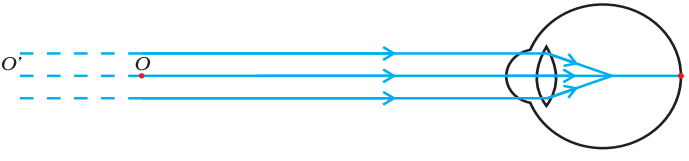
Myopic Eye
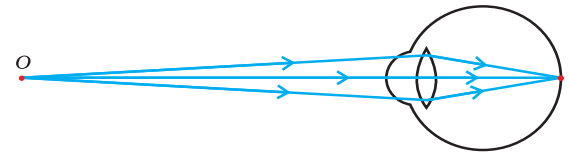
Far Point of a Myopic Eye
This defect may arise due to (i) excessive curvature of the eye lens or (ii) elongation of the eyeball.
To correct myopia, the person has to wear spectacles with a concave lens of focal length equal to the distance of far point of the myopic eye.

Correction for Myopia
(a) Hypermetropia or Long-Sightedness
A person with hypermetropia can see objects lying at large distances clearly but cannot see nearby objects clearly, as if the near point of the eye has shifted away from the eye.
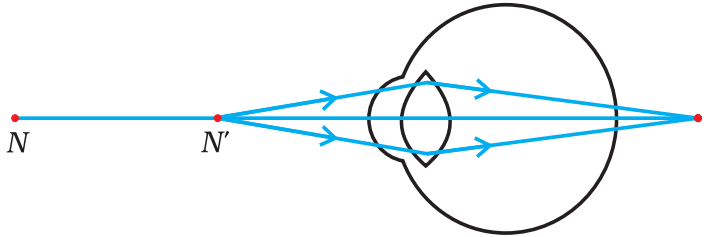
Hypermetropic Eye

Near Point of a Hypermetropic Eye
This defect may arise because (i) focal length of the eye lens is too long or (ii) the eyeball has become too small. To correct hypermetropia, the person has to wear spectacles with a convex lens of focal length f, given by
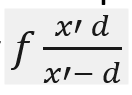
, where d is the least distance of distinct vision and x′ is the distance of near point N of the hypermetropic eye.
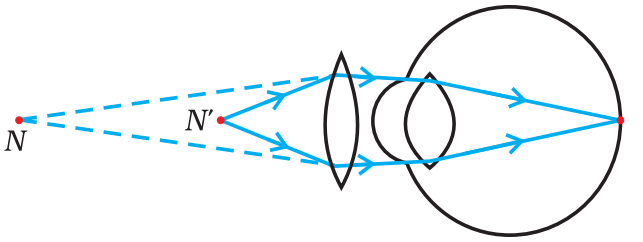
Correction for Hypermetropia eye
(a) Presbyopia
- Presbyopia is a human eye defect because of which an old person cannot read and write comfortably.
- It occurs in old age when the ciliary muscles holding the eye lens weaken and the eye lens loses some of its flexibility.
- To correct presbyopia, an old person has to wear spectacles with a convex lens of suitable focal length (as in hypermetropia).
Sometimes, a person may suffer from both myopia and hypermetropia. Such a person requires bi-focal lenses. The upper part of a bi-focal lens consists of concave lens facilitating distant vision, and the lower part consists of convex lens facilitating nearby vision.
Refraction through a glass prism
● If you take a glass prism, you can see that it has 2 triangular bases and three rectangular lateral surfaces, inclined at an angle. This angle is called the angle of the prism.
● Let’s look at a top view of a triangular prism with a ray of light entering it.

| PE – Incident ray EF – Refracted ray FS – Emergent ray ∠A – Angle of the prism ∠i – Angle of incidence ∠r – Angle of refraction ∠e – Angle of emergence ∠D – Angle of deviation |
In the figure above, A is the angle of the prism.
● As per Snell’s law, light travelling from a rarer medium to a denser medium bends towards the normal, and vice versa. Glass is denser than air, and thus, when a ray of light falls on the surface of the prism, it bends towards the normal. According to the diagram, ray PE falls on the surface of the prism and bends towards the normal NE.
● Then, while moving from the glass to air, the emergent ray FS bends away from the normal.
● ∠HDS is the angle of deviation which tells us how much the emergent ray has deviated from the incident ray. When the angle of incidence is equal to the angle of emergence, the angle of deviation is minimum.
● According to the figure, ∠PEN = ∠MES and ∠HDS is thus the angle of minimum deviation. The refracted ray EF is parallel to side BC in this case.
Dispersion of Light
- Dispersion of light is the phenomenon of splitting of a beam of white light into its seven constituent colours on passing through a glass prism.
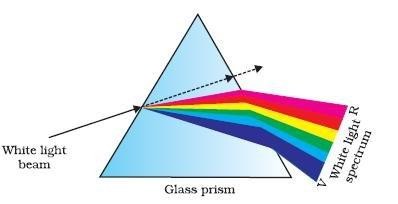
- The band of coloured components of a light beam is called its spectrum.
- The sequence of colours given by the prism is Violet, Indigo, Blue, Green, Yellow, Orange and Red. VIBGYOR is the acronym for this sequence.
- The cause of dispersion is that different colours of white light with different wavelengths undergo different deviations on passing through a glass prism.
- If a second identical prism is placed in an inverted position with respect to the first prism, all the seven colours recombine to form white light.
- The rainbow is a beautiful example of dispersion of light in nature. Sunlight gets dispersed on passing through tiny droplets of water suspended in air during or after a shower.
Isaac Newton was the first to use a glass prism to obtain the spectrum of sunlight. Hetried to split the colours of the spectrum of white light further by using another similar prism. However, he could not get any more colours. He then placed a second identical prism in an inverted position with respect to the first prism, allowed all the colours of the spectrum to pass through the second prism. He found a beam of white light emerging from the other side of the second prism. This observation gave Newton the idea that the sunlight is made up of seven colours.
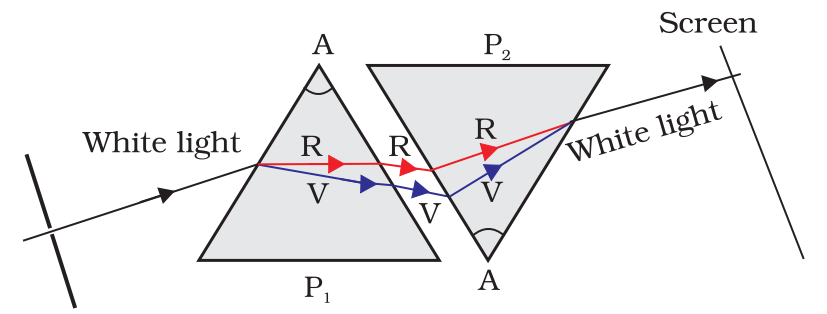
Recombination of the spectrum of white light
Atmospheric Refraction
- Atmospheric refraction is the phenomenon of bending of light on passing through the Earth’s atmosphere. This reason for this occurrence is that the upper layers of the Earth’s atmosphere are rarer compared to the lower layers.
- On account of atmospheric refraction of light,
- The stars seem higher than they actually are.
- The Sun appears to rise 2 minutes before and set 2 minutes later, increasing the apparent length of the day by 4 minutes.
- The Sun appears oval at sunrise and sunset, but appears circular at noon.
- The stars twinkle and planets do not.
Scattering of Light
The scattering of light is one of the most important phenomena in daily lives. This phenomenon has been seen by everyone from their childhood like the blue colour of the sky, the colour of the rainbow, etc. The scattering of light is completely different from the reflection and refraction of light. In reflection of light, the light goes in a straight line whereas in the scattering of light the light ray gets scattered in different directions by the medium through which it passes.
The process by which small particles are present in the atmosphere causes the scatter in the light which in turn gives rise to optical phenomena such as the blue colour of the sky in which we term as the scattering of light.
Example: When light strikes the particles in the air, the particles absorb some light and radiate the rest in all directions except the incident direction. This is called “scattering of light”. The wavelength of the light and the size of the particle which scattered the light assists in determining the strength of the scattering.
Let p be considered as the probability of scattering and λ is the wavelength of radiation, then it is given as:

The probability for scattering will give a high rise for shorter wavelength and it is inversely proportional to the fourth power of the wavelength of radiation.
Tyndall Effect
The Tyndall effect is the phenomenon in which the particles in a colloid scatter the beams of light that are directed at them. This effect is exhibited by all colloidal solutions and some very fine suspensions. Therefore, it can be used to verify if a given solution is a colloid. The intensity of scattered light depends on the density of the colloidal particles as well as the frequency of the incident light.
When a beam of light passes through a colloid, the colloidal particles present in the solution do not allow the beam to completely pass through. The light collides with the colloidal particles and is scattered (it deviates from its normal trajectory, which is a straight line). This scattering makes the path of the light beam visible, as illustrated below.
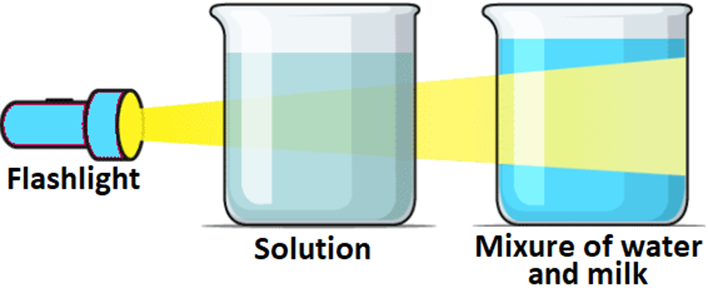
Generally, blue light is scattered to a greater extent when compared to red light. This is because the wavelength of blue light is smaller than that of red light. This is the reason why the smoke released by motorcycles sometimes appears blue.
The Tyndall effect was first discovered by (and is named after) the Irish physicist John Tyndall. The diameters of the particles that cause the Tyndall effect can range from 40 to 900 nanometers (1 nanometer = 10-9 meter). In comparison, the wavelength of the visible light spectrum ranges from 400 to 750 nanometers.
Examples of Tyndall Effect
We get to see Tyndall effect in our surroundings very often, some of the examples are
- When a beam of sunlight enters the dark room through small hole or window then its path become visible due to scattering of light by the dust particles present in the room.
- When a beam of light is projected on a screen from a projector in the cinema hall, it becomes visible.
- When sunlight passes through the canopy of a dense forest it get scattered by tiny water droplets.
The colour of the clear Sky Blue
The molecules of air and other fine particles in the atmosphere have smaller size than the wavelength of visible light. These are more effective in scattering light of shorter wavelengths at the blue end than the light of longer wavelength at the red end. Thus, the blue colour is due to the scattering of sunlight through fine particles in air.
Why does the sky appear dark instead of blue to an astronaut?
The sky appears dark instead of blue to an astronaut because there is no atmosphere in the outer space that can scatter the sunlight. As the sunlight is not scattered, no scattered light reach the eyes of the astronauts and the sky appears black to them.
Colour of Sunrise and Sunset
While sunset and sunrise, the colour of the sun and its surrounding appear red. During sunset and sunrise, the sun is near to horizon, and therefore, the sunlight has to travel larger distance in atmosphere. Due to this, most of the blue light (shorter wavelength) is scattered away by the particles. The light of longer wavelength (red colour) reaches our eye. This is why sun appears red in colour.
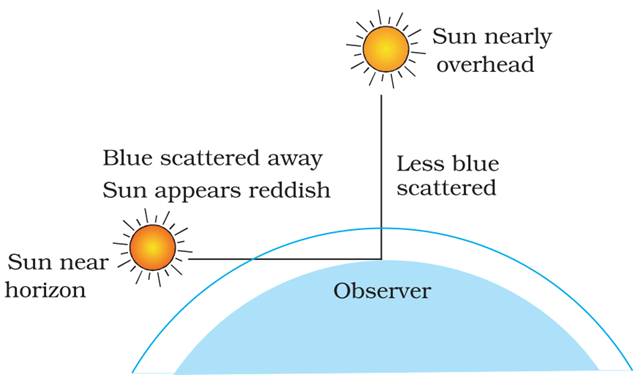
Reddening of the Sun at sunrise and sunset
Important Questions
- Multiple Choice Questions:
1. A person cannot see distinctly objects kept beyond 2 m. This defect can be corrected by using lens of power
(a) +0.5 D
(b) -0.5 D
(c) +0.2 D
(d) -0.2 D
2. A student sitting on the last bench can read the letters written on the blackboard but is not able to read / the letters written in his textbook. Which of the following statements is correct?
(a) The near point of his eyes has receded away.
(b) The near point of his eyes has come closer to him.
(c) The far point of his eyes has come closer to him.
(d) The far point of his eyes has receded away.
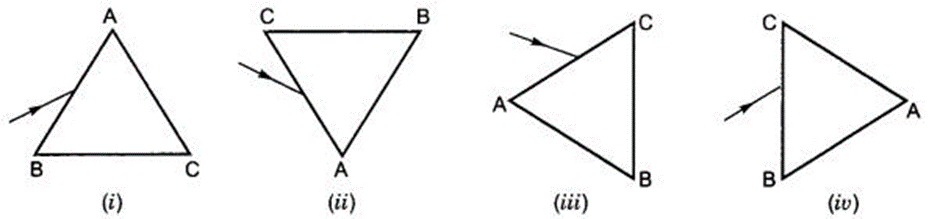
3. A prism ABC (with BC as base) is placed in different orientations. A narrow beam of white light is incident on the prism as shown in the Figures given below. In which of the following cases, after dispersion, the third colour from the top corresponds to the colour of the sky?
(a) (i)
(b) (ii)
(c) (iii)
(d) (iv)
4. At noon the sun appears white as
(a) light is least scattered.
(b) all the colours of the white light are scattered away.
(c) blue colour is scattered the most.
(d) red colour is scattered the most.
5. Which of the following phenomena of light are involved in the formation of a rainbow?
(a) Reflection, refraction and dispersion
(b) Refraction, dispersion and total internal reflection
(c) Refraction, dispersion and internal reflection
(d) Dispersion, scattering and total internal reflection
6. Twinkling of stars is due to atmospheric
(a) dispersion of light by water droplets
(b) refraction of light by different layers of varying refractive indices
(c) scattering of light by dust particles
(d) internal reflection of light by clouds
7. The clear sky appears blue because
(а) blue light gets absorbed in the atmosphere.
(b) ultraviolet radiations are absorbed in the atmosphere.
(c) violet and blue lights get scattered more than lights of all other colours by the atmosphere.
(d) light of all other colours is scattered more than the violet and blue colour lights by the atmosphere.
8. Which of the following statements is correct regarding the propagation of light of different colours of white light in air?
(a) Red light moves fastest.
(b) Blue light moves faster than green light.
(c) All the colours of the white light move with the same speed.
(d) Yellow light moves with the mean speed as that of the red and the violet light.
9. The danger signals installed at the top of tall buildings are red in colour. These can be easily seen from a distance because among all other colours, the red light
(a) is scattered the most by smoke or fog.
(b) is scattered the least by smoke or fog.
(c) is absorbed the most by smoke or fog.
(d) moves fastest in air.
10. Which of the following phenomena contributes significantly to the reddish appearance of the sun at sunrise or sunset?
(a) Dispersion of light
(b) Scattering of light
(c) Total internal reflection of light
(d) Reflection of light from the earth
- Very Short Question:
1. Name the following part of human eye: A thin membrane through which light enters the eye.
2. Write the function of iris in the human eye.
Or
Mention the name of a structure formed in human eye that controls the size of the pupil.
3. What is the function of pupil in human eye?
4. Name the following part of human eye: A dark muscular diaphragm that controls the size of the pupil.
5. Name the type of lens in human eye.
6. Name the part of human eye that helps in changing the focal length of the eye lens.
Or
Name the part responsible for the power of accommodation of the human eye.
7. Name the ability of eye lens to adjust its focal length.
8. What is the nature of the image formed at the retina of human eye?
9. Name the part of human eye which acts as a screen to obtain the image of an object.
10. Mention the value of near point for normal eye.
- Short Questions:
1. When we enter a dim-lit room from a bright light, we are not able to see the object in the room for some time.
Explain, why?
Or
Why does it take some time to see objects in a cinema hall when we just enter the hall from bright sun light? Explain.
2. The ciliary muscles of a normal eye are in their (i) most relaxed (ii) most contracted state. In which of the two cases is the focal length of the eye-lens more?
3. Why do we have two eyes instead of one eye?
4. A convex lens made of glass forms a sharp image on the screen for a particular position of an object with respect to the lens. A human eye lens is also a convex lens but it can form sharp images on the retina of eye for different positions of the objects. Explain, why?
5. How is a normal eye able to see distinctly distant as well as nearer objects? What is the distance of distinct vision?
6. What is short-sightedness? How can this defect be corrected?
7. What is long-sightedness? How can this defect be corrected?
8. What is presbyopia? State the cause of Presbyopia. How is presbyopia of a person be corrected?
- Long Questions:
1. Write different parts of eye and explain their functions. Also explain, how an image of an object is formed on the retina of eye.
2. What is short-sightedness? List two causes for development of short-sightedness. Describe with a ray diagram, how this defect may be corrected using spectacles.
Or
What is myopia? State the two causes of myopia with a labelled ray diagram show
(i) the eye defect myopia,
(ii) correction of myopia using lens.
3. What is long-sightedness? List two causes for development of long-sightedness. Describe with a ray diagram, how this defect may be corrected using spectacles.
Or
What is hypermetropia? State the two causes of hypermetropia. With the help of a ray diagram, show (i) the eye defect hypermetropia, (ii) correction of hypermetropia by using a lens.