




1. Strategic Introduction to the 2027 Board Examination
The final window before the CBSE Class 12 Computer Science exam is not merely for reading; it is for high-stakes, tactical alignment. Transforming 365 days of curriculum into exam-ready precision requires the “Science Adda247” methodology. With 15 years of board-level experience, I have distilled this revision to ensure you move beyond “just passing” to absolute mastery.
This 60-minute intensive guide is designed to sharpen your logical reflexes. Every second counts, whether you are attending our live sessions or reviewing this at 4:00 AM. We begin by deconstructing Python—the backbone of your paper—where marks are won or lost on the nuances of syntax and scope.
2. Python Programming: Functions, Scope, and Keywords
In the CBSE evaluation pattern, Python fundamentals carry immense strategic weight. Mastery of keywords and variable scope is non-negotiable. If you cannot differentiate between a local variable and a global override, you are leaving marks on the table.
Key Functional Concepts and Scope Analysis
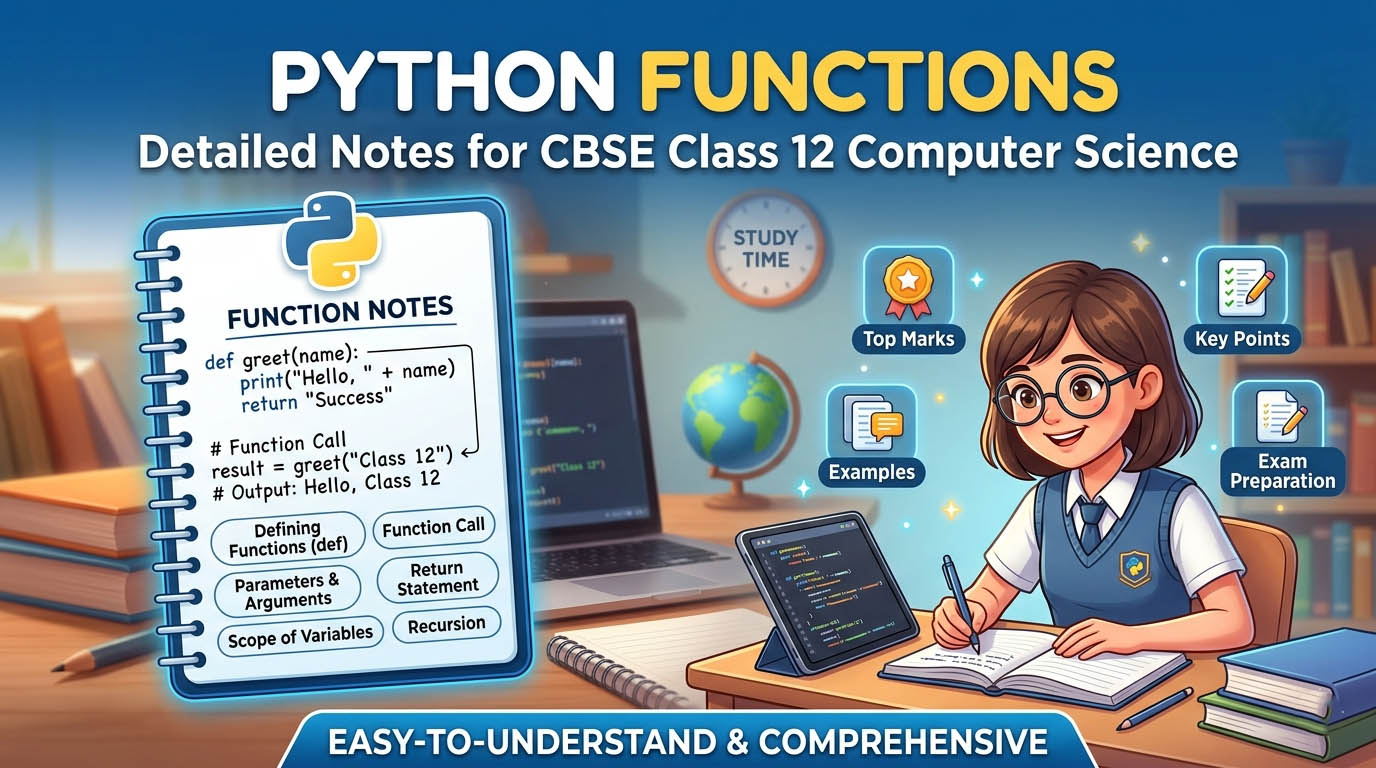
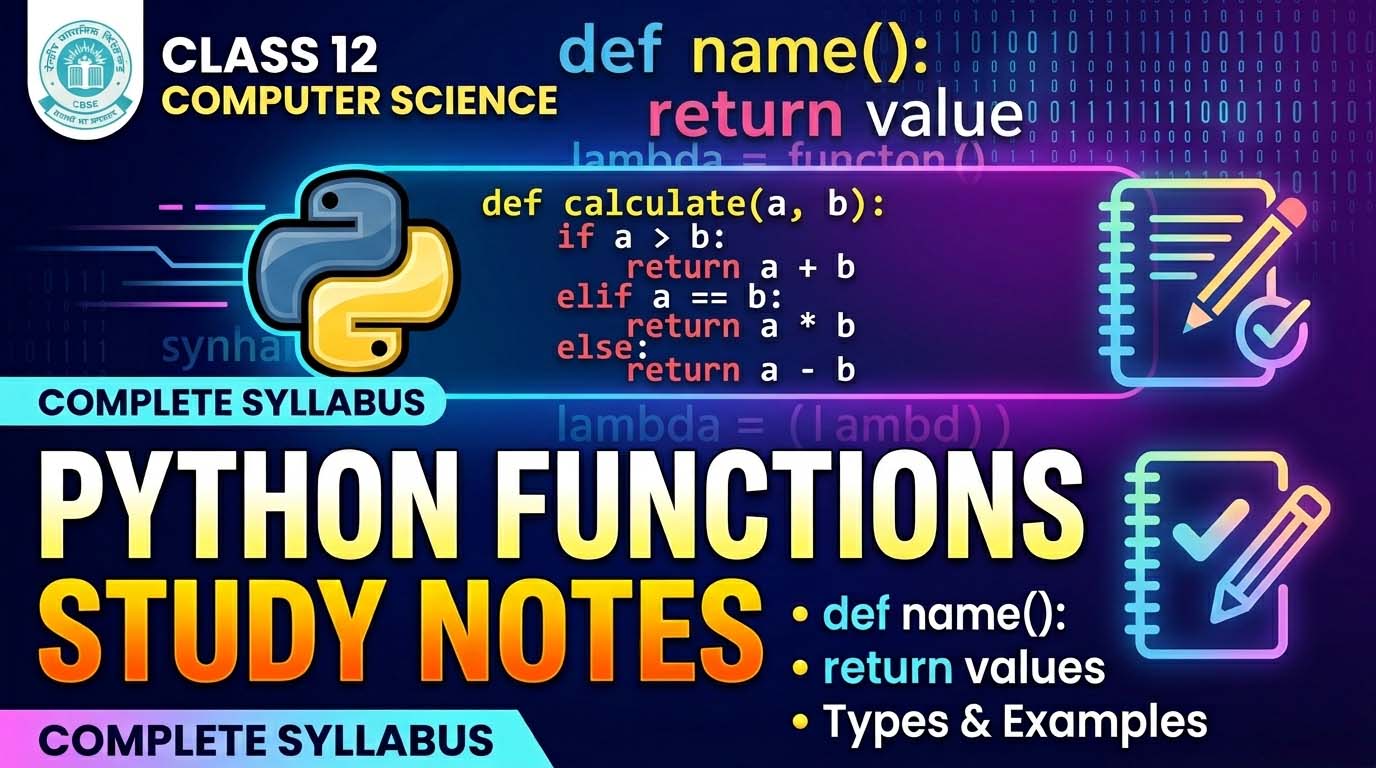
- Function Definition (
def): Use thedefkeyword to initiate. A “Board-Favorite” question involves identifying the structure:def function_name(parameters):. Remember the colon (:)—omitting it is a classic “Syntax Error” trap. - Function Categories:
- User-Defined: Built by you for specific logic.
- Predefined: Built-in functions like
print()orinput(). - Module-based: Functions imported from libraries (e.g.,
math.sqrt()).
- Anonymous Functions (
lambda): These are unnamed, single-line functions. - Variable Scope:
- Local Scope: Exists only within the function.
- Global Scope: Accessible throughout the program.
- The
globalKeyword: Use this to modify a global variable from within a function. This is a high-probability “Sure-Shot” concept.
Parameters vs. Arguments: The Mark-Saver Table
| Feature | Parameters | Arguments |
| Location | Defined in the function header (def line). | Provided in the function call statement. |
| Purpose | Act as placeholders (variables). | Represent the actual values/data being passed. |
| Strategist Note | Also known as “Formal Parameters.” | Also known as “Actual Parameters.” |
3. Analytical Code Snippets and Output Logic
Output-based questions are the ultimate test of your logical rigour. You must act as the Python Interpreter, tracing every jump and skip in execution.
Exam-Style Logic Deconstruction
- Conditional Execution (The Typo Trap):
- Scenario:
if 1 + 3 == 7: - Solution Logic: Python evaluates
4 == 7, which isFalse. The program immediately jumps to theelseblock. - Strategist Note: In many guess papers, you might see
1 + 3 = 7. Technically, a single=is an assignment and would cause a Syntax Error. However, in a Board context, if you see this in anifstatement, treat it as a comparison (==) unless “Error” is a clear option.
- Scenario:
- Looping and Range Boundaries:
- Scenario:
for i in range(1, 5): - Solution Logic: The loop runs for
1, 2, 3, 4. It never includes the stop value (5). - Common Trap: Students often include the last digit. If a
breakstatement is triggered ati == 3, the output stops at3, and4is never processed.
- Scenario:
- Complex String Slicing:
- Scenario:
s = "Python Programming"evaluated ass[::-1][::2]. - Solution Logic: First,
[::-1]reverses the string. Second,[::2]takes every second character from that reversed result. - Exact Output:
G I M R O P N T Y(Note: Spaces depend on the original string length; count carefully!)
- Scenario:
- Set Operations and Uniqueness:
- Scenario: Converting
[1, 2, 3, 4, 5](with duplicates) into aset. - Solution Logic: Sets are unordered collections of unique elements. Any duplicates in the input list are discarded during conversion.
- Exact Output:
{1, 2, 3, 4, 5}.
- Scenario: Converting
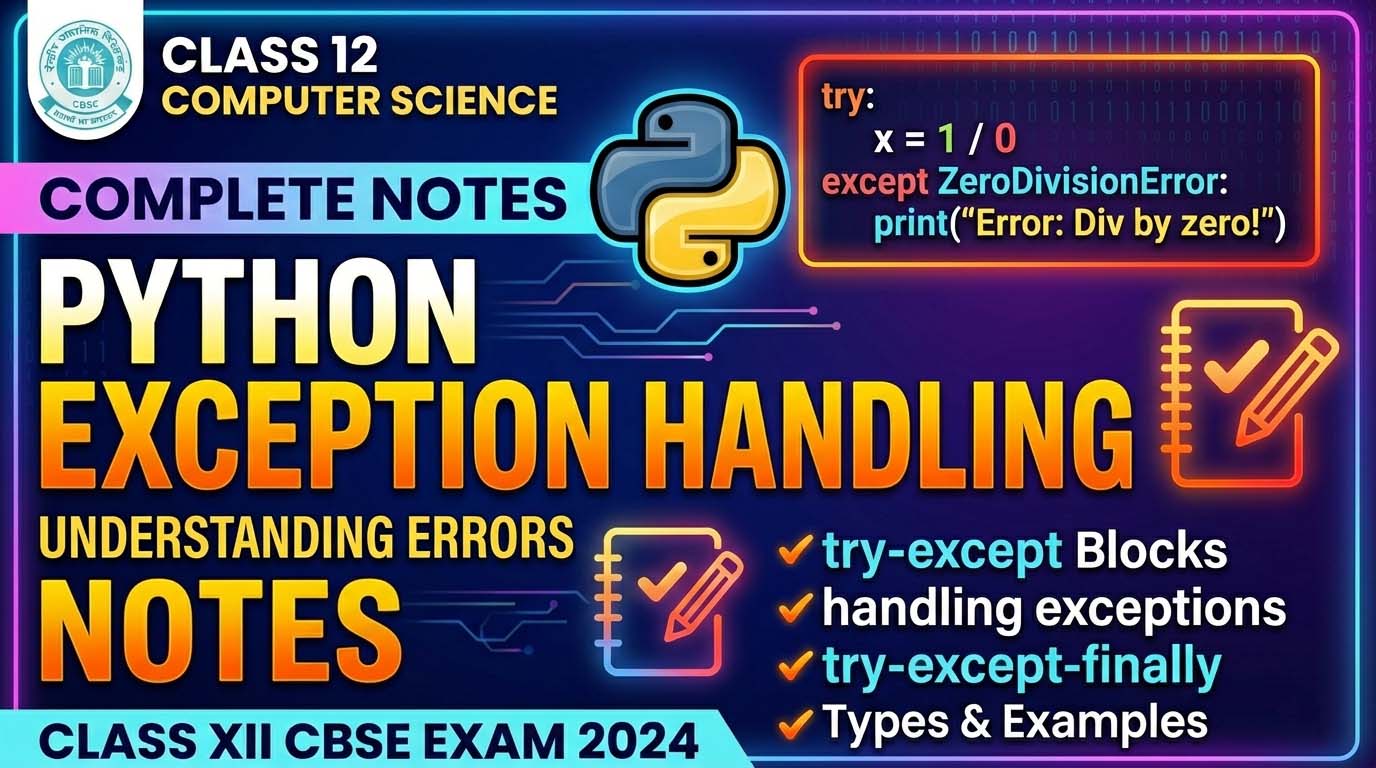
- Exception Handling Execution Flow:
- Concept: The
finallyblock. - Solution Logic: The
exceptblock only runs during an error. However, thefinallyblock is guaranteed to execute whether an exception occurs or not. This is a frequent “True/False” or “Theory” question.
- Concept: The
4. Computer Networking Foundations: Protocols and Devices
Networking efficiency is dictated by the precise choice of hardware and protocols. In the 2027 exam, expect questions that force you to choose between similar-looking technologies.
Critical Networking Entities
- Switch vs. Router: A Switch manages local traffic within a network using MAC addresses. A Router connects different networks and determines the best path across the internet.
- Email Protocols (The Directionality Rule):
- SMTP (Simple Mail Transfer Protocol): Used exclusively for sending email.
- POP3 (Post Office Protocol v3): Used for retrieving/receiving email from a server.
- The Addressing Trio (Bit Sizes):
- IPv4: 32-bit (Numerical).
- IPv6: 128-bit (Alphanumeric/Hex).
- MAC Address: 48-bit (Physical address, fixed on the NIC).
- Network Security: A Firewall filters incoming/outgoing traffic. For secure, encrypted tunnels over public internet, a VPN (Virtual Private Network) is the required solution.
5. Network Architecture and Case Study Synthesis
Case studies require you to act as a “Network Expert.” For the “Patiala Branch” scenario involving multiple blocks (Admin, Sales, Services, Insurance), use these strategic rules:
The “Expert” Solutions
- Server Placement: Always place the server in the block with the maximum number of computers.
- Example: If the Sales block has 80 computers (the highest), the server goes there to minimize overall network traffic.
- Topology Selection: Star Topology is the standard for modern branches. It connects all computers to a central Switch/Hub, ensuring that one cable failure doesn’t bring down the whole branch.
- Transmission Media: For high-speed, reliable, and “best-wired” connectivity, Fiber Optic is the only answer.
- Signal Boosting: A Repeater is only used when the distance between blocks exceeds the effective range of the cable (usually >100m). For short distances, it is unnecessary.
Quick-Reference Topology Checklist
| Topology | Defining Characteristic | Strategic Disadvantage |
| Bus | Single backbone cable. | If the backbone fails, the whole network fails. |
| Star | Central Hub/Switch. | Hub failure stops all communication. |
| Ring | Circular data flow. | Hard to add new nodes; one node failure disrupts the loop. |
| Mesh | Every node connects to every other node. | Extremely expensive and complex (High Redundancy). |
6. Final Examination Strategy and Conclusion
Success on exam day is a combination of theoretical knowledge and logical precision. Focus heavily on the “Sure-Shot” questions provided in our sessions.
The 2027 Critical Takeaways
- Master Technical Nomenclature: You must know these full forms: ARPANET (Advanced Research Projects Agency Network), SMTP, POP3, VoIP (Voice over IP), URL, HTTP/HTTPS, RJ45 (Registered Jack), and NIC (Network Interface Card).
- The Bit-Size Rule: Memorize 32 (IPv4), 128 (IPv6), and 48 (MAC). These are easy 1-mark wins.
- Loop Logic: Always subtract 1 from the “Stop” value in a
range()function.
Review this guide during your 4:00 AM session for maximum retention. You have the tools, the logic, and the strategy. Go forth and conquer the 2027 Board Exam. Good luck, Class of 2027!