








1. Introduction to Chemical Reactions and Equations
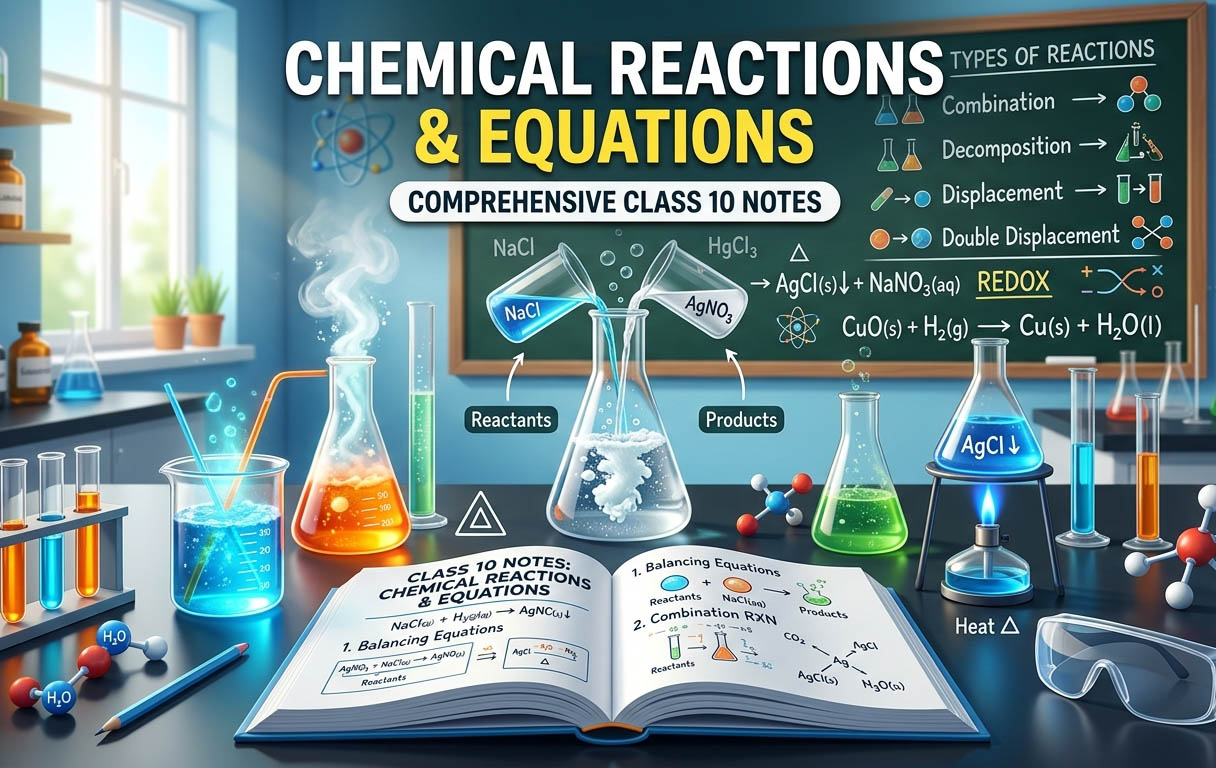
A Chemical Reaction is a process in which original substances undergo a transformation to form new chemicals with entirely different properties. A Chemical Equation is the symbolic representation of this process using chemical formulas and state symbols.
- Reactants: Substances present before the reaction (Left-Hand Side).
- Products: New substances formed (Right-Hand Side).
Physical State Symbols
To provide a complete scientific description, equations must include the physical state of every substance:
| Symbol | Meaning |
| (s) | Solid |
| (l) | Liquid |
| (g) or \uparrow | Gas / Evolution of Gas |
| (aq) | Aqueous (Substance dissolved in water) |
| (ppt) or \downarrow | Precipitate (Insoluble solid formed in a solution) |
Pro-Tip: Formula-Making Refresher
Before balancing, you must write correct formulas. Use this valency guide based on the “Gunshot” lecture:
| Valency (+1) | Valency (+2) | Valency (+3) | Anions (Negative) |
| Sodium (Na^+) | Magnesium (Mg^{2+}) | Aluminium (Al^{3+}) | Chloride (Cl^-) |
| Potassium (K^+) | Calcium (Ca^{2+}) | Ferric (Fe^{3+}) | Nitrate (NO_3^-) |
| Silver (Ag^+) | Zinc (Zn^{2+}) | Hydroxide (OH^-) | |
| Copper I (Cu^+) | Ferrous (Fe^{2+}) | Sulphate (SO_4^{2-}) | |
| Barium (Ba^{2+}) | Carbonate (CO_3^{2-}) |
2. The Science of Balancing Equations
The “Why”: Law of Conservation of Mass
Mass can neither be created nor destroyed in a chemical reaction. Therefore, the total mass of the reactants must equal the total mass of the products. To satisfy this law, the number of atoms for each element must be identical on both sides of the equation.
The “How”: The Gapshot Method
Follow this strict priority sequence to balance any equation efficiently. Crucial Rule: If a later step changes the count of a previously balanced element, you must restart from Step 1.
- Metals: Balance elements like Na, K, Ag, Cu, Zn, Ca, Fe, Al, Pb, Mn, Ba first.
- Non-metals: Balance elements like Cl, Br, S, N, C, P.
- Oxygen
- Hydrogen
Balanced Example (Iron and Steam): Note the state symbols indicating water is in the form of gas (steam): 3Fe(s) + 4H_2O(g) \rightarrow Fe_3O_4(s) + 4H_2(g)
3. The Five Characteristics of Chemical Reactions (FACTS)
When a reaction occurs, students should look for “FACTS” to confirm the chemical change:
- F – Formation of Precipitate: An insoluble solid appears.
- A – (Note: This is a placeholder to complete the word “FACTS”).
- C – Color Change: A visible shift in the appearance of the reactants.
- T – Temperature Change: The reaction is either Exothermic (heat released) or Endothermic (heat absorbed).
- S – State Change: Transformation between solid, liquid, or gas.
- E – Evolution of a Gas: Release of substances like H_2 or CO_2.
4. Types of Chemical Reactions: Part 1 – Combination
A Combination Reaction occurs when two or more reactants combine to form a single product.
- Key Example 1: Burning Magnesium Ribbon 2Mg(s) + O_2(g) \rightarrow 2MgO(s)
- Observation: Burns with a Dazzling White Flame to form a White Powder.
- Pro-Tip: The ribbon is cleaned with sandpaper first to remove the protective layer of magnesium oxide that prevents burning.
- Key Example 2: Quick Lime and Water CaO(s) + H_2O(l) \rightarrow Ca(OH)_2(aq) + \text{Heat} This is a highly vigorous and exothermic reaction.
Key Terms Box
- Quick Lime: Calcium Oxide (CaO)
- Slaked Lime: Calcium Hydroxide (Ca(OH)_2)
Application: White-washing
Slaked lime is applied to walls. Over 2–3 days, it reacts with atmospheric CO_2 to form a thin, hard layer of Calcium Carbonate (CaCO_3), which provides a shiny white finish: Ca(OH)_2(aq) + CO_2(g) \rightarrow CaCO_3(s) + H_2O(l)
5. Types of Chemical Reactions: Part 2 – Decomposition
One reactant breaks into two or more products. These are Endothermic as they require energy to proceed.
A. Thermal Decomposition (Energy from Heat)
- Ferrous Sulphate (FeSO_4 \cdot 7H_2O): A two-step color change. Green crystals first lose water to become White (Anhydrous FeSO_4), then decompose into Reddish-brown powder (Fe_2O_3).
- Observation: Releases SO_2 and SO_3, which have a “Burning Sulphur” smell. These gases are acidic and turn moist blue litmus paper red.
- Lead Nitrate (Pb(NO_3)_2): White powder decomposes into a Yellow residue (Lead Oxide, PbO), Brown fumes of Nitrogen Dioxide (NO_2), and Oxygen (O_2).
- Observation: NO_2 is acidic and will turn moist blue litmus red.
B. Electrolytic Decomposition (Electrolysis)
The breakdown of water using electricity.
- Setup: Dilute Sulphuric Acid (H_2SO_4) is added to water because pure water is a poor conductor.
- Mnemonic: PAO (Positive Anode Oxygen). Oxygen (O_2) is collected at the Anode, while Hydrogen (H_2) is collected at the Cathode.
- Ratios:
- Volume Ratio: 2:1 (Hydrogen to Oxygen).
- Mass Ratio: 1:8 (Hydrogen to Oxygen).
C. Photochemical Decomposition (Energy from Light)
Silver salts break down in sunlight:
- 2AgCl(s) \xrightarrow{\text{Sunlight}} 2Ag(s) + Cl_2(g) (White turns Grey).
- 2AgBr(s) \xrightarrow{\text{Sunlight}} 2Ag(s) + Br_2(g).
- Use: Black and White Photography. These chemicals are stored in dark/black bottles to prevent accidental decomposition.
6. Types of Chemical Reactions: Part 3 – Displacement
A more reactive metal displaces a less reactive metal from its salt solution.
The Reactivity Series Mnemonic
(From most to least reactive): Kudi (K) Nal (Na) Car (Ca) Mango (Mg) Alto (Al) Jiske (Zn) Fir (Fe) Leker (Pb) Hum (H) Chale (Cu) Mathura (Hg) Sath (Ag) Ghoomne (Au)
Key Experiments
- Iron Nail in Copper Sulphate: Fe(s) + CuSO_4(aq) \rightarrow FeSO_4(aq) + Cu(s)
- Observation: Solution color changes from Blue (CuSO_4) to Pale Green (FeSO_4). The iron nail gets a Reddish-brown coating of Copper.
- Zinc and Acid: Zinc reacts with sulphuric acid to produce H_2 gas, identified by a “Pop Sound” when a burning candle is brought near.
7. Types of Chemical Reactions: Part 4 – Double Displacement
An exchange of ions between two reactants.
Precipitation Reactions
- Sodium Sulphate + Barium Chloride: Forms a White Precipitate of Barium Sulphate (BaSO_4). Na_2SO_4(aq) + BaCl_2(aq) \rightarrow BaSO_4(s) \downarrow + 2NaCl(aq)
- Lead Nitrate + Potassium Iodide: Forms a Yellow Precipitate of Lead Iodide (PbI_2). Pb(NO_3)_2(aq) + 2KI(aq) \rightarrow PbI_2(s) \downarrow + 2KNO_3(aq)
8. Redox Reactions (Oxidation & Reduction)
Redox involves the simultaneous transfer of oxygen or hydrogen.
| Process | Definition |
| Oxidation | Gain of Oxygen OR Loss of Hydrogen |
| Reduction | Loss of Oxygen OR Gain of Hydrogen |
- Oxidizing Agent: The substance that is reduced (gives oxygen).
- Reducing Agent: The substance that is oxidized (takes oxygen).
Observation (Copper): Heating reddish-brown Copper in air forms Black Copper Oxide (CuO). This is oxidation. If H_2 gas is passed over the heated CuO, the Black surface turns back to Reddish-brown (Reduction).
9. Practical Concepts: Corrosion and Rancidity
Corrosion
The attack of air, moisture, or acids on metal surfaces.
- Iron: Reddish-brown Rust.
- Copper: Green coating (Basic Copper Carbonate).
- Silver: Blackening due to the formation of Silver Sulphide (Ag_2S).
Rancidity
The oxidation of fats and oils in food, causing bad smell and taste. Prevention:
- Adding Antioxidants.
- Using Airtight containers.
- Flushing packets with Nitrogen Gas (an inert gas that prevents oxidation).
10. Comparison: Physical vs. Chemical Changes
| Physical Change | Chemical Change |
| No new substance is formed. | A new chemical substance is formed. |
| Usually reversible change in state or shape. | Usually irreversible change in composition. |
| Example: Melting of Ice. | Example: Digestion, Rusting, Respiration. |
Important Distinction for Exams:
- Melting of Wax: A physical change (state change only).
- Burning of a Candle: A chemical change (new substances like CO_2 and H_2O are produced).