
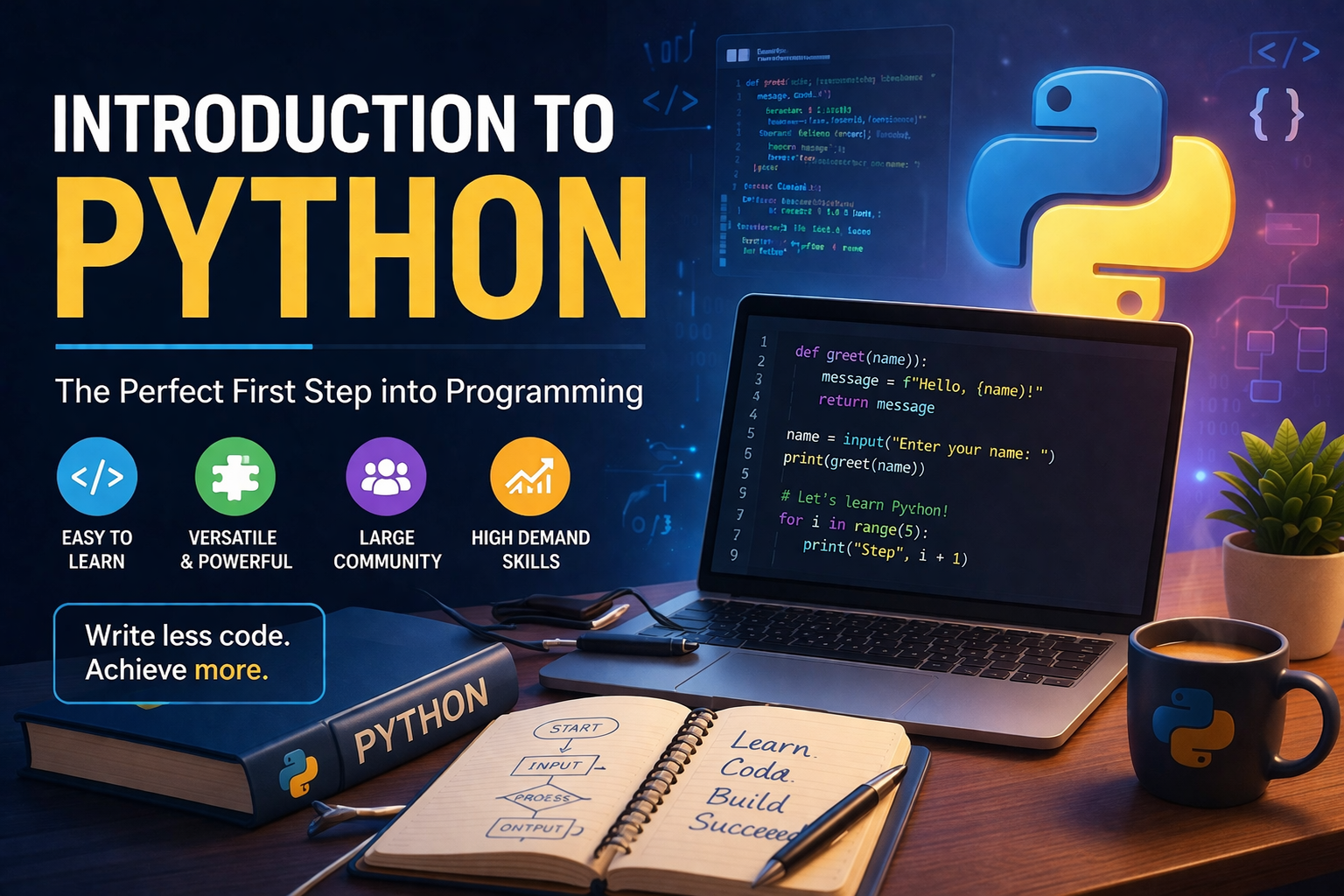
In today’s digital era, programming has become an essential skill across industries—from software development and data science to finance, healthcare, and even the arts. Among the many programming languages available, Python stands out as one of the most popular, accessible, and powerful choices for beginners and professionals alike.
This comprehensive guide introduces Python in a clear, structured, and AdSense-friendly format, helping readers understand what Python is, why it matters, and how to begin using it effectively.
What is Python?
Python is a high-level, interpreted programming language known for its simplicity and readability. It was created by Guido van Rossum and first released in 1991. Python emphasizes clean syntax and code readability, making it an ideal language for beginners.
Unlike many other programming languages that rely heavily on complex syntax, Python allows developers to write fewer lines of code while achieving more functionality. Its design philosophy focuses on clarity, simplicity, and efficiency.
Why Learn Python?
Python has become one of the most widely used programming languages in the world. Here are several compelling reasons to learn Python:
1. Beginner-Friendly Syntax
Python’s syntax closely resembles human language, making it easy to learn and understand. For example:
print("Hello, World!")
This simple line outputs text without needing complex structure or formatting.
2. Versatility
Python can be used for a wide range of applications, including:
- Web development
- Data analysis
- Artificial intelligence
- Machine learning
- Automation and scripting
- Game development
3. Large Community Support
Python has a massive global community. This means beginners can easily find tutorials, forums, and documentation when they encounter challenges.
4. Extensive Libraries and Frameworks
Python offers thousands of libraries and frameworks that simplify development tasks. Examples include:
- NumPy for numerical computing
- Pandas for data analysis
- Django for web development
- TensorFlow for machine learning
5. High Demand in the Job Market
Python developers are in high demand across industries. Learning Python can open doors to various career opportunities, including:
- Software Developer
- Data Scientist
- Machine Learning Engineer
- Automation Specialist
Key Features of Python
Understanding Python’s core features will help you appreciate its power:
1. Interpreted Language
Python does not require compilation before execution. This makes development faster and easier.
2. Dynamically Typed
You don’t need to declare variable types explicitly.
x = 10
x = "Hello"
3. Object-Oriented
Python supports object-oriented programming (OOP), allowing you to structure code using classes and objects.
4. Cross-Platform Compatibility
Python works on various operating systems, including Windows, macOS, and Linux.
5. Open Source
Python is free to use and distribute, making it accessible to everyone.
Setting Up Python
Before you start coding, you need to install Python on your system.
Step 1: Download Python
Visit the official Python website and download the latest version.
Step 2: Install Python
Follow the installation instructions based on your operating system.
Step 3: Verify Installation
Open your terminal or command prompt and type:
python --version
If installed correctly, it will display the Python version.
Your First Python Program
Let’s write your first Python program:
print("Welcome to Python Programming!")
Save this file as hello.py and run it using:
python hello.py
Basic Concepts in Python
1. Variables
Variables store data values.
name = "John"
age = 25
2. Data Types
Python supports several data types:
- Integer (int)
- Float (float)
- String (str)
- Boolean (bool)
x = 10        # Integer
y = 3.14      # Float
z = "Hello"   # String
flag = True   # Boolean
3. Input and Output
name = input("Enter your name: ")
print("Hello,", name)
4. Operators
Python includes arithmetic, comparison, and logical operators.
a = 5
b = 2print(a + b)  # Addition
print(a > b)  # Comparison
Control Structures
Control structures help manage the flow of a program.
1. Conditional Statements
age = 18if age >= 18:
    print("You are an adult.")
else:
    print("You are a minor.")
2. Loops
For Loop
for i in range(5):
    print(i)
While Loop
count = 0
while count < 5:
    print(count)
    count += 1
Functions in Python
Functions allow code reuse and better organization.
def greet(name):
    return "Hello " + nameprint(greet("Alice"))
Python Data Structures
1. Lists
fruits = ["apple", "banana", "cherry"]
print(fruits[0])
2. Tuples
colors = ("red", "green", "blue")
3. Dictionaries
person = {
    "name": "John",
    "age": 25
}
print(person["name"])
4. Sets
numbers = {1, 2, 3, 3}
print(numbers)
File Handling in Python
Python allows you to read and write files easily.
# Writing to a file
with open("file.txt", "w") as f:
    f.write("Hello Python")# Reading a file
with open("file.txt", "r") as f:
    print(f.read())
Popular Uses of Python
1. Web Development
Frameworks like Django and Flask help build robust web applications.
2. Data Science and Analytics
Python is widely used for data visualization and analysis.
3. Machine Learning and AI
Libraries like TensorFlow and Scikit-learn make Python a leader in AI.
4. Automation
Python can automate repetitive tasks such as file management and web scraping.
5. Game Development
Libraries like Pygame enable game creation.
Advantages of Python
- Easy to learn and use
- Large ecosystem of libraries
- Strong community support
- High readability
- Cross-platform compatibility
Limitations of Python
- Slower execution compared to compiled languages
- Not ideal for mobile development
- Higher memory consumption
Best Practices for Beginners
- Write clean and readable code
- Use meaningful variable names
- Practice regularly
- Work on small projects
- Learn debugging techniques
Simple Project Ideas for Beginners
- Calculator application
- To-do list program
- Number guessing game
- Password generator
- Simple chatbot
Tips to Master Python Faster
- Follow structured tutorials
- Build real-world projects
- Read official documentation
- Join coding communities
- Practice daily
Future of Python
Python continues to grow rapidly, especially in fields like:
- Artificial Intelligence
- Data Science
- Automation
- Cybersecurity
Its adaptability ensures that it will remain relevant for years to come.
Conclusion
Python is one of the most powerful and beginner-friendly programming languages available today. Its simplicity, versatility, and wide range of applications make it an excellent choice for anyone starting their programming journey.
Whether you want to build websites, analyze data, or develop intelligent systems, Python provides the tools and flexibility needed to succeed. By learning Python, you are not just learning a language—you are opening the door to countless opportunities in the digital world.
Start small, stay consistent, and keep building. Your journey into Python programming begins today.