









The Hook: The Effect of When “France Sneezed”
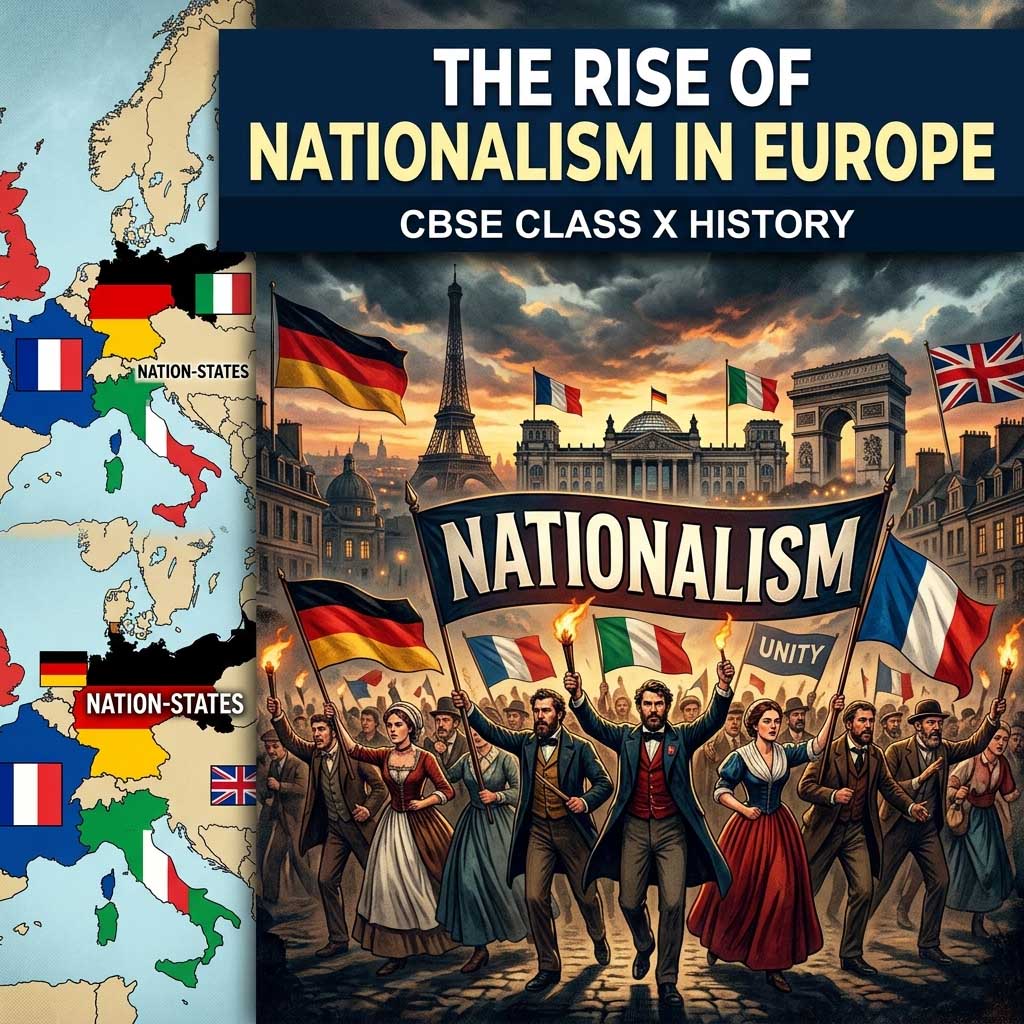
In the present day, we think of the map as a static jigsaw puzzle of “nations,” but for much of human history, this idea would have been a bizarre fantasy. The question of nationality was not determined by the flag you swore loyalty to but rather by which monarch owned the soil you worked. Nationalism was not a primordial slumbering beast; it was a disruptive 19th century phenomenon that tore apart the existing order like a seismic shockwave.
The European disease started with one violent flash of rebellion in Paris. In the words of the Austrian Chancellor, Duke Metternich, “When France sneezes, the rest of Europe catches cold.” The French Revolution showed that even kings were not immune to human will; their power could be snuffed out and replaced by the “will of the people.” This was no isolated event; it was a virus of national identity that compelled all of Europe to redefine itself when the crowns fell off their heads.
Takeaway 1: Forming a “Nation” Was an Exercise in Branding
In the pre-revolutionary era, a farmer living in southern France probably had more in common with a neighboring villager from across the border than a Parisian merchant. The challenge of forming a nation required the creation of a sense of “collective belonging.” This was the first massive branding effort in history, using psychology and symbolism to forge a disparate group into one big family.
The revolutionaries employed a powerful arsenal of nationalism:
- Reimagined Citizens: The notions of La Patrie (Fatherland) and Le Citoyen (Citizen) were introduced, thus redefining the citizens’ identity as equal inhabitants of the same geographical territory instead of being the “subjects” of their king or queen.
- New Iconography: The previous Royal Standard flag was abolished and replaced by the famous Tri-color (blue, white, and red) flag, which belongs to the people themselves.
- Lore and Language: All regional dialects gave way to French, the common language of the land, while hymns of a new era were written, and revolutionary “martyrs” were celebrated to provide the nation with a secular mythological background.
- The Nightmare of Administration Made Easy: Until the revolution, trading in France was a very disorganized process since all sorts of goods had different sizes depending on where they originated. In other words, such a measure as an Elle in textile differed in length from Frankfurt (54.7 cm) to Mainz (55.1 cm), and to Nuremberg (65.6 cm). Standardization of the weights, measurements, and “Al” was not only useful in trading but also brought logic and order into the life of the country.
Takeaway 2: Napoleon Was the “Mixed Bag” in World History
Napoleon Bonaparte is an utter oxymoron, a tyrant, but who unknowingly became the teacher of Europe. Though he brought an end to democracy in France, he carried the “rational” principles of revolution throughout Europe at the sharp end of his bayonets.
The “Good”: Through the Napoleonic Code of 1804 (the Civil Code), he introduced a “rational” administrative system to Europe, abolishing the feudal structure, freeing peasants from the serfs’ lot and manorial dues, and establishing improved modes of transportation and communication to enable the free movement of goods and ideas.
The “Bad”: Initially welcomed as a “liberator,” Napoleon proved to be a conqueror who required extensive taxation, censorship of the press, and forced enrollment of the local populations in the French army for conquests.
“The local populations’ initial enthusiasm was often followed by their hatred, when it came to light that the new administration did not include political freedom.”
Napoleon Bonaparte’s irony consisted in the fact that, while being a foreign oppressor, he provided unity among the scattered German and Italian peoples through creating a common enemy to fight against.
Conclusion #3: The Middle Class “Invention” of Freedom (With a Twist)
The Industrial Revolution gave rise to the Educated Middle Class, the class of doctors, clerks, and business people whose social mobility was restricted by the traditional aristocracy. They employed an ideology known as Liberalism (from the Latin liber, which means free) as a weapon against their opponents. Yet, freedom had its limitations.
| Category | Political Liberalism | Economic Liberalism |
| Primary Goal | Government by consent; individual freedom; equality before the law. | Freedom of markets; abolition of state-imposed restrictions on the movement of goods. |
| Key Features | The demand for a constitution and representative government; the end of clerical privileges. | The formation of the Zollverein (1834), a customs union that reduced 30 currencies down to just two. |
| The “Catch” | Excluded the masses. Voting rights were only for property-owning men. | Designed to facilitate the growth of the middle class and the movement of capital. |
The Catch: These “liberals” were no true democrats. With the Napoleonic Code and liberal systems that came after it, women were regarded as “minors,” under the control of their fathers and husbands and explicitly prohibited from voting or holding public office.
Takeaway #4: “The Empire Strikes Back” at the Treaty of Vienna
After the defeat of Napoleon in the Battle of Waterloo in 1815, the “traditional powers of Europe”—Prussia, Austria, Russia, and Britain (PARB nations)—attempted to “freeze the clock” and halt history through the Treaty of Vienna. Under the leadership of the Austrian Chancellor, Duke Metternich, the Treaty of Vienna was a demonstration of “Conservatism.”
However, they failed to take into account a cold, hard reality: Once a “citizen” is tasted, one could not be forced to go back to being a mere “subject.” The revolution was just below the surface, where secret societies sprang up, headed by individuals such as Giuseppe Mazzini. Mazzini established “Young Italy” in Marseilles and “Young Europe” in Berne. Mazzini held that nations were the natural units of mankind as designed by God. He was a formidable threat to the old order; Metternich had famously called him:
“The most dangerous enemy of our social order.”
Lesson #5: Nationalism Becomes a Powder Keg
By the end of the nineteenth century, “healthy” nationalism had started turning into imperialism. There was nowhere where the nationalism became more explosive than in the Balkans, an ethnically diverse region in the decaying Ottoman Empire.
People inhabiting the Balkans, referred to collectively as the Slavs, began seeking national independence. However, the process of disintegration of the Ottoman Empire did not make them happy with having merely their independence. On the contrary, they became fiercely envious of each other, wishing for greater control over other countries in that area. Thus, the “nationalism combined with imperialism” made the region ripe for explosions; when great powers such as Russia and Germany decided to intervene, it all ended in World War I.
Conclusion: The Incomplete Map
What the 19th-century showed was that a nation was not only about its borders but also about its essence. In order to make the concept of country personal enough to inspire feelings of love and possibly death for its sake, the era invented national females, such as Marianne in France and Germania in Germany. These female characters received heroic attributes, Germania being crowned by an oak wreath representing heroism, so that there would be a “maternal” or “heroic” face of the state.
In the contemporary world, there is no escaping the heritage of that time: we continue using the instruments of national branding from the 18th century, flags, anthems, and common laws. It remains unclear whether nationalism is to become one of the unifying factors around liberty or to turn into an imperialistic “powder keg” of the past times.